
2 layers22 × 15 mm

 leggomyfroggo/mgl_switch10
Open source design for a Game Boy Light replacement switch.
Mgl switch is an open-source printed circuit board by leggomyfroggo, from the leggomyfroggo/mgl_switch repository on GitHub. It is a 2-layer board of 34 × 19 mm with 20 parts on 13 nets, routed with 65 tracks and 37 vias.
It is built around the SI2312BDS-T1-BE3-HXY and DMP6350SQ-7. Its parts include 5 resistors, 5 transistors and 1 switch.
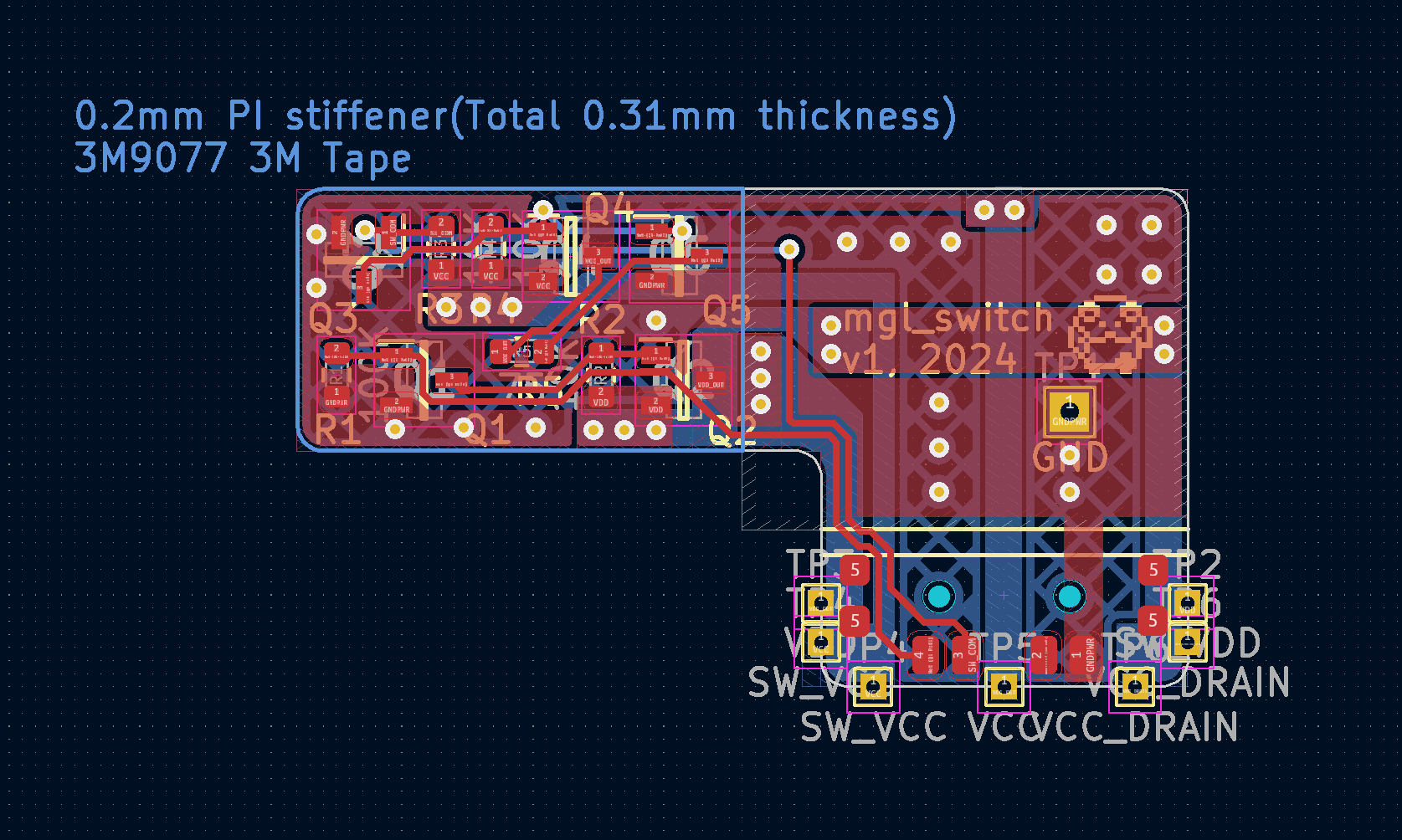 This is a replacement switch for the Game Boy Light. The original MGL switch is an unusual 3PDT for which a suitable replacement isn't currently known. This design uses a standard SP3T switch and mosfets to replicate the ability to turn on the system and back light with a single switch.
This repo consists of three main components:
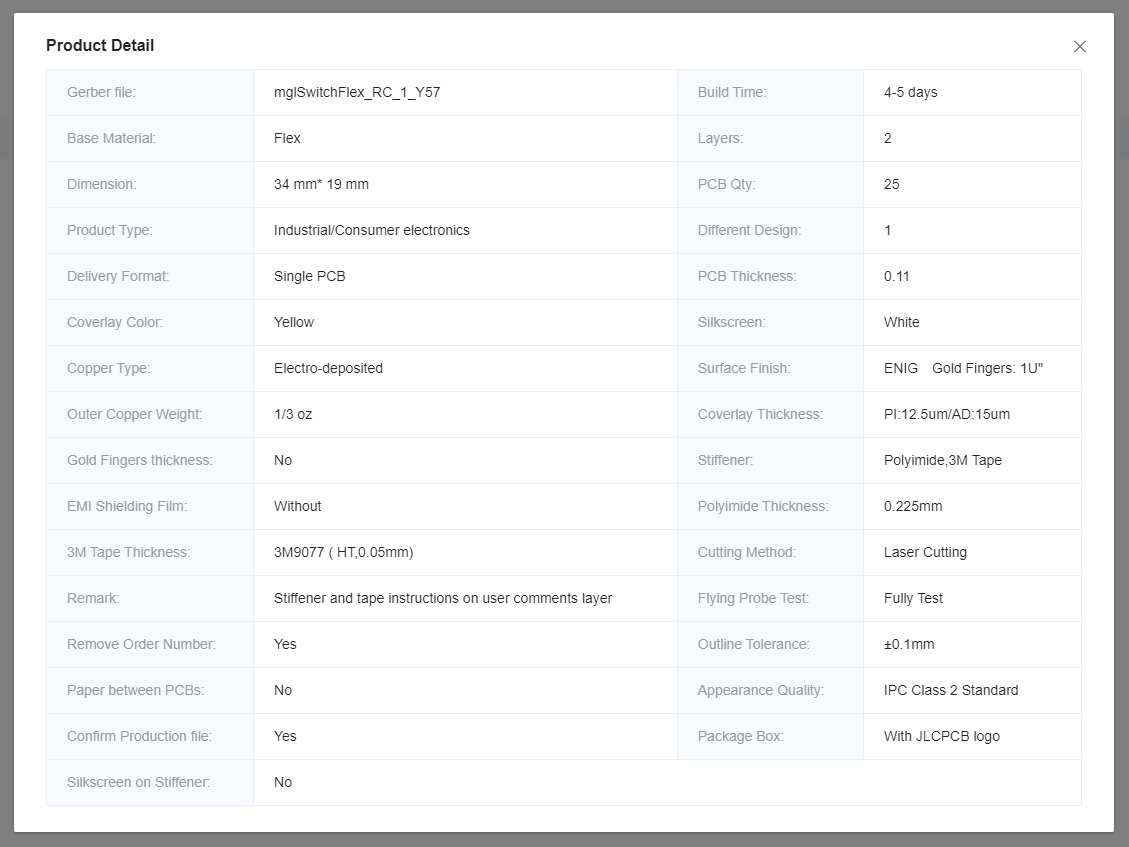
root)artifacts)artifacts)To make it easy to assemble this project, the gerbers for the current version can be found in artifacts and uploaded at your PCB fabricator of choice, e.g. JLCPCB. For best results, follow these paramters:
Below is a screenshot of the complete order parameters from JLCPCB:
mgl_switch by Chris Hackmann is licensed under CC BY-NC 4.0


| Qty | Value | Footprint | References |
|---|---|---|---|
| 3 | 10K | Resistor_SMD:R_0603_1608Metric | R2, R3, R4 |
| 3 | SI2312BDS-T1-BE3 | SamacSys_Parts:SOT95P237X112-3N | Q1, Q3, Q5 |
| 2 | DMP6350SQ-7 | SamacSys_Parts:SOT96P240X110-3N | Q2, Q4 |
| 2 | SW_VCC | TestPoint:TestPoint_THTPad_1.0x1.0mm_Drill0.5mm | TP4, TP4 |
| 2 | VCC_DRAIN | TestPoint:TestPoint_THTPad_1.0x1.0mm_Drill0.5mm | TP6, TP6 |
| 1 | 100K | Resistor_SMD:R_0603_1608Metric | R1 |
| 1 | 75 | Resistor_SMD:R_0603_1608Metric | R5 |
| 1 | GND | TestPoint:TestPoint_THTPad_1.5x1.5mm_Drill0.7mm | TP1 |
| 1 | SW_SP3T | SamacSys_Parts:MSKT-13C01 | SW1 |
| 1 | SW_VDD | TestPoint:TestPoint_THTPad_1.0x1.0mm_Drill0.5mm | TP2 |
| 1 | VCC | TestPoint:TestPoint_THTPad_1.0x1.0mm_Drill0.5mm | TP5 |
| 1 | VDD | TestPoint:TestPoint_THTPad_1.0x1.0mm_Drill0.5mm | TP3 |
The 19 most common of 20 parts.


gasiepgodoy/Open-Source-PLC
Open Source Programmable Logic Controller (Hardware and Software). Based on the Master of Science in Electrical Engineering of João Vitor Rocha Santana

Scottapotamas/spe-marine-node
Prototype project to build an underwater sensor node, powered by and communicating with the surface via Single Pair Ethernet (10BASE-T1L + 802.3cg)


atopile/atopile
Design circuit boards with code! ✨ Get software-like design reuse 🚀, validation, version control and collaboration in hardware; starting with electronics ⚡️

davidphilipbarr/Sweep
Sweep - a small promicro based keyboard inspired by the Ferris.
It measures 34 × 19 mm and has 2 copper layers, 0.19 mm thick.
20 parts, built around the SI2312BDS-T1-BE3-HXY and DMP6350SQ-7. The full list of its parts is on this page, with links to each part's symbol and footprint where PCBKit's library has them.
From the leggomyfroggo/mgl_switch repository on GitHub, at the commit this page was made from: the board is mglSwitch.kicad_pcb and its schematic mglSwitch.kicad_sch. PCBKit opens the board in the browser, with nothing to install.
Its repository states no licence, so its author keeps all rights: ask leggomyfroggo before reusing the design.