2 layers98 × 27 mm

 KrishPatil512/MacroPad
Mini Keyboard I made myself
PcbProject2 is an open-source printed circuit board by KrishPatil512, from the KrishPatil512/MacroPad repository on GitHub, published under the MIT licence. It is a 2-layer board of 62 × 49 mm with 5 parts on 14 nets, routed with 33 tracks and 0 vias.
Its parts include 3 switches and 1 IC. It belongs with the keyboards and input boards and the SAM D and SAM boards of this library.
MacroKeyboard Project
A simple custom macro keyboard built to trigger shortcuts, automate tasks, and speed up everyday workflows.
This project is a compact macro keyboard using a microcontroller (like ESP32) and programmable buttons to send custom key inputs to a computer. It can be used for productivity, gaming, or creative workflows.
Features Custom programmable keys Supports keyboard shortcuts/macros Compact and portable design Easy to modify and expand Can be used with different layouts
Hardware Used ESP32 / microcontroller Mechanical switches / buttons PCB OLED .96 in screen Optional: enclosure (3D printed or case) How It Works
Each button is mapped to a specific function. When pressed, the microcontroller sends a signal to the computer (via USB) that acts like a keyboard input.
Example:
Button 1 → Copy (Ctrl + C) Button 2 → Paste (Ctrl + V) Button 3 → Open app Setup Clone the repository Upload code to the microcontroller Connect via USB Customize key mappings in code Project Structure /code → firmware and logic /pcb → PCB design files /cad → enclosure / case design /bom → bill of materials Future Improvements Rotary encoder support OLED display Wireless (Bluetooth) control Custom software interface
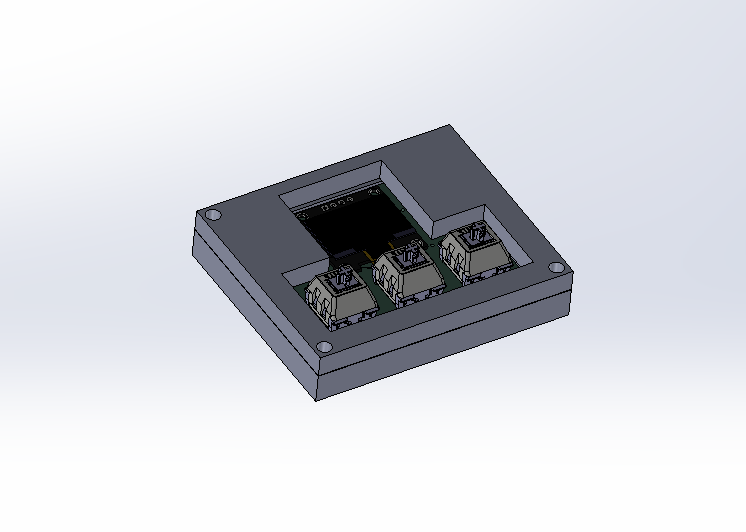
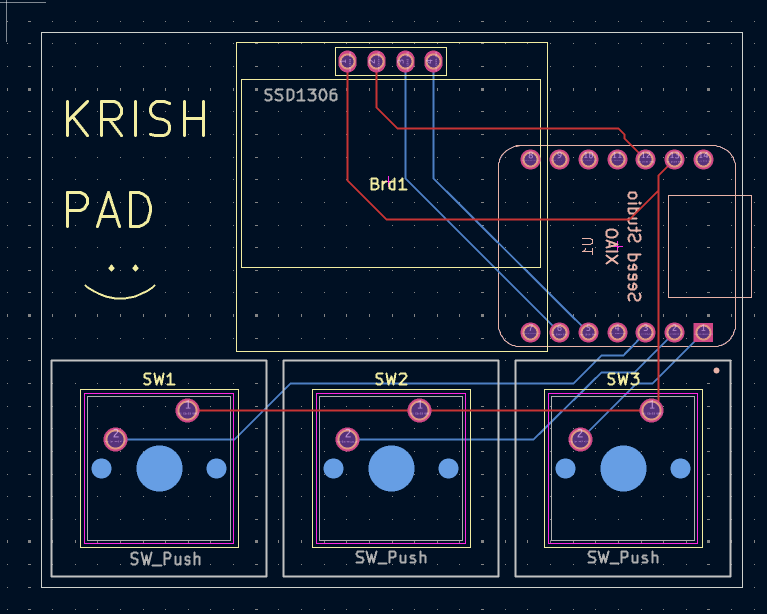
| Qty | Value | Footprint | References |
|---|---|---|---|
| 3 | SW_Push | Button_Switch_Keyboard:SW_Cherry_MX_1.00u_PCB | SW1, SW2, SW3 |
| 1 | SSD1306 | SSD1306:128x64OLED | Brd1 |
| 1 | Seeed Studio XIAO SAMD21 | hackclub hackpad main hackpads-orpheuspad_pcb_libraries_OPL_Kicad_Library_Seeed Studio XIAO Series Library:XIAO-Generic-Thruhole-14P-2.54-21X17.8MM | U1 |
It measures 62 × 49 mm and has 2 copper layers, 1.6 mm thick.
5 parts. The full list of its parts is on this page, with links to each part's symbol and footprint where PCBKit's library has them.
From the KrishPatil512/MacroPad repository on GitHub, at the commit this page was made from: the board is pcb/pcbProject2.kicad_pcb and its schematic pcb/pcbProject2.kicad_sch. PCBKit opens the board in the browser, with nothing to install.
Its repository publishes it under the MIT licence: you may reuse it on that licence's terms (keep the author's notice, and for a copyleft licence share your changes alike).

joypad-ai/joypad-os
Universal controller firmware for building adapters, dongles, and custom controllers.

OLIMEX/OLINUXINO
OLINUXINO is Open Source / Open Hardware, low cost from EUR 24 Linux Industrial grade Single Board Computer capable to operate -25+85C

jamro/tiny-engineer
A small desktop robot that brings an AI coding assistant to life, physically acting out when it reads files, thinks, writes code, and finishes work.

hackclub/OnBoard
💡 Join 1,000 teenagers and make your first PCB with a $100 grant!


Luos-io/luos_engine
Open-source and real-time orchestrator for cyber-physical-systems, to easily design, test and deploy embedded applications and digital twins.