
4 layers108 × 50 mm

Feeding Experimentation Device version 3
FED3 is an open-source printed circuit board by KravitzLabDevices, from the KravitzLabDevices/FED3 repository on GitHub, published under the GPL-3.0 licence. It is a 4-layer board of 108 × 50 mm with 89 parts on 98 nets, routed with 830 tracks and 281 vias.
It is built around the ATSAMD21G18A-MU, MC74VHC1GT125DF and TB6612FNG,C,8,EL, with the MCP73831T-2ACI/OT-HXY, MIC5504-3.3YM5-TR and XT1511RGBW-BW among its other parts. Its parts include 19 capacitors, 18 resistors, 10 diodes, 6 ICs and 4 crystals. It belongs with the SAM D and SAM boards of this library.


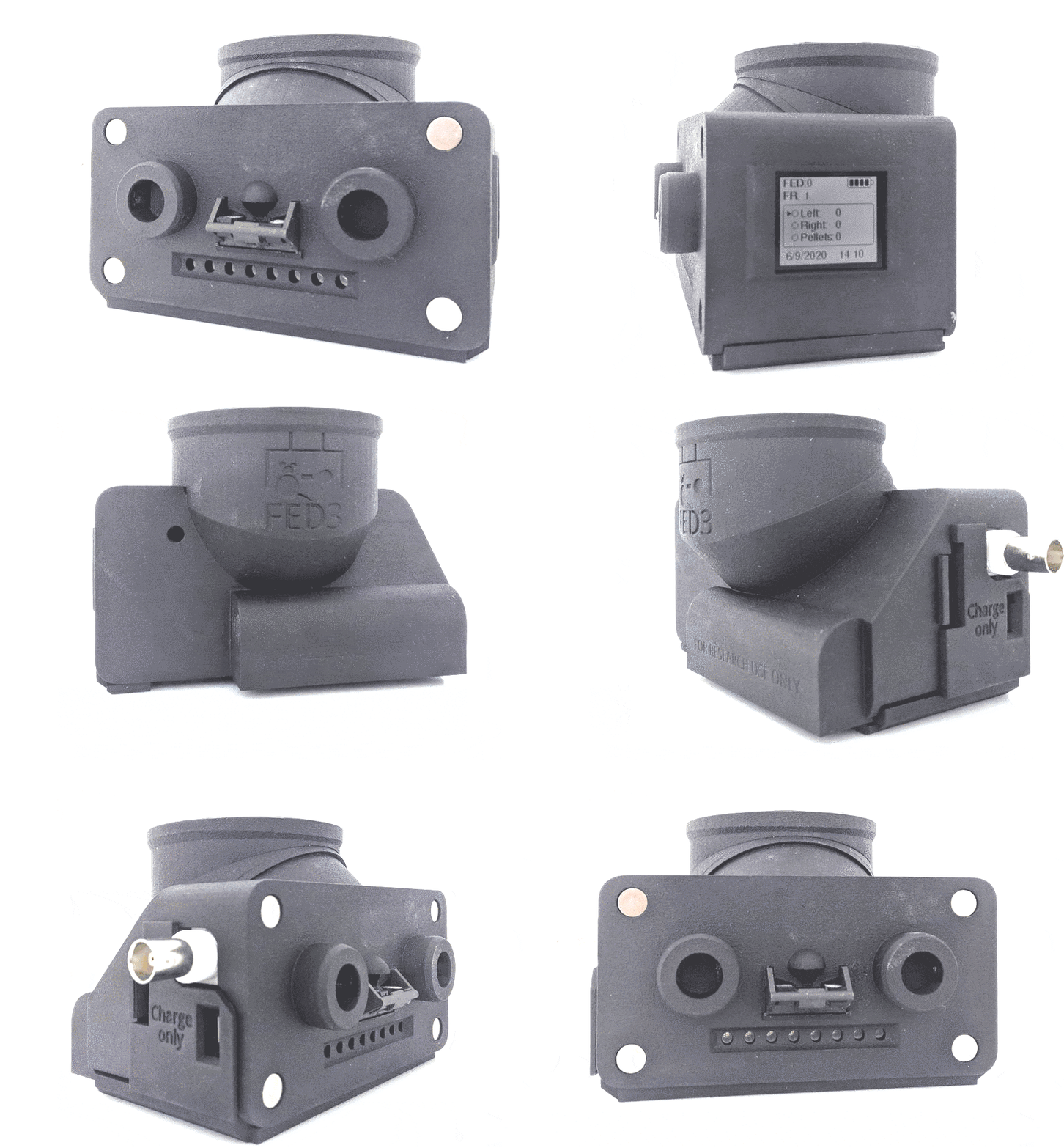
FED3 is an open-source battery-powered device for home-cage training of mice in operant tasks. FED3 can be 3D printed and the control code is open-source and can be modified. The code is written in the Arduino language and is run on a Feather M0 Adalogger microcontroller inside of FED3. For information on how to build and use FED3 check out the Wiki, and the Google group.
Mice interact with FED3 through two nose-pokes and FED3 responds with visual stimuli, auditory stimuli, and by dispensing pellets. FED3 also has an analog output that allows it to synchronize with and control external equipment such as lasers or brain recording systems. A screen provides feedback to the user, and all behavioral events are logged to an on-board microSD card.
The default code includes multiple built-in programs but FED3 is open-source and hackable, and can be easily modified to perform other tasks. This page will contain the latest version of the FED3 code and code variants, as well as 3D files. More information on the build process and history of FED3 can be found at the FED3 Hackaday.io page. You can also check out the FED3 Google group. Finally, you can download FED3_Viz an analysis application for processing FED3 data in Python.
FED3 is open-source and can be built from scratch by users. However, if you would like to purchase FED3 it is also being sold by Open Ephys and LabMaker as either a kit or a fully assembled device. The Kravitz lab is not financially involved with either of these sources but is supportive of their efforts to disseminate open-source tools!
Significant contributors to FED3 include: Lex Kravitz (Washington University), Bridget Matikainen-Ankney (Washington University), Tom Earnest (Washington University), Mohamed Ali (University of Maryland), Katrina Nguyen (Carnegie Mellon), and Filipe Carvalho (Champalimaud Foundation and OEPS).
| Qty | Value | Footprint | References |
|---|---|---|---|
| 10 | RGBLed | FED3_PCBLib:WS2812B | LED1, LED2, LED3, LED4, LED5, LED6, LED7, LED8, LED9, LED10 |
| 9 | 1uF | Capacitor_SMD:C_0402_1005Metric | C5, C6, C7, C8, C9, C10, C12, C15, C19 |
| 8 | 10µF | Capacitor_SMD:C_0402_1005Metric | C1, C2, C3, C4, C11, C13, C14, C16 |
| 7 | , @HOLE0, @HOLE1, @HOLE2, @HOLE2, @HOLE5, @HOLE6 | ||
| 5 | 1k | Resistor_SMD:R_0402_1005Metric | R1, R2, R3, R6, R10 |
| 3 | 100k 0.1% | Resistor_SMD:R_0402_1005Metric | R11, R16, R17 |
| 3 | 4k7 | Resistor_SMD:R_0402_1005Metric | R4, R5, R8 |
| 3 | GP1A57HR | FED3_PCBLib:GP1A57HR | PI1, PI2, PI3 |
| 2 | 22pF | Capacitor_SMD:C_0402_1005Metric | C17, C18 |
| 2 | 2k2 | Resistor_SMD:R_0402_1005Metric | R13, R14 |
| 2 | DNP | Resistor_SMD:R_0402_1005Metric | R7, R19 |
| 2 | RED | LED_SMD:LED_0603_1608Metric | CHG0, L0 |
| 1 | 10k | Resistor_SMD:R_0402_1005Metric | R15 |
| 1 | 330R | Resistor_SMD:R_0402_1005Metric | R12 |
| 1 | 34k | Resistor_SMD:R_0402_1005Metric | R9 |
| 1 | 3V3 | TestPoint:TestPoint_Pad_1.0x1.0mm | TP1 |
| 1 | ATSAMD21G18A | FED3_PCBLib:TQFN48_7MM | U1 |
| 1 | B2B-PH-K-S | FED3_PCBLib:JST-XH-02-PACKAGE-ROUND-PAD | X5 |
| 1 | Buzzer | FED3_PCBLib:Buzzer | BZ1 |
| 1 | CR1220 | FED3_PCBLib:CR1220 | B1 |
| 1 | ClockXtal | FED3_PCBLib:CRYSTAL_8X3.8 | X1 |
| 1 | Conn_02x03_Odd_Even | Connector_PinHeader_2.54mm:PinHeader_2x03_P2.54mm_Vertical | J1 |
| 1 | DMP2035U-7 | FED3_PCBLib:TSMT3 | Q2 |
| 1 | DNP | LED_SMD:LED_0603_1608Metric | L2 |
| 1 | GND | TestPoint:TestPoint_THTPad_2.0x2.0mm_Drill1.0mm | TP5 |
| 1 | GREEN | LED_SMD:LED_0603_1608Metric | L1 |
| 1 | LOGO | FED3_PCBLib:oe logo | G*** |
| 1 | LOGO | FED3_PCBLib:FED_logo | G*** |
| 1 | MC74VHC1GT125 | Package_TO_SOT_SMD:SOT-23-5 | IC1 |
| 1 | MCP73831T | Package_TO_SOT_SMD:SOT-23-5 | U3 |
| 1 | MIC5504-3.3 | Package_TO_SOT_SMD:SOT-23-5 | U2 |
| 1 | PINHD-1X5 | FED3_PCBLib:1X05 | MOTOR0 |
| 1 | PINHD-1X6 | FED3_PCBLib:1X06 | SCREEN0 |
| 1 | Qwiic | Connector_JST:JST_SH_BM04B-SRSS-TB_1x04-1MP_P1.00mm_Vertical | AUX_I2C0 |
| 1 | RTC PCF8523T | Package_SO:SO-8_3.9x4.9mm_P1.27mm | IC4 |
| 1 | SPST_TACT-KMR2 | Button_Switch_SMD:SW_SPST_TL3305B | SW2 |
| 1 | STEREO_JACK | FED3_PCBLib:35RASMT2BHNTRX | EXT0 |
| 1 | Sw | FED3_PCBLib:SSSS811101 | SW1 |
| 1 | TB6612FNG | FED3_PCBLib:SSOP24 | IC2 |
| 1 | USB_MICRO_B | FED3_PCBLib:ZX62D-B-5P8 | USB0 |
| 1 | VBat | TestPoint:TestPoint_Pad_1.0x1.0mm | TP3 |
| 1 | VUSB | TestPoint:TestPoint_Pad_1.0x1.0mm | TP4 |
| 1 | VccNEO | TestPoint:TestPoint_Pad_1.0x1.0mm | TP2 |
| 1 | microsd | FED3_PCBLib:MICROSD | X4 |
| 1 | uXtal | Crystal:Crystal_SMD_MicroCrystal_CC8V-T1A-2Pin_2.0x1.2mm | X2 |
It measures 108 × 50 mm and has 4 copper layers, 1.6 mm thick.
89 parts, built around the ATSAMD21G18A-MU, MC74VHC1GT125DF, TB6612FNG,C,8,EL and MCP73831T-2ACI/OT-HXY. The full list of its parts is on this page, with links to each part's symbol and footprint where PCBKit's library has them.
From the KravitzLabDevices/FED3 repository on GitHub, at the commit this page was made from: the board is Electronics/old_PCB_designs/v7.4 (uC on board, fully functional)/FED3.kicad_pcb and its schematic Electronics/old_PCB_designs/v7.3 (uC on board, first revision)/FED3_v7.3.kicad_sch. PCBKit opens the board in the browser, with nothing to install.
Its repository publishes it under the GPL-3.0 licence: you may reuse it on that licence's terms (keep the author's notice, and for a copyleft licence share your changes alike).


harp-tech/device.stepperdriver
A stepper motor controller device for four motors including individual quadrature encoders.


open-ephys/ephys-test-board
General purpose, automated electrophysiology test board

open-ephys/oe-acquisition-board-gen3
3rd Generation Open Ephys USB Acquisition Board