
2 layers154.9 × 66 mm

 knaruo/pisces2
Pisces - Tiny Split Keyboard
Pisces is an open-source printed circuit board by knaruo, from the knaruo/pisces repository on GitHub, published under the MIT licence. It is a 2-layer board of 137.8 × 60.1 mm with 63 parts on 61 nets, routed with 595 tracks and 69 vias.
It is built around the ATMEGA32U2-AU. Its parts include 20 diodes, 19 switches, 6 capacitors, 6 resistors and 2 connectors. It belongs with the keyboards and input boards and the AVR (ATmega, ATtiny) boards of this library.
Pisces - Tiny Split Keyboard
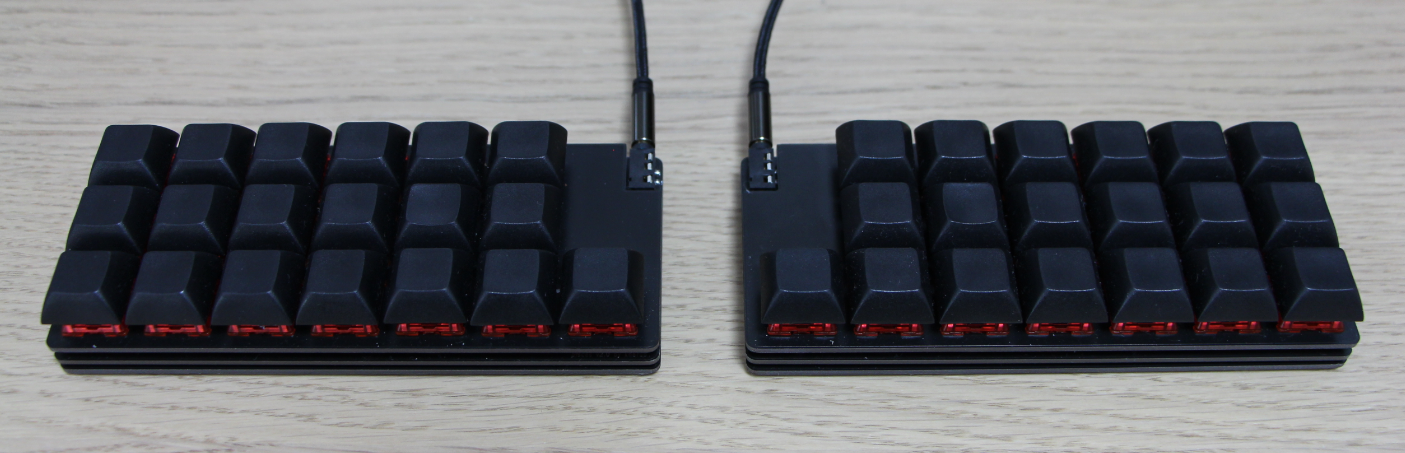
Number of components in the following bill of material table is for one hand.
Here are the mandatory items:
| Name | Parts id | Number | Note |
|---|---|---|---|
| Diode | 1N4148W | 19 | Availaable from here |
| ATmega32U2 | - | 1 | |
| TRRS jack | PRT-12639 | 1 | Available from here |
| TRRS cable | - | 1 | |
| Reset Switch | TVAF06-A020B-R | 1 | Available from here |
For Cherry MX profile:
| Name | Parts id | Number | Note |
|---|---|---|---|
| Socket (MX) | CPG151101S11 | 19 | here |
| Spacer (M2 7mm) | ARB-2007E | 6 | here |
| Thread (M2 3mm) | - | 12 | here for example.. |
| Qty | Value | Footprint | References |
|---|---|---|---|
| 20 | D | pisces_v2:D3_SMD | D1, D2, D3, D4, D5, D6, D10, D11, D12, D13, D14, D15, D16, D17, D18, D19 +4 |
| 19 | SW_PUSH | pisces_v2:CherryMX_Choc_Hotswap | SW1, SW2, SW3, SW4, SW5, SW6, SW10, SW11, SW12, SW13, SW14, SW15, SW16, SW17, SW18, SW19 +3 |
| 6 | Val** | pisces_v2:HOLE | HOLE1, HOLE2, HOLE7, HOLE8, HOLE13, HOLE14 |
| 2 | 0.1u | Capacitor_SMD:C_0402_1005Metric | C3, C6 |
| 2 | 10k | Resistor_SMD:R_0603_1608Metric | R3, R4 |
| 2 | 22p | Capacitor_SMD:C_0402_1005Metric | C1, C2 |
| 2 | 5.1k | Resistor_SMD:R_0603_1608Metric | R1, R2 |
| 2 | 5.1k | Resistor_SMD:R_0402_1005Metric | R5, R6 |
| 1 | 10u | Capacitor_SMD:C_0805_2012Metric | C4 |
| 1 | 1u | Capacitor_SMD:C_0603_1608Metric | C5 |
| 1 | ATmega32U2-AU | Package_QFP:TQFP-32_7x7mm_P0.8mm | U1 |
| 1 | AudioJack4 | pisces_v2:Jack_3.5mm_PJ320D_Horizontal_reversible | J2 |
| 1 | Crystal_GND24_Small | Crystal:Crystal_SMD_SeikoEpson_FA238-4Pin_3.2x2.5mm | Y1 |
| 1 | Polyfuse_Small | pisces_v2:RESC1206X70N | F1 |
| 1 | SW_PUSH | pisces_v2:TVAF06-A020B-R_reversible | RSTSW1 |
| 1 | USB_C | pisces_v2:USB_C_Receptacle_XKB_U262-16XN-4BVC11 | J1 |


cookpad/cookpad-pad
Cookpad Pad — A six keys macro pad made by Cookpad.


ScatteredDrifter/Endeavour
An 38 key orthogonal Keyboard with 3d printable case

simoninns/TMS6100-Emulator
TMS6100 speech PHROM (PHrase Read Only Memory) hardware emulator for use with the TMS5220 Voice Synthesis Processor in an Acorn BBC Microcomputer
It measures 137.8 × 60.1 mm and has 2 copper layers, 1.6 mm thick.
63 parts, built around the ATMEGA32U2-AU. The full list of its parts is on this page, with links to each part's symbol and footprint where PCBKit's library has them.
From the knaruo/pisces repository on GitHub, at the commit this page was made from: the board is pcb/v2/pisces.kicad_pcb and its schematic pcb/v2/pisces.kicad_sch. PCBKit opens the board in the browser, with nothing to install.
Its repository publishes it under the MIT licence: you may reuse it on that licence's terms (keep the author's notice, and for a copyleft licence share your changes alike).