4 layers50 × 50 mm

 kinoshita-lab/MIDI-guy67
SAM2695 based tiny synthesizer
MIDI guy is an open-source printed circuit board by kinoshita-lab, from the kinoshita-lab/MIDI-guy repository on GitHub, published under the MIT licence. It is a 2-layer board of 44 × 32 mm with 42 parts on 50 nets, routed with 362 tracks and 45 vias.
It is built around the SAM2695, SM4007PL and GZ1608D222TF, with the TAXM12M4RDBCCT2T and TLP291(GB-TP,SE among its other parts. Its parts include 14 capacitors, 9 resistors, 3 ICs, 3 diodes and 3 connectors. It belongs with the audio and music boards of this library.


MIDI Guy is a sound module with SAM2695, a single chip General MIDI(GM) synthesizer. It can generate GM's 127 sound programs such as "Acoustic Grand Piano", "Trumpet", etc.
You can also use effects and EQs. Please refer to the SAM2695's datasheet for details. https://www.dream.fr/pdf/Serie2000/SAM_Datasheets/SAM2695.pdf
Please visit: https://www.tindie.com/products/kinoshitalab/midi-guy-rev-21-kit/
Solder the included TRS Jacks to the places shown below.
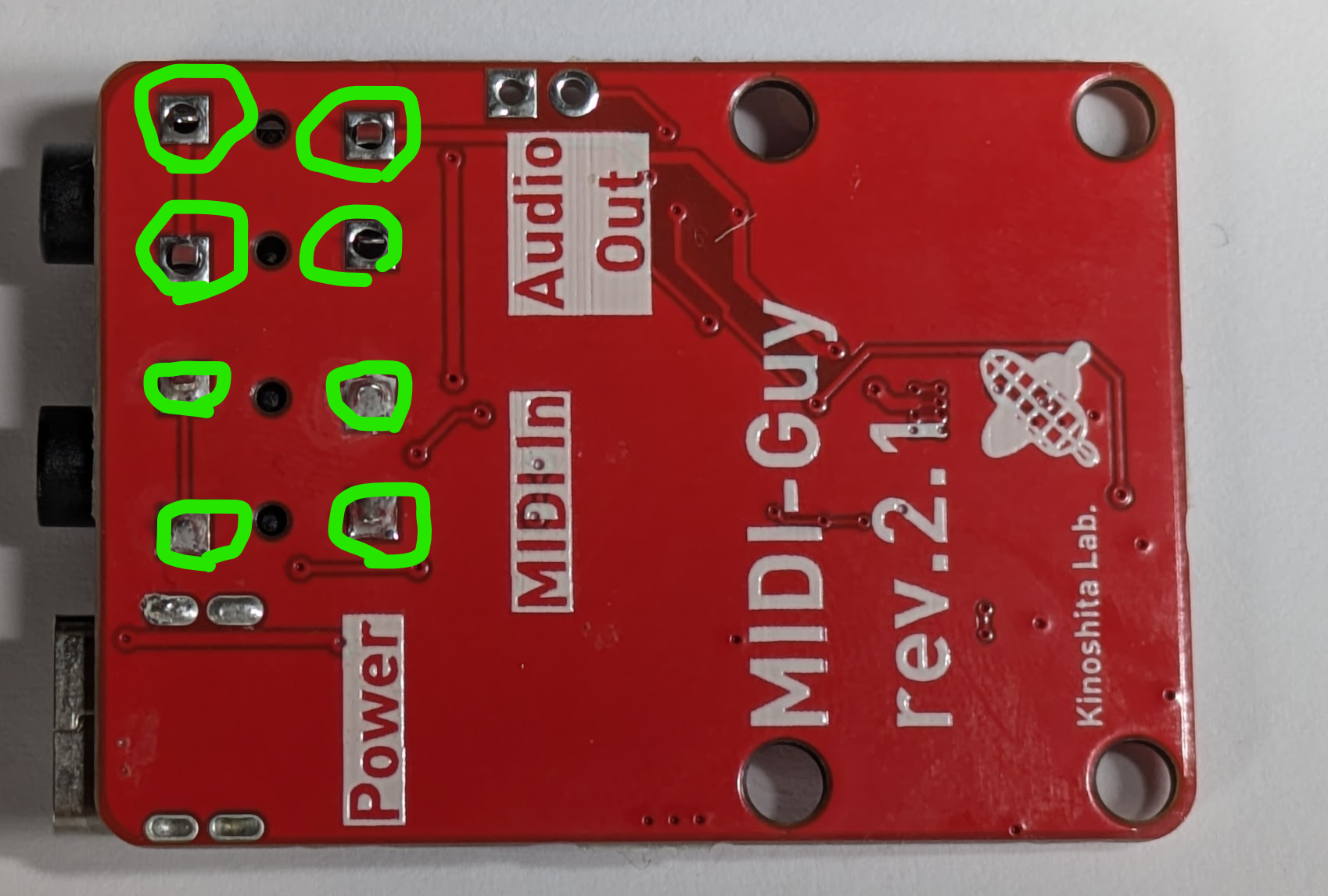
https://github.com/kinoshita-lab/MIDI-guy
STL file made by @maks. Thank you!! https://www.printables.com/model/1151667-case-for-a-midi-guy-pcb
| Qty | Value | Footprint | References |
|---|---|---|---|
| 4 | 0.1u | Capacitors_SMD:C_0603_HandSoldering | C9, C11, C12, C13 |
| 4 | 10u | Capacitors_SMD:C_0603_HandSoldering | C2, C7, C14, C15 |
| 2 | 10p | Capacitors_SMD:C_0603_HandSoldering | C3, C6 |
| 2 | 1u | Capacitors_SMD:C_0603_HandSoldering | C1, C10 |
| 2 | 220 | Resistors_SMD:R_0603_HandSoldering | R2, R3 |
| 2 | 47k | Resistors_SMD:R_0603_HandSoldering | R6, R7 |
| 2 | 5.1k | Resistor_SMD:R_0402_1005Metric | R8, R9 |
| 2 | AudioJack3 | my_footprint:3.5mm_Stereo_TRS_PJ-3210-4A_and_ST-005-G | J2, J3 |
| 2 | MountingHole_3.2mm_M3_DIN965 | Mounting_Holes:MountingHole_3.2mm_M3_DIN965 | REFe, REFe |
| 2 | SM4007PL | Diode_SMD:D_SOD-123 | D1, D2 |
| 1 | 0 | Resistors_SMD:R_0603_HandSoldering | R5 |
| 1 | 0.01u | Capacitors_SMD:C_0603_HandSoldering | C5 |
| 1 | 10k | Resistors_SMD:R_0603_HandSoldering | R1 |
| 1 | 1k | Resistors_SMD:R_0603_HandSoldering | R4 |
| 1 | 4.7u | Capacitors_SMD:C_0603_HandSoldering | C8 |
| 1 | BAS40DW-04-7-F | ultra_librarian:SOT-363_DIO | U3 |
| 1 | GZ1608D222TF | Inductors_SMD:L_0603_HandSoldering | L1 |
| 1 | LED | LED_SMD:LED_0603_1608Metric_Pad1.05x0.95mm_HandSolder | D3 |
| 1 | LOGO | my_footprint:kinoshita-logo_simplified_600dpi | G*** |
| 1 | SAM2695 | my_footprint:SAM2695_QFN-48-6x6mm_Pitch0.4mm | U2 |
| 1 | TAR5S33 | mylib:TAR5S33_Akizuki_Toshiba_SSOP5 | U1 |
| 1 | TAXM12M4RDBCCT2T | snapeda:OSCSC320X250X100N | Y1 |
| 1 | TLP291(GB-TP,SE | mylib:TLP291 | P1 |
| 1 | TestPoint | TestPoint:TestPoint_THTPad_2.0x2.0mm_Drill1.0mm | TP2 |
| 1 | TestPoint | TestPoint:TestPoint_THTPad_D2.0mm_Drill1.0mm | TP1 |
| 1 | ~ | Revbox_lib:HRO TYPE-C-31-M-08A | USB1 |
The 40 most common of 42 parts.


realraum/luefterklappensteuerung
Damper Control for ventilation exhaust system in realraum


UzixLS/zxuno1010-board
10x10cm PCB variant of ZX-UNO project for G738/G706 enclosure

hkzlab/DWAVE_MIDI_Wavetable
DWAVE is a small General MIDI module for the wavetable connector of your old sound card, based on the SAM2695 chip
It measures 44 × 32 mm and has 2 copper layers, 1.6 mm thick.
42 parts, built around the SAM2695, SM4007PL, GZ1608D222TF and TAXM12M4RDBCCT2T. The full list of its parts is on this page, with links to each part's symbol and footprint where PCBKit's library has them.
From the kinoshita-lab/MIDI-guy repository on GitHub, at the commit this page was made from: the board is MIDI-Guy.kicad_pcb and its schematic MIDI-Guy.kicad_sch. PCBKit opens the board in the browser, with nothing to install.
Its repository publishes it under the MIT licence: you may reuse it on that licence's terms (keep the author's notice, and for a copyleft licence share your changes alike).