
2 layers204 × 80 mm

USB-MIDI Interface(2IN/2OUT) for STM32
Midi is an open-source printed circuit board by keshikan, from the keshikan/CureMIDI repository on GitHub. It is a 2-layer board of 64 × 67 mm with 182 parts on 70 nets, routed with 346 tracks and 19 vias.
It is built around the 74VHCV541FT, TLP2361(E and ESDA6V1BC6. Its parts include 13 resistors, 10 capacitors, 10 connectors, 8 diodes and 6 ICs. It belongs with the audio and music and interfaces and adapters boards and the STM32 boards of this library.


This repository shows STM32F0 (ARM Cortex-M0) based USB-MIDI Interface. It has 2 MIDI-IN and 2 MIDI-OUT, and is USB MIDI class-compliant.
The USB-MIDI Class Driver is based on mimuz-tuch project (c) D.F.Mac. @TripArts Music.
STM32F0を使用した、USB-MIDIインターフェースです。INを2系統、OUTを2系統実装しています。USB MIDI Classに対応するシステム(Windows, iOS, Android, etc.)に対し、ドライバレスでMIDI入出力ポートを追加できます。
USB MIDI Classドライバは、D.F.Mac. @TripArts Music氏作成のドライバを基に、一部改造を加えています。
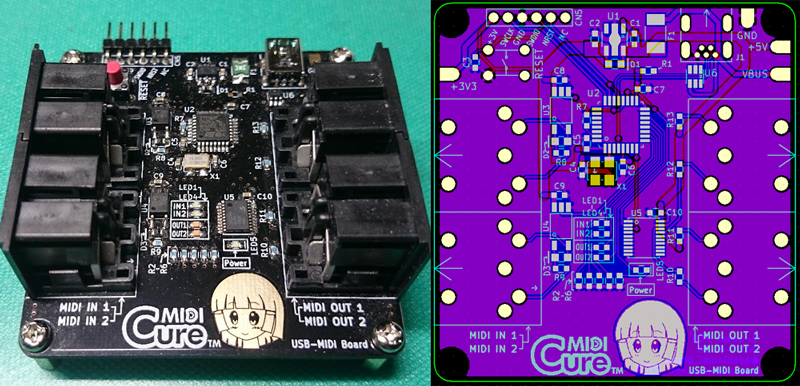
See Schematic, KiCad Source.
Install SW4STM32(need registration), import Project files, and build.
Vendor ID(VID) and Product ID(PID) in <usbd_desc.c> should be unique pair for each USB devices. Default VID 0x1209 and PID 0x0001 is experimental IDs from http://pid.codes .When distributing or selling, you must get your own IDs, and change to your own IDs in order to avoid conflicting to other USB devices.
USBのVendor ID(VID)とProduct ID(PID)は、<usbd_desc.c>内に記述します。 デフォルトのVID(0x1209)/PID(0x0001)ペアは、http://pid.codesで定められている実験用IDです。そのため、本機器を配布したり販売したりする場合には、別途固有のIDペアを取得し、書き換えてご使用下さい。
(c) 2018 Keshikan ( Website, Twitter )
See also LICENSE.md
| Qty | Value | Footprint | References |
|---|---|---|---|
| 8 | 0.1μF | keshikan:SMD_0603(1608) | C3, C4, C5, C6, C7, C8, C9, C10 |
| 6 | 220 | keshikan:SMD_0603(1608) | R8, R9, R10, R11, R12, R13 |
| 5 | 750 | keshikan:SMD_0603(1608) | R2, R3, R4, R5, R6 |
| 5 | Led_Small | keshikan:SMD_0603(1608)_polar | LED1, LED2, LED3, LED4, LED5 |
| 4 | DIN_5 | keshikan:DIN_5P_MIDI | CN1, CN2, CN3, CN4 |
| 2 | D_Small | keshikan:SMD_0805(2012)_polar | D2, D3 |
| 2 | TLP2361 | keshikan:11-4L1S(TLP2361) | U3, U4 |
| 1 | 0.33μF | keshikan:SMD_0603(1608) | C1 |
| 1 | 10k | keshikan:SMD_0603(1608) | R7 |
| 1 | 2.2μF | keshikan:SMD_0603(1608) | C2 |
| 1 | 3V | keshikan:CHK_Terminal_TH | P4 |
| 1 | 4.7k | keshikan:SMD_0603(1608) | R1 |
| 1 | 5V | keshikan:CHK_Terminal_TH | P2 |
| 1 | 74VHCV541FT | keshikan:TSSOP20B | U5 |
| 1 | CHK_GND | keshikan:CHK_Terminal_TH | P3 |
| 1 | CONN_01X06 | keshikan:CONN_DIP_6Pin | CN5 |
| 1 | D_Schottky_Small | keshikan:SMD_0805(2012)_polar | D1 |
| 1 | ESDA6V1BC6 | keshikan:SOT23-6L | U6 |
| 1 | LOGO | keshikan:CureMIDI | G*** |
| 1 | NJM2884U1 | keshikan:SOT-89-5 | U1 |
| 1 | PolySW 0.35A | keshikan:miniSMDC030F | F1 |
| 1 | SG5032CAN 8MHz | keshikan:SG5032 | X1 |
| 1 | STM32F042K6Tx | keshikan:LQFP32_7x7_STM32 | U2 |
| 1 | SW_PUSH_SMALL_H | keshikan:Tactile_Switches_2by2 | SW1 |
| 1 | USB_OTG_ORIG | keshikan:USB_miniB_MUSB-5BF01AS | J1 |
| 1 | VBUS | keshikan:CHK_Terminal_TH | P1 |
The 51 most common of 182 parts.


martinribelotta/h7dragonman
STM32H7 board for industrial protocol bridge

themainframe/p3-cellular-module
CAD/CAM for a GPD Pocket 3 Cellular Module

dchwebb/MidiMonger
Eurorack MIDI interface supporting USB and serial MIDI. Based on ARM STM32F446 MCU.

Resaj/time2time
Chronometer with partials measurement for the line-following competitions


arraym/ESP8266Tetris
Tetris game with ESP8266 (ESP-12F) and WS2812B (128 RGB LEDs) - KiCAD schematic and PCB
It measures 64 × 67 mm and has 2 copper layers, 1.6 mm thick.
182 parts, built around the 74VHCV541FT, TLP2361(E and ESDA6V1BC6. The full list of its parts is on this page, with links to each part's symbol and footprint where PCBKit's library has them.
From the keshikan/CureMIDI repository on GitHub, at the commit this page was made from: the board is hardware/kicad_source/midi.kicad_pcb. PCBKit opens the board in the browser, with nothing to install.
Its repository states no licence, so its author keeps all rights: ask keshikan before reusing the design.