2 layers

 KamMalinski/PRISM7
Automatic PCB Analysis and Reverse Engineering
Filter is an open-source printed circuit board by KamMalinski, from the KamMalinski/PRISM repository on GitHub, published under the AGPL-3.0 licence. It is a 2-layer board with 7 parts on 7 nets, routed with 40 tracks and 0 vias.
Its parts include 2 capacitors, 2 connectors, 2 inductors and 1 resistor.
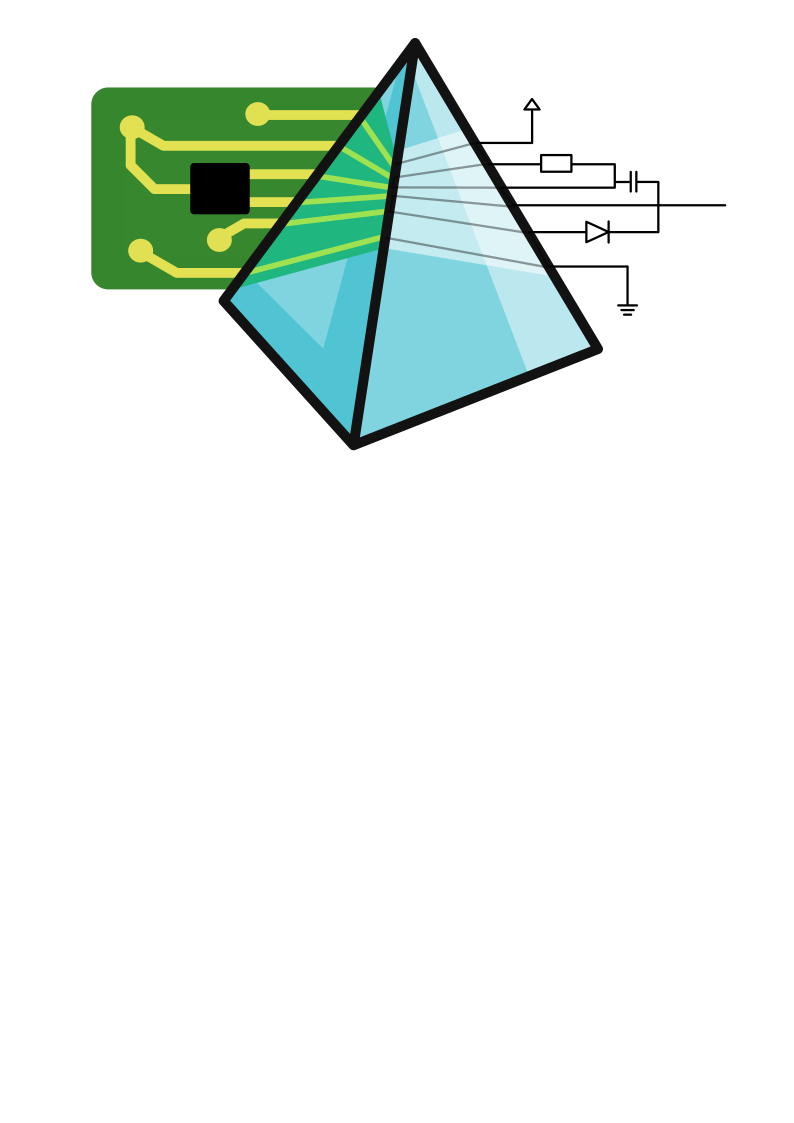
PCB Recognition and Intelligent Schematic Mapping
PRISM reconstructs an editable KiCad schematic from aligned images of the top and bottom sides of a PCB. It combines image processing, pad and trace detection, OCR-assisted component recognition, connectivity analysis, manual correction tools, and schematic optimization in one desktop application.
PRISM is currently alpha software. Generated connectivity and component assignments must be reviewed before they are used for manufacturing, servicing, or safety-critical work.
kicad-cli for round-trip validation and optimized previews.PRISM searches PATH first and then conventional installation locations for
the current operating system. Tesseract can also be selected manually in the
interface.
On Debian or Ubuntu, install the native GUI and OpenCV runtime libraries before running from source or building:
sudo apt-get install python3-venv python3-tk libgl1 libglib2.0-0Create and activate a virtual environment, then install the project:
python -m venv .venvWindows PowerShell:
.\.venv\Scripts\Activate.ps1
python -m pip install -r requirements.txt
prism
macOS and Linux:
source .venv/bin/activate
python -m pip install -r requirements.txt
prism
Windows users can alternatively run .\run.ps1.
PyInstaller creates native applications and does not cross-compile. Run the matching script on each target operating system:
# Windows
.\scripts\build\build_windows.ps1# macOS
bash scripts/build/build_macos.sh
# Linux
bash scripts/build/build_linux.shThe scripts create an isolated .venv-build environment and use the shared
configuration in scripts/build/package.py.
| Platform | Output |
|---|---|
| Windows | dist/PRISM/PRISM.exe |
| macOS | dist/PRISM.app |
| Linux | dist/PRISM/PRISM |
Windows and Linux use PyInstaller's onedir layout. Distribute the complete
dist/PRISM directory, not only the executable. The macOS application is
unsigned; public releases should be code-signed and notarized by the release
owner.
Generated files are written under ~/PRISM/results by default. Set the
PRISM_OUTPUT_DIR environment variable to use a different location. A local
results/ directory is also excluded from version control.
Dataset/ contains twelve PCB examples with TOP/BOTTOM
images and reference KiCad projects. It is intended for repeatable development
and evaluation, not as a formal train/test split.
evaluation/ contains the versioned reference
annotations and English-language tools for synthetic regression tests and
ablation studies. A baseline run is started from the repository root with:
python evaluation/run_evaluation.pyThe six supported ablation configurations can be executed with:
python evaluation/run_ablations.pyThe tools generate machine-readable JSON reports, compact Markdown summaries,
and a LaTeX ablation table under evaluation/results/. See the
evaluation guide for sample selection, dependency
requirements, command-line options, report interpretation, and the exact scope
of the synthetic results. These tests exercise controlled KiCad-derived board
images; they do not validate PRISM on photographs of physical PCBs.
.
|-- Dataset/                         Test images and reference KiCad projects
|-- evaluation/                      Synthetic evaluation, ablations, and reference annotations
|-- scripts/build/                   Native build entry points and shared build logic
|-- src/schematic_generator/
|   |-- assets/                      Application and executable icons
|   |-- correction_editor/           Manual reconstruction editor
|   |-- detection/                   Pad, trace, plane, and pair detection
|   |-- diagnostics/                 Diagnostic reports
|   |-- geometry/                    Alignment and rectification
|   |-- gui/                         Main desktop workflow
|   |-- kicad/                       KiCad serialization and routing
|   |-- netlist/                     Connectivity and component inference
|   |-- schematic/                   Validation and optimization
|   |-- platform_support.py          Operating-system integration
|   `-- __main__.py                  Application entry point
|-- pyproject.toml                  Package metadata and runtime dependencies
|-- requirements-build.txt          Build-only dependencies
`-- requirements.txt Editable development installationThe GitHub Actions workflow in .github/workflows/build.yml runs smoke tests
and creates Windows, macOS, and Linux artifacts using the same scripts as local
builds.
Keep platform-independent behavior in the application modules. Operating-system
differences belong in platform_support.py, while packaging differences belong
in scripts/build/package.py. New detection or reconstruction behavior should
be checked against multiple samples from Dataset/.
No project license has been selected yet. Add a LICENSE file before presenting
PRISM as open-source software or accepting external contributions.
| Qty | Value | Footprint | References |
|---|---|---|---|
| 1 | 100R | Resistor_THT:R_Axial_Power_L20.0mm_W6.4mm_P25.40mm | R1 |
| 1 | 20mF | Capacitor_THT:CP_Radial_Tantal_D8.0mm_P5.00mm | C1 |
| 1 | 20nH | Inductor_THT:L_Axial_L20.0mm_D8.0mm_P7.62mm_Vertical | L1 |
| 1 | 330mH | Inductor_THT:L_Axial_L29.9mm_D14.0mm_P38.00mm_Horizontal_Vishay_IHA-105 | L2 |
| 1 | 470pF | Capacitor_THT:C_Rect_L9.0mm_W4.9mm_P7.50mm_MKT | C2 |
| 1 | Conn_01x04 | Connector_PinHeader_2.54mm:PinHeader_1x04_P2.54mm_Horizontal | J2 |
| 1 | Conn_01x04 | Connector_Wire:SolderWire-0.5sqmm_1x04_P4.8mm_D0.9mm_OD2.3mm | J1 |


byrantech/laptop
anyon_e, a highly integrated, high end, open source laptop. Attempt the impossible.


AxxAxx/AxxSolder
STM32 Based soldering station for JBC cartridges, 9-24 VDC and USB-PD power


jamro/tiny-engineer
A small desktop robot that brings an AI coding assistant to life, physically acting out when it reads files, thinks, writes code, and finishes work.

hoglet67/RGBtoHDMI
Bare-metal Raspberry Pi project that provides pixel-perfect sampling of Retro Computer RGB/YUV video and conversion to HDMI

7 parts. The full list of its parts is on this page, with links to each part's symbol and footprint where PCBKit's library has them.
From the KamMalinski/PRISM repository on GitHub, at the commit this page was made from: the board is Dataset/Filter/Filter/Filter.kicad_pcb and its schematic Dataset/Cascade/Cascade/Cascade.kicad_sch. PCBKit opens the board in the browser, with nothing to install.
Its repository publishes it under the AGPL-3.0 licence: you may reuse it on that licence's terms (keep the author's notice, and for a copyleft licence share your changes alike).