6 layers338.8 × 107.2 mm
Inboard386
ronnyroy111/inboard386
Reverse engineered schematics, PCB and logic equations for the Intel 386/PC accelerator
199 parts16MIT

 Kalidomra/SuperClone-5.038
A clone of the Super Snapshot 5.0 for the C64
SuperClone is an open-source printed circuit board by Kalidomra, from the Kalidomra/SuperClone-5.0 repository on GitHub. It is a 2-layer board of 63.5 × 76.2 mm with 23 parts on 59 nets, routed with 896 tracks and 64 vias.
It is built around the PAL16L8-5JC, 74LS174DC and PN2222A. Its parts include 5 ICs, 3 capacitors, 2 resistors, 2 transistors and 2 connectors.


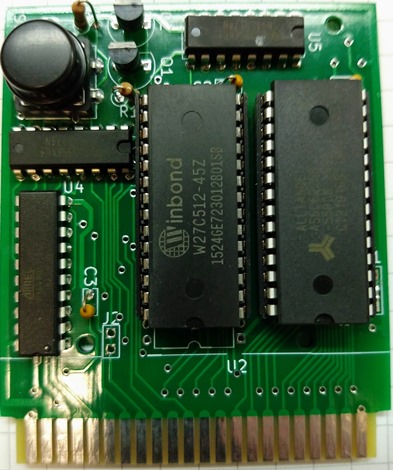
This is a clone of the Super Snapshot v5 hardware. All of the traces are close to the original and it will fit in the same case as an original. It uses an Atmel ATF16V8B in the place of the original PAL. I have also tried a ATF16V8C, but it did not work. All of the parts, including the Atmel are interchangeable with an original. I have also included the WinCUPL source files and a DigiKey bill of materials. The EEPROM is not available at DigiKey. I bought one from Ebay.
The following parts will need to programmed:
ATF16V8B-15PU --> This needs to be programmed with the include .jed file.
W27C512-45Z --> Programmed with any available Super Snapshot v5 ROM. See: https://rr.pokefinder.org/wiki/Super_Snapshot
It will also work with a larger 32 pin EEPROM like the W27C010-70 or W27C020-70. This is only required for a larger rom file like the SnappyROM: https://github.com/adrianglz64/snappyrom
The EPROM used must be relatively fast (70ns or faster seems to work fine.) Some of the cheap, clone, UV erasable 27C512 EPROMS I tried did not work. I suspect they were remarked and in reality a slower part.
I have also included a 3d printable case. However, Hackup has made great case available here: https://www.thingiverse.com/thing:4623905
The original PCB was setup for 8K Ram, the clone is also defaulted this way. In order to use the 32K ram you need to cut the trace betrween pin 1 and 2 on J1 and then jumper pin 2 and 3 on J1.
| Qty | Value | Footprint | References |
|---|---|---|---|
| 3 | 100nF | SuperClone:C_Disc_D3.4mm_W2.1mm_P2.50mm | C1, C2, C3 |
| 2 | 1.5K | SuperClone:R_Axial_DIN0207_L6.3mm_D2.5mm_P2.54mm_Vertical | R1, R2 |
| 2 | 74LS174 | SuperClone:DIP-16_W7.62mm_Socket | U4, U5 |
| 2 | PN2222A | SuperClone:TO-92L_Inline_Wide | Q1, Q2 |
| 1 | 27C010 | SuperClone:DIP-32_W15.24mm_Socket | U2 |
| 1 | EXPANSION_PORT-SuperClone | SuperClone:expansion_port | EXP1 |
| 1 | HM62256 | SuperClone:DIP-28_W15.24mm_Socket | U1 |
| 1 | Jumper_2_Bridged | SuperClone:PinHeader_1x02_P2.54mm_Vertical | J2 |
| 1 | Jumper_3_Bridged12 | SuperClone:PinHeader_1x03_P2.54mm_Vertical | J1 |
| 1 | PAL16L8 | SuperClone:DIP-20_W7.62mm_Socket | U3 |
| 1 | SW_DIP_x01 | SuperClone:SW_PUSH-12mm | SW1 |
The 16 most common of 23 parts.
It measures 63.5 × 76.2 mm and has 2 copper layers, 630 mm thick.
23 parts, built around the PAL16L8-5JC, 74LS174DC and PN2222A. The full list of its parts is on this page, with links to each part's symbol and footprint where PCBKit's library has them.
From the Kalidomra/SuperClone-5.0 repository on GitHub, at the commit this page was made from: the board is Kicad/SuperClone.kicad_pcb. PCBKit opens the board in the browser, with nothing to install.
Its repository states no licence, so its author keeps all rights: ask Kalidomra before reusing the design.
ronnyroy111/inboard386
Reverse engineered schematics, PCB and logic equations for the Intel 386/PC accelerator


inmbolmie/Memotron
Retro-inspired DIY 256KB memory expansion for the Amstrad CPC 464 computers

RichCini/LomasBoards
Small repository of files/data related to Lomas Data Products S-100 boards.

raymondh2/CompaqPortableIII
Current PCB Memory Expansion board layout is untested. The backplane for the expansion cards is tested and working.

alvaroalea/QL_CST_FLoppyController
A clone of the CST's Floppy Disk Interface for Sinclair QL (PCB version 3 & 4)


54weasels/sun3_60
Notes on each section: - CPU - 68030 support left out entirely - 68881 in the schematics but left out of the PCB - MMU - U2001 which would be needed to support any video, either P4 or built-in not in the PCB - U314…