2 layers144 × 121.4 mm
Pando right
jyap808/pando
58 key split keyboard. Integrated STM32G0B1KBT6, USB-C interconnect, PCA9555 IO Expander design
71 parts13

 jyap808/pando13
58 key split keyboard. Integrated STM32G0B1KBT6, USB-C interconnect, PCA9555 IO Expander design
Pando left is an open-source printed circuit board by jyap808, from the jyap808/pando repository on GitHub. It is a 2-layer board of 144 × 121.4 mm with 89 parts on 72 nets, routed with 576 tracks and 72 vias.
It is built around the STM32G0B1KBT6, PRTR5V0U2X and 1N4148W. Its parts include 29 diodes, 8 resistors, 7 capacitors, 4 ICs and 2 connectors. It belongs with the keyboards and input boards and the STM32 boards of this library.


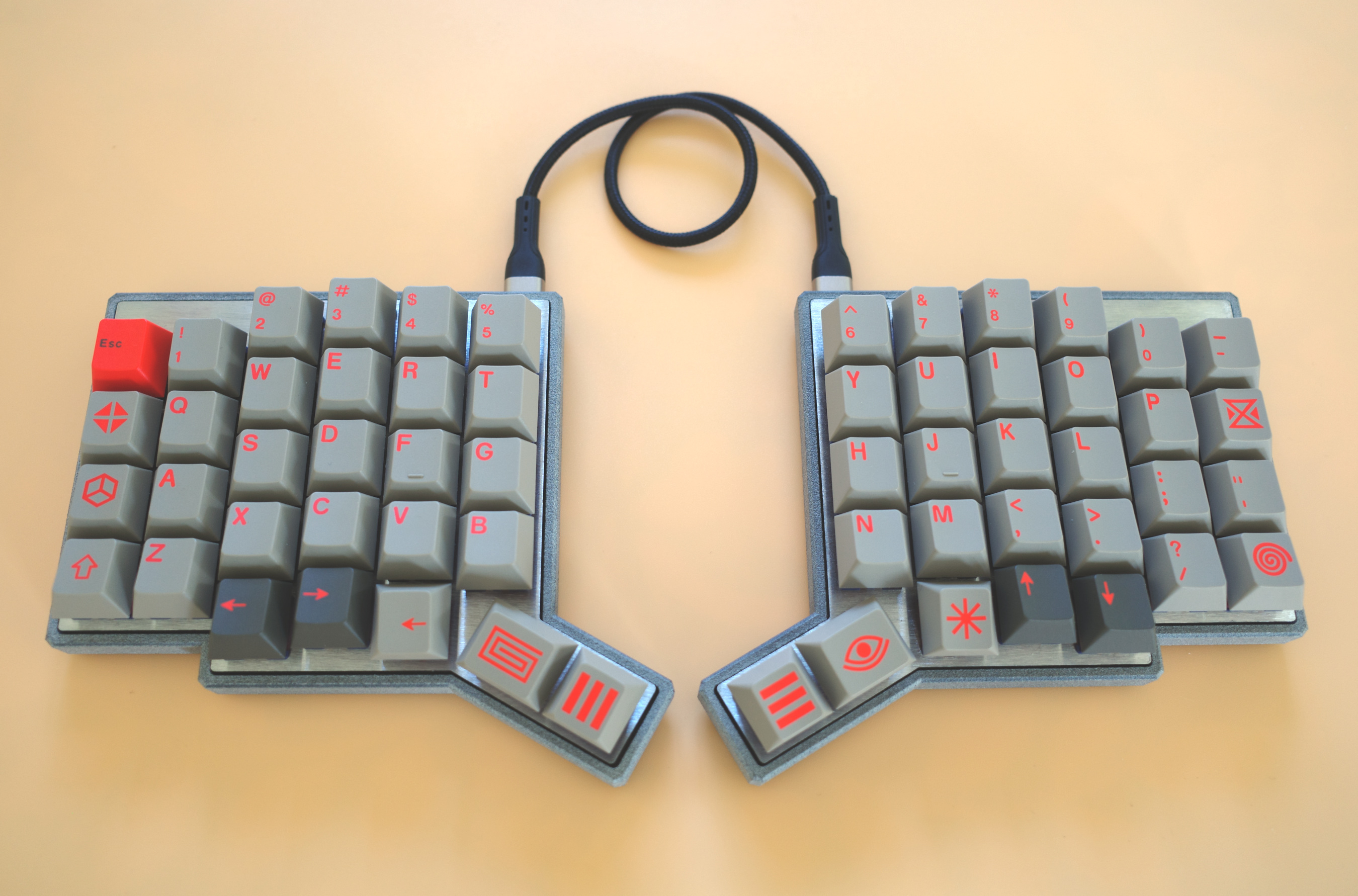
Pando is a wired 58-key column-staggered split keyboard. It uses an integrated MCU design on the STM32 platform (STM32G0B1) with an IO expander (PCA9555) on the secondary half, connected over USB-C.
[!NOTE] 📘 The Documentation pages contain a Build and Firmware guide.
[!TIP] 🚀 Want one? Pre-assembled and PCB-tested kits are available on Etsy. Your support helps me keep this project open-source and encourages the development of new models!


| Directory | Description |
|---|---|
kicad/ | Schematics and PCB (left, right, switch plates) |
firmware/ | QMK/Vial keyboard definition |
ergogen/ | Layout configuration and case/plate generation |
case/ | 3D printed case models (FreeCAD) |
docs/ | This project's documentation site (built with Zensical) |
Pando runs Vial firmware. Precompiled builds are on GitHub Releases — flash with dfu-util, or build from source with the keyboard definition in firmware/keyboards/. See Installing Firmware for details.
Pando Keyboard © 2026 by Julian Yap is Open Hardware, licensed under CERN-OHL-S v2. See LICENSE.
The firmware in firmware/ is licensed under the GPL v2.
| Qty | Value | Footprint | References |
|---|---|---|---|
| 29 | 1N4148W | Diode_SMD:D_SOD-123 | D1, D2, D10, D11, D12, D13, D14, D15, D16, D17, D18, D19, D20, D21, D22, D23 +13 |
| 29 | MX_SW_HS | PCM_Switch_Keyboard_Hotswap_Kailh:SW_Hotswap_Kailh_MX | MX1, MX2, MX10, MX11, MX12, MX13, MX14, MX15, MX16, MX17, MX18, MX19, MX20, MX21, MX22, MX23 +13 |
| 8 | 5.1k | Resistor_SMD:R_0603_1608Metric | R1, R2, R3, R4, R5, R6, R7, R8 |
| 5 | Mounting_Wuerth:Mounting_Wuerth_WA-SMSI-M2_H3.5mm_9774035243 | H1, H2, H3, H4, H5 | |
| 4 | 100nF | Capacitor_SMD:C_0603_1608Metric | C1, C3, C8, C11 |
| 2 | 1uF | Capacitor_SMD:C_0603_1608Metric | C9, C10 |
| 2 | 500mA | Fuse:Fuse_1206_3216Metric | F1, F2 |
| 2 | PRTR5V0U2X | Package_TO_SOT_SMD:SOT-143 | U2, U4 |
| 2 | SW_SPST | Button_Switch_SMD:SW_SPST_TL3342 | BOOT1, RST1 |
| 2 | USB_C_Receptacle_USB2.0_14P | PCM_marbastlib-various:USB_C_Receptacle_HRO_TYPE-C-31-M-12 | J1, J2 |
| 1 | Pando logo | Logo1 | |
| 1 | 10uF | Capacitor_SMD:C_0603_1608Metric | C2 |
| 1 | STM32G0B1KBT6 | Package_QFP:LQFP-32_7x7mm_P0.8mm | U1 |
| 1 | XC6206PxxxMR-Regulator_Linear | Package_TO_SOT_SMD:SOT-23-3 | U3 |
jyap808/pando
58 key split keyboard. Integrated STM32G0B1KBT6, USB-C interconnect, PCA9555 IO Expander design

aaronraj11/MES4-MCU
A small STM32G0B1 microcontroller module with CAN, built as an M.2 2242 (B-key) card.

mgkoenig/lyft
LYFT is a sophisticated remote control for your IKEA BEKANT desk.

sadekbaroudi/barobord
I have spent a lot of time and money designing prototypes, testing, developing, etc. Any contributions would be greatly appreciated!

sporkus/le_chiffre_keyboard_stm32
Le Chiffre keyboard pcb with stm32F072


markstory/ursa-minor-keyboard
Design and schematics for the ursaminor keyboard

melonbred/open-source-projects
This is a repository for all open-sourced or available files for my projects. PCBs will typically have their own repository linked in the table below.

hungrygeek/HSKB
Open-source HHKB-layout MX custom keyboard — KiCad PCB, case STL, QMK/VIA firmware. Personal iteration of the HSKB (Happy Sabi Keyboard).
It measures 144 × 121.4 mm and has 2 copper layers, 1.6 mm thick.
89 parts, built around the STM32G0B1KBT6, PRTR5V0U2X and 1N4148W. The full list of its parts is on this page, with links to each part's symbol and footprint where PCBKit's library has them.
From the jyap808/pando repository on GitHub, at the commit this page was made from: the board is kicad/left/pando_left.kicad_pcb and its schematic kicad/left/pando_left.kicad_sch. PCBKit opens the board in the browser, with nothing to install.
Its repository states no licence, so its author keeps all rights: ask jyap808 before reusing the design.