

2 layers52 × 52 mm
Tinker pod buttons
juansulca/tinker-pod
Open-Source hardware platform for makers and creatives
7 parts2MIT

 juansulca/tinker-pod2
Open-Source hardware platform for makers and creatives
Tinker pod v3 is an open-source printed circuit board by juansulca, from the juansulca/tinker-pod repository on GitHub, published under the MIT licence. It is a 2-layer board of 51.8 × 52.8 mm with 29 parts on 27 nets, routed with 118 tracks and 99 vias.
It is built around the JS202011AQN and MBR120. Its parts include 6 capacitors, 6 resistors, 6 switches, 5 connectors and 2 ICs. It belongs with the SAM D and SAM boards of this library.
Open-Source | DIY | Multitool | Modular | Extendable
The TinkerPod is an Open-Source hardware platform designed to appeal to makers, creative coders, and designers by providing a hackable and customizable hardware. Inspired by the evolution of multitools and influenced by contemporary devices like the Flipper Zero and SQRT, this project explores the application of critical making, and personal fabrication to Open-Source hardware. The TinkerPod is an ideal hardware platform for designers and makers to explore, learn, modify and extend; make it your own!
The TinkerPod was designed to have 3 versions. All the versions are currently supported. The main difference between versions is the parts list, complexity of assembly and features.
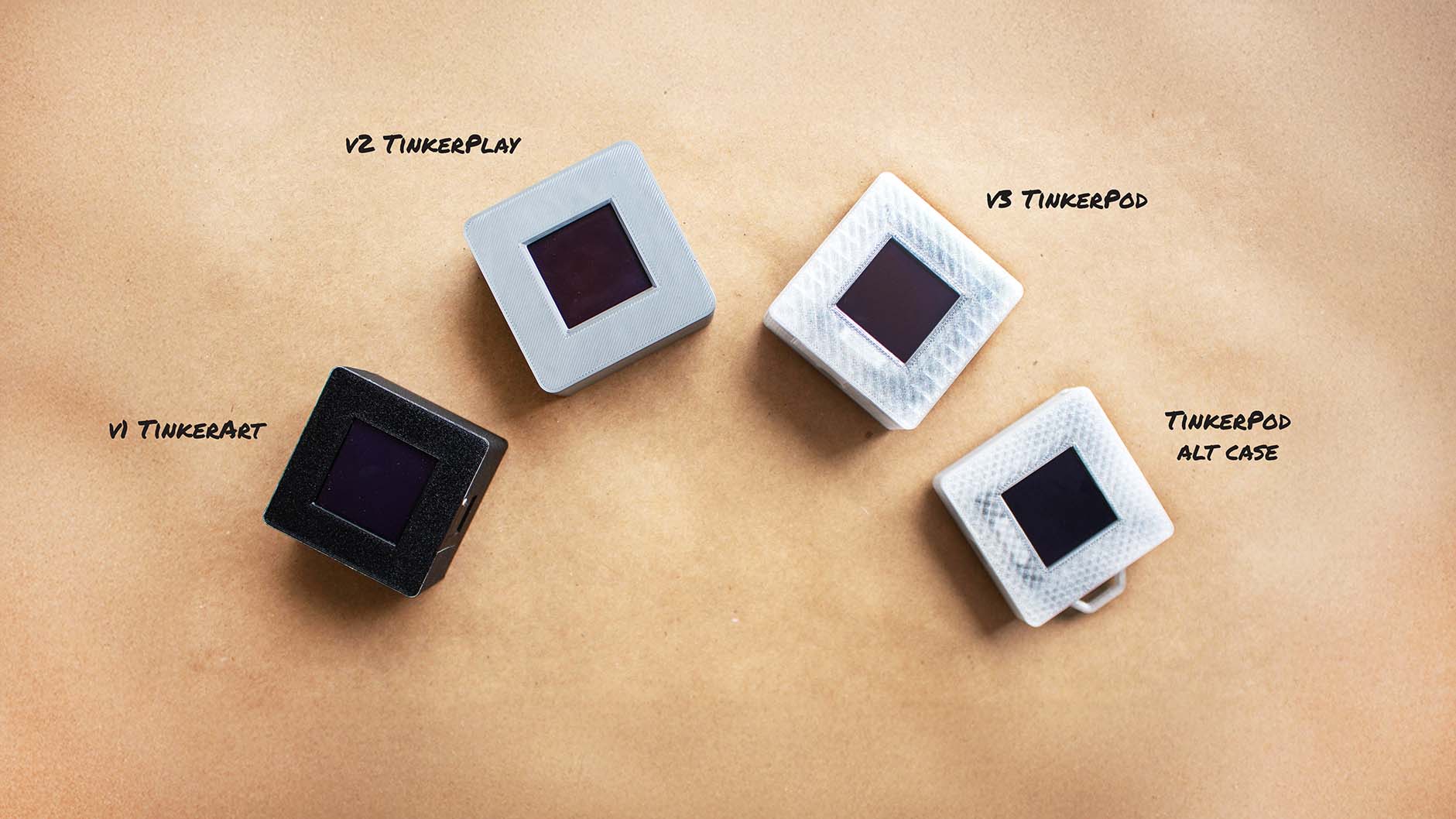
This project was designed to work around the QT PY RP2040 from Adafruit. Despite this, it is possible to run the TinkerPod with other microcontrollers with the same pinout and form factor from other manufacturers. This includes other boards from Adafruit (QT PY line), the XIAO boards from Seeed Studio, among others.
TinkerPod v1, does not include a PCB and can be wired without tools using a tiny solderless breadboard, the display, microcontroller, and the case.
For ease of assembly starting from V2, the Screen for the TinkerPod is a 1.5" grayscale OLED display with the SSD1327 controller using a STEMMA cable. This display can be found from Adafruit and other manufacturers but the Adafruit version is recommended due to the STEMMA cable, that reduces complexity for the assembly.
The TinkerPod v2 and v3 include PCB designs and schematics and require soldering. A detailed assembly guide can be found along side the version files.
The hardware for this project took inspiration from the following sources:
All versions of the TinkerPod run on CircuitPython. The included firmware includes assets and base functionality. You can modify the the firmware and add or change the functionality of the TinkerPod.
If you want to get started writing your own firmware and functionality, you can start with the examples directory. This will provide the bassis for modifying the firmware and adding new functionality.
The case for the TinkerPod designed for 3D printing and can be printed using any FDM printer. Printing settings are provided with each version files.
The cases for all versions were tested and printed using PLA and PETG. With the best results being achieved with PETG on a textured plate.
Alternative cases can be found in the variants directory.
General guides can be found in the docs directory, including a simple guide to install CircuitPython and managing the dependencies for the firmware.
The hardware for this project took inspiration from the following sources:
Contributions are welcome and appreciated. If you have any suggestions or improvements, please feel free to open an issue or submit a pull request.
The TinkerPod is licensed under the following terms:
| Qty | Value | Footprint | References |
|---|---|---|---|
| 4 | .1u | tinker-pod-library:C_1210_3225Metric_Pad1.33x2.70mm_HandSolder | C1, C2, C3, C4 |
| 4 | 1K | tinker-pod-library:R_1206_3216Metric_Pad1.30x1.75mm_HandSolder | R1, R2, R3, R4 |
| 4 | 3101 | tinker-pod-library:3101 | S1, S2, S3, S4 |
| 4 | Conn_01x01_MountingPin | tinker-pod-library:MountingHole_2.2mm_M2 | J2, J3, J4, J5 |
| 2 | 10u | tinker-pod-library:C_1210_3225Metric_Pad1.33x2.70mm_HandSolder | C5, C6 |
| 2 | 5.1K | tinker-pod-library:R_1206_3216Metric_Pad1.30x1.75mm_HandSolder | R5, R6 |
| 1 | Conn_01x02_MountingPin | tinker-pod-library:B2BPHSM4TBLFSN | J1 |
| 1 | JS202011AQN | tinker-pod-library:JS202011AQN | S5 |
| 1 | LED | tinker-pod-library:LED_1206_3216Metric_Pad1.42x1.75mm_HandSolder | D1 |
| 1 | LOGO | tinker-pod-library:TP_v3_logo | G*** |
| 1 | LOGO | tinker-pod-library:TP_long_logo | G*** |
| 1 | MBR120 | tinker-pod-library:D_SOD-123 | D2 |
| 1 | MCP73831-2-OT | tinker-pod-library:SOT-23-5 | U2 |
| 1 | SW_SPST | tinker-pod-library:CP_Radial_D4.0mm_P1.50mm | SW1 |
| 1 | Seeed Studio XIAO SAMD21 | tinker-pod-library:XIAO-SAMD21-RP2040-14P-2.54-21X17.8MM (Seeeduino XIAO) | U1 |
juansulca/tinker-pod
Open-Source hardware platform for makers and creatives


StuckAtPrototype/PCB_business_card_original
A custom PCB based "business" card that lets you play a version of Flappy Bird.


Mage-Control-Systems-Ltd/CANBOB
A breakout board that enables USB or SPI to CAN communication using the MCP2515.

microbug/soldering-station
DIY soldering station compatible with JBC C245 handle/tips

ayan20985/wavelength-keyboard
the wavelength keyboard is a custom ortholinear bluetooth mechanical keyboard

embedrapp/ai-pendant-recorder
AI pendant recorder firmware, PCB, and mechanical design

researchanddesire/assembly-docs
RAD unified assembly docs — ohai.researchanddesire.com
It measures 51.8 × 52.8 mm and has 2 copper layers, 1.6 mm thick.
29 parts, built around the JS202011AQN and MBR120. The full list of its parts is on this page, with links to each part's symbol and footprint where PCBKit's library has them.
From the juansulca/tinker-pod repository on GitHub, at the commit this page was made from: the board is v3/hardware/tinker-pod-v3.kicad_pcb and its schematic v2/hardware/tinker-pod-buttons.kicad_sch. PCBKit opens the board in the browser, with nothing to install.
Its repository publishes it under the MIT licence: you may reuse it on that licence's terms (keep the author's notice, and for a copyleft licence share your changes alike).