2 layers274 × 158 mm
Acacia
jpsecher/keyboards
Goals - Good ergonomics - Good for programming - No drivers - Configurable - Use standard components where possible
127 parts1ISC
 jpsecher/keyboards1
Goals - Good ergonomics - Good for programming - No drivers - Configurable - Use standard components where possible
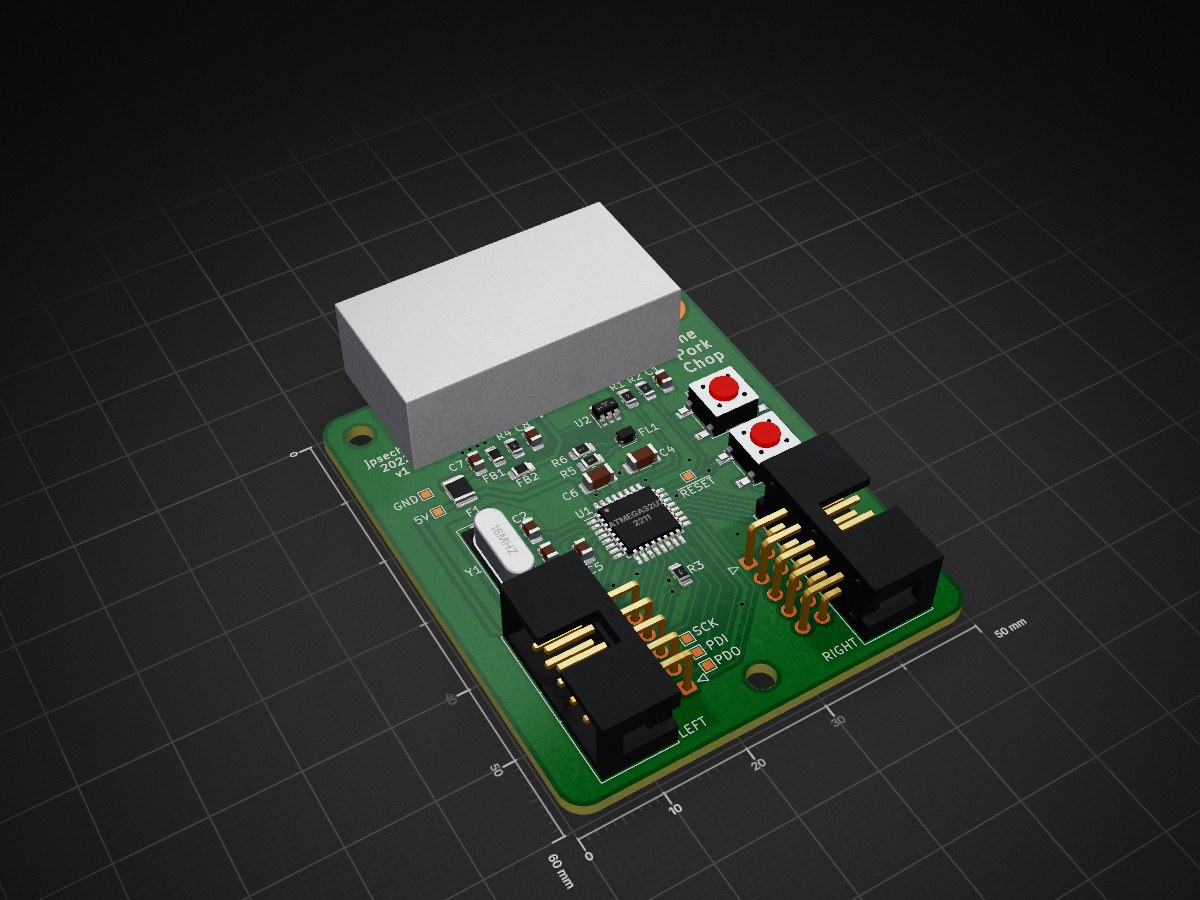
Controller is an open-source printed circuit board by jpsecher, from the jpsecher/keyboards repository on GitHub, published under the ISC licence. It is a 2-layer board of 50 × 60 mm with 35 parts on 40 nets, routed with 263 tracks and 21 vias.
It is built around the ATMEGA32U2-AU, USBLC6-2SC6 and MUSBD111M0. Its parts include 8 capacitors, 6 resistors, 3 connectors, 2 ICs and 2 switches. It belongs with the AVR (ATmega, ATtiny) boards of this library.


Goals
On the ergonomics side, the initial design will be a pseudo-split staggered-column because it follows the natural physiology of the hands, and because I only need to make one or two for myself. I want to make a PCB for the keyboard, so it seems to convoluted to go all the way to curved surfaces (eg. wells). With a PCB, I can also support hot-swappable keys, which makes it possible to try out different spring weights for the individual fingers (like the Absolem). And no stabilisers should be needed because the keys should just be where your finger naturally land, and therefore there should be no need for large 2U keys. For the thumb keys, size 1.5U is probably sufficient.
Keys that need to be hold down while pressing other keys should only be operated by strong fingers. So all modifier keys and layer shifting should probably be in the thumbs area, where it will be most comfortable to hold down a keys (as opposed to tapping the key). But some modifier keys need to be hold down together, so these modifiers then need to be on opposite sides, using both thumbs at the same time.
Good ergonomics with no curvatures then means that the number of keys must be limited to avoid stretching the fingers too much. Which means that the keyboard needs to have several layers to accommodate all the ASCII characters used in programming, as well as the various European letters I use daily. I am toying with the idea of using the thumb keys exclusively for layer-shift and control keys.
The keyboard should use standard hot-swappable Cherry MX keys. And to ease experimentation, I will start out with DSA profile key caps.
Contexts:
And:
Also, I prefer that each group of keys follow the traditional QWERTY layout, simply because it makes switching between keyboards less stressful.
| Qty | Value | Footprint | References |
|---|---|---|---|
| 3 | 22 | Resistor_SMD:R_0805_2012Metric_Pad1.20x1.40mm_HandSolder | R2, R5, R6 |
| 3 | 22p | Capacitor_SMD:C_0805_2012Metric_Pad1.18x1.45mm_HandSolder | C1, C2, C3 |
| 2 | 10k | Resistor_SMD:R_0805_2012Metric_Pad1.20x1.40mm_HandSolder | R1, R3 |
| 2 | 120 | Resistor_SMD:R_0805_2012Metric_Pad1.20x1.40mm_HandSolder | FB1, FB2 |
| 2 | 1µ | Capacitor_SMD:C_1206_3216Metric_Pad1.33x1.80mm_HandSolder | C4, C6 |
| 1 | 16MHz | Crystal:Crystal_SMD_HC49-SD | Y1 |
| 1 | 1M | Resistor_SMD:R_0805_2012Metric_Pad1.20x1.40mm_HandSolder | R4 |
| 1 | 1µ | Capacitor_SMD:C_0805_2012Metric_Pad1.18x1.45mm_HandSolder | C5 |
| 1 | 22p/100V | Capacitor_SMD:C_0805_2012Metric_Pad1.18x1.45mm_HandSolder | C8 |
| 1 | 350mA | Resistor_SMD:R_1210_3225Metric_Pad1.30x2.65mm_HandSolder | F1 |
| 1 | 4µ7 | Capacitor_SMD:C_0805_2012Metric_Pad1.18x1.45mm_HandSolder | C7 |
| 1 | 5V | TestPoint:TestPoint_Pad_1.0x1.0mm | TP6 |
| 1 | ATmega32U2 | Package_QFP:TQFP-32_7x7mm_P0.8mm | U1 |
| 1 | DEBUG | Button_Switch_SMD:SW_SPST_EVQQ2 | SW2 |
| 1 | GND | TestPoint:TestPoint_Pad_1.0x1.0mm | TP5 |
| 1 | LEFT | Connector_IDC:IDC-Header_2x05_P2.54mm_Horizontal | J2 |
| 1 | MUSBD111M0 | mech-kbd:AMPHENOL_MUSBD111M0 | J1 |
| 1 | NCC0805F900KTRF | Inductor_SMD:L_CommonModeChoke_Coilcraft_0805USB | FL1 |
| 1 | PDI | TestPoint:TestPoint_Pad_1.0x1.0mm | TP3 |
| 1 | PDO | TestPoint:TestPoint_Pad_1.0x1.0mm | TP4 |
| 1 | RESET | Button_Switch_SMD:SW_SPST_EVQQ2 | SW1 |
| 1 | RIGHT | Connector_IDC:IDC-Header_2x05_P2.54mm_Horizontal | J3 |
| 1 | SCK | TestPoint:TestPoint_Pad_1.0x1.0mm | TP2 |
| 1 | USBLC6-2SC6 | Package_TO_SOT_SMD:SOT-23-6 | U2 |
| 1 | case | MountingHole:MountingHole_3.2mm_M3_DIN965_Pad | H1 |
| 1 | ~{RESET} | TestPoint:TestPoint_Pad_1.0x1.0mm | TP1 |
The 33 most common of 35 parts.
It measures 50 × 60 mm and has 2 copper layers, 1.6 mm thick.
35 parts, built around the ATMEGA32U2-AU, USBLC6-2SC6 and MUSBD111M0. The full list of its parts is on this page, with links to each part's symbol and footprint where PCBKit's library has them.
From the jpsecher/keyboards repository on GitHub, at the commit this page was made from: the board is acacia/kicad/controller.kicad_pcb and its schematic acacia/kicad/acacia-2.kicad_sch. PCBKit opens the board in the browser, with nothing to install.
Its repository publishes it under the ISC licence: you may reuse it on that licence's terms (keep the author's notice, and for a copyleft licence share your changes alike).
jpsecher/keyboards
Goals - Good ergonomics - Good for programming - No drivers - Configurable - Use standard components where possible

jpsecher/keyboards
Goals - Good ergonomics - Good for programming - No drivers - Configurable - Use standard components where possible

jpsecher/keyboards
Goals - Good ergonomics - Good for programming - No drivers - Configurable - Use standard components where possible


JKattackk/JKattPad-ATM32u2
Custom numpad using ATMega32u2, QMK, and USB-C connectivity


jackhumbert/reform
This is the main repository for the MNT Reform open source laptop.

