2 layers98 × 27 mm

 joelspadin/battery-breakout-pcb
Breakout PCB for LiPo batteries
Battery breakout is an open-source printed circuit board by joelspadin, from the joelspadin/battery-breakout-pcb repository on GitHub. It is a 2-layer board of 23 × 14 mm with 5 parts on 2 nets, routed with 16 tracks and 0 vias.
It belongs with the power and interfaces and adapters boards of this library.
This is a small PCB for connecting various types of 2-pin LiPo batteries. It has connectors for Molex Pico EZ-mate, JST SH, and JST PH plugs as well as a terminal for bare wire batteries. It also has a 2-pin header for connecting to a device.
Because there is no standard polarity for these batteries, the pins are not labeled as positive and negative. Instead, the pins on the left side of each connector are labeled 1 and are connected together, and the pins on the right side of each connector are labeled 2 and are connected together. You should check the polarity of the battery before connecting the breakout to your device. For example, if the positive wire of the battery is on the 1 (left) side of the connector, you should connect the positive side of your device to the 1 (left) side of the 2-pin header.
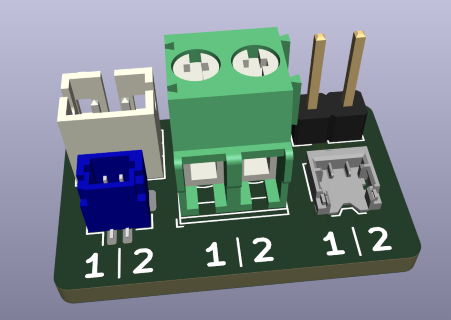
You will need one of each of the following parts:
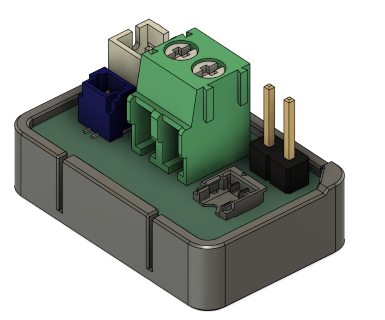
A 3D-printable enclosure is also provided in STEP and 3MF formats. This covers the bottom of the PCB to prevent the through hole components from shorting out on anything.
| Qty | Value | Footprint | References |
|---|---|---|---|
| 1 | Conn_01x02 | Connector_PinHeader_2.54mm:PinHeader_1x02_P2.54mm_Vertical | J1 |
| 1 | JST PH | Connector_JST:JST_PH_B2B-PH-K_1x02_P2.00mm_Vertical | J3 |
| 1 | JST SH | Connector_Extra:JST_SH_BM02B-SRSS-TB_1x02-1MP_P1.00mm_Vertical | J4 |
| 1 | Molex Pico-EZmate | Connector_Extra:Molex_Pico-EZmate_78171-0002_1x02-1MP_P1.20mm_Vertical | J5 |
| 1 | Terminal Block | TerminalBlock_Phoenix:TerminalBlock_Phoenix_PT-1,5-2-3.5-H_1x02_P3.50mm_Horizontal | J2 |

joypad-ai/joypad-os
Universal controller firmware for building adapters, dongles, and custom controllers.

OLIMEX/OLINUXINO
OLINUXINO is Open Source / Open Hardware, low cost from EUR 24 Linux Industrial grade Single Board Computer capable to operate -25+85C

jamro/tiny-engineer
A small desktop robot that brings an AI coding assistant to life, physically acting out when it reads files, thinks, writes code, and finishes work.

hackclub/OnBoard
💡 Join 1,000 teenagers and make your first PCB with a $100 grant!


Luos-io/luos_engine
Open-source and real-time orchestrator for cyber-physical-systems, to easily design, test and deploy embedded applications and digital twins.
It measures 23 × 14 mm and has 2 copper layers, 1.6 mm thick.
5 parts. The full list of its parts is on this page, with links to each part's symbol and footprint where PCBKit's library has them.
From the joelspadin/battery-breakout-pcb repository on GitHub, at the commit this page was made from: the board is battery-breakout.kicad_pcb and its schematic battery-breakout.kicad_sch. PCBKit opens the board in the browser, with nothing to install.
Its repository states no licence, so its author keeps all rights: ask joelspadin before reusing the design.