Skip to the content
2 layers60 × 38.2 mmGk controls trigger, the printed circuit board in 3D

Gk controls trigger

jncronin/gk79

This respository provides PCB schematics, firmware and debugging support for the gkv4 handheld game console and its operating system, gkos. For the original STM32H7S7-based gk, see README-v3.md.

Size
60 × 38.2 mm
Copper layers
2
Thickness
1.6 mm
Parts
7
Nets
7
Pads
43
Tracks, vias
16, 0
Routed
Yes
KiCad
KiCad 9.0 (file 20241229)
Created
4 Jan 2024
Updated
4 Nov 2026

Overview

Gk controls trigger is an open-source printed circuit board by jncronin, from the jncronin/gk repository on GitHub. It is a 2-layer board of 60 × 38.2 mm with 7 parts on 7 nets, routed with 16 tracks and 0 vias.

README

README.md

gk and gkos

This respository provides PCB schematics, firmware and debugging support for the gkv4 handheld game console and its operating system, gkos. For the original STM32H7S7-based gk, see README-v3.md.

gkv4 represents a significant upgrade over the original gk with improved speed, a bigger screen, more gamepad buttons and hardware-accelerated 3D rendering.

Videos of the gkv4 in action
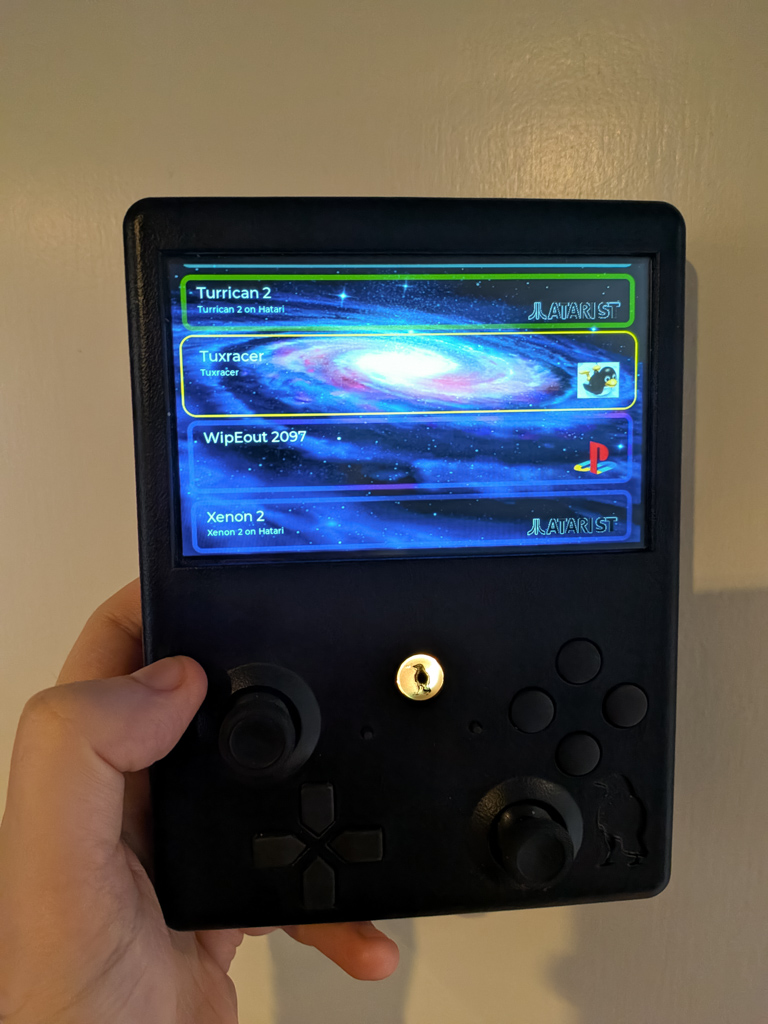
An image of the gk showing its menu screen

Overview

gkv4 is a small, battery powered handheld gaming console running on a STM32MP2 MPU (dual Cortex-A35 cores with additional Cortex-M33 core). It runs a custom OS called gkos which allows near-instantaneous (MCU-like) cold boot times but is powerful enough to run most POSIX userspace applications. See https://github.com/jncronin/gk-userland for the userland support including cross GCC toolchains and useful libraries. https://github.com/jncronin/gk-repo contains all the userspace code including ports of various emulators, games and utilities.

Game/emulator support:

  • Mednafen for NES, SNES, SMS, MD and Lynx support
  • Hatari for Atari ST
  • PCSX_rearmed for PS1
  • Mupen64plus (see fork at https://github.com/jncronin/mupen64-combined) for N64 (GPU-accelerated)
  • Atari++ for Atari XL
  • DOSBox-X (achieves 25000 cycles/second, 199561 parrots, 74 XT on speedtst.com, roughly 486 50 MHz equivalent)
  • Native ports of:
    • Neverball/neverputt (GPU-accelerated with tilt support)
    • Tuxracer (GPU-accelerated)
    • Doom (sdl2-doom)
    • Quake (ChocolateQuake)
    • Descent (ChocolateDescent)
    • koules

Hardware Specifications

PCBs, schematics and case STL files are available in https://github.com/jncronin/gk/tree/main/gk-pcbv4.

  • STM32MP255D processor with variable clock rate (defined on a per-game basis). Debug and trace ports exposed.
  • LPDDR4 RAM (1 GiB in current version)
  • Lithium ion battery (10,000 mAH in current version) with USB-C charging via BQ25601, state of charge monitoring via MAX17048 and current sensing via INA236
  • 800x480 5 inch touchscreen (ER-TFT050-6). Hardware scaling support via STM32MP2 LTDC peripheral.
  • Micro SD for storage with voltage switch support
  • Wifi/Bluetooth module attached via M.2 E-key interface (e.g. EAR00389 module)
  • Gyrometer/accelerometer + optional magnetometer for tilt interface
  • Headphone + internal speaker audio out via TAD5112
  • Multiple controls including:
    • Left and right analog sticks (programmable as digital on per-game basis)
    • ABXY + DPAD buttons
    • Start + select buttons
    • Analog throttle controller
    • Volume up/down (can be programmed as additional game inputs)
    • Menu button (opens OSD)
    • Left/right trigger + bumper buttons on back of device
  • Battery backup for RTC

Total current draw is heavily dependent on screen brightness but is typically 1.5W or less at full CPU + GPU load with medium brightness, and max ~2W at full brightness.

Software

gkos is a custom OS written from scratch in C++. It is available in the https://github.com/jncronin/gk/tree/main/Firmware-v4 directory. Features:

  • Armv8-A SMP scheduler with multiple active processes + threads
  • Syscall interface with wrappers for most POSIX functions
  • High resolution (10 ns precision) timer provided to games
  • pthread support including threads, mutexes, semaphores, conditions, rwlocks and barriers
  • A port of the etnaviv GPU driver allowing hardware-accelerated OpenGL
  • Driver for Infineon CYW43439 chipset and IPv4 network stack
  • SD card (with UHS-I mode support) with Ext4 (Lwext4) and FAT (fatfs) drivers
  • USB driver allowing the device to present itself as a mass storage device to allow provisioning the internal SD card
  • Offloading of all input tasks, including tilt sensor and touch screen filtering, to Cortex-M33 core

Examples

Tuxracer using the GPU for rendering:
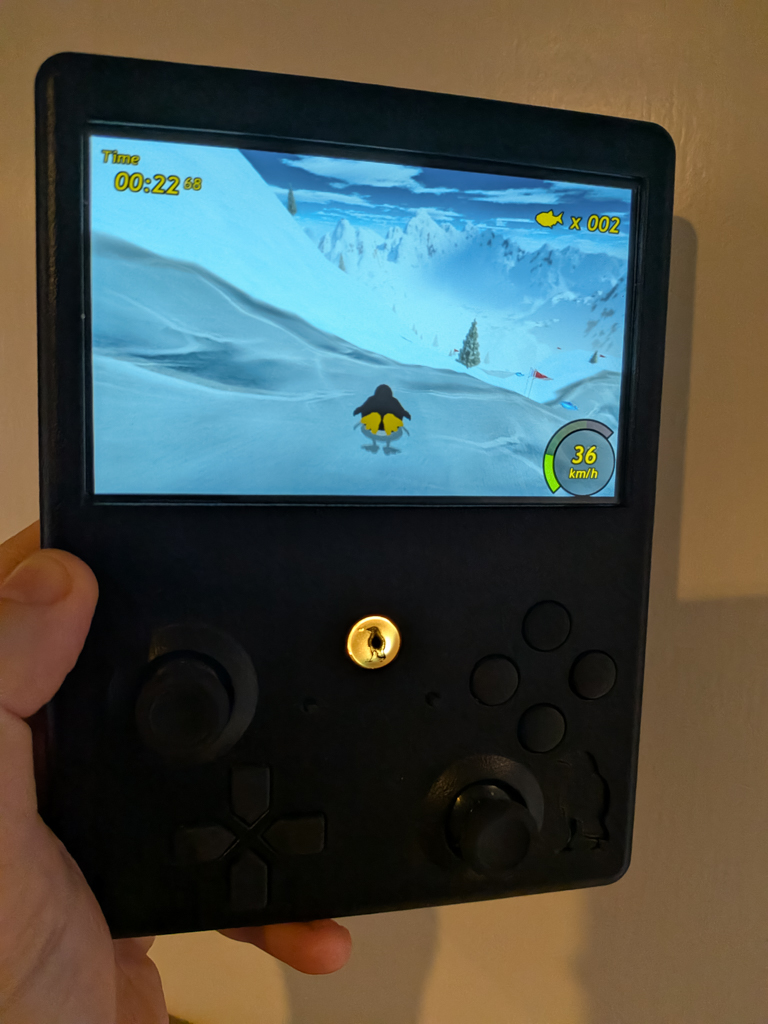
Tuxracer on the GK

Tuxracer with the OSD overlay (handled by the gk-supervisor process in the (https://github.com/jncronin/gk-userland) repo) showing current system health, battery and cpu usage:
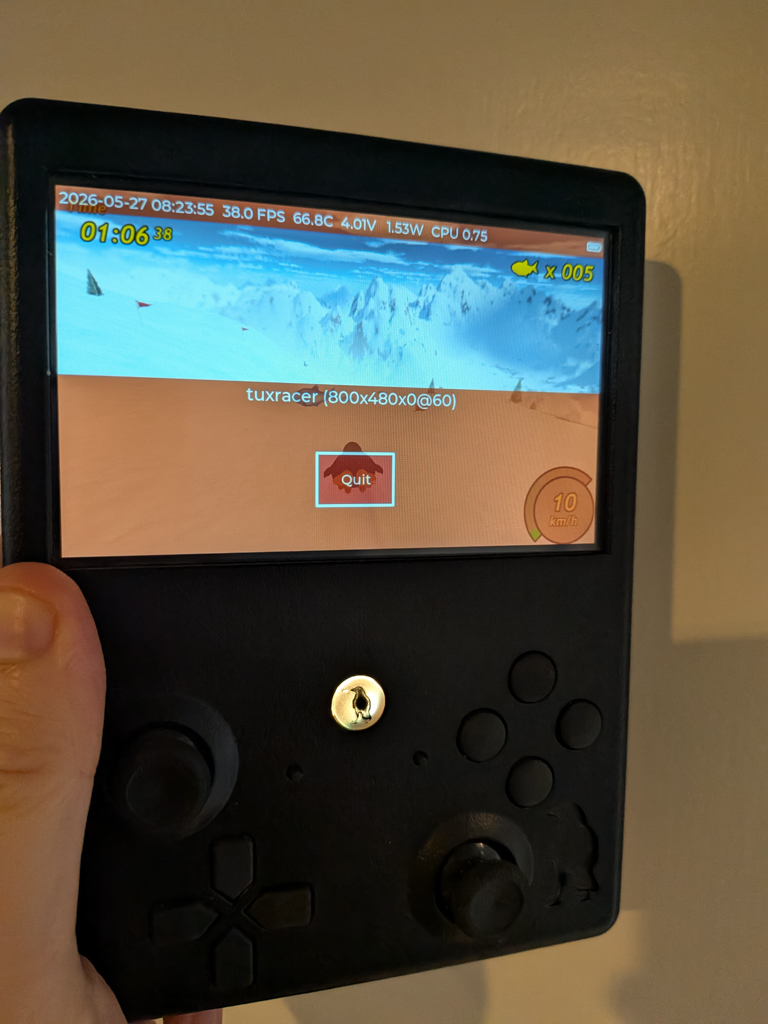
Tuxracer with on-screen display

Parts

7
QtyValueFootprintReferences
4Conn_01x01Connector_PinHeader_2.54mm:PinHeader_1x01_P2.54mm_VerticalJ2, J3, J4, J5
2SW_Pushgk:TouchButton-8x8mm_2SW_LT1, SW_RT1
1Conn_01x03Connector_PinHeader_2.54mm:PinHeader_1x03_P2.54mm_VerticalJ1

More from jncronin/gk

8
  • 4 layers96.2 × 75.8 mmPmic panel, the printed circuit board in 3D

    Pmic panel

    jncronin/gk

    This respository provides PCB schematics, firmware and debugging support for the gkv4 handheld game console and its operating system, gkos. For the original STM32H7S7-based gk, see README-v3.md.

    498 parts79
  • 6 layers108 × 158.8 mmGk pcbv3, the printed circuit board in 3D

    Gk pcbv3

    jncronin/gk

    This respository provides PCB schematics, firmware and debugging support for the gkv4 handheld game console and its operating system, gkos. For the original STM32H7S7-based gk, see README-v3.md.

    289 parts79
  • 6 layers121.6 × 110 mmGk pcbv4, the printed circuit board in 3D

    Gk pcbv4

    jncronin/gk

    This respository provides PCB schematics, firmware and debugging support for the gkv4 handheld game console and its operating system, gkos. For the original STM32H7S7-based gk, see README-v3.md.

    270 parts79
  • 6 layers108 × 158.8 mmGk pcbv2, the printed circuit board in 3D

    Gk pcbv2

    jncronin/gk

    This respository provides PCB schematics, firmware and debugging support for the gkv4 handheld game console and its operating system, gkos. For the original STM32H7S7-based gk, see README-v3.md.

    262 parts79
  • 6 layers108 × 158.8 mmGk, the printed circuit board in 3D

    Gk

    jncronin/gk

    This respository provides PCB schematics, firmware and debugging support for the gkv4 handheld game console and its operating system, gkos. For the original STM32H7S7-based gk, see README-v3.md.

    203 parts79
  • 2 layers120.6 × 72.2 mmGk controls, the printed circuit board in 3D

    Gk controls

    jncronin/gk

    This respository provides PCB schematics, firmware and debugging support for the gkv4 handheld game console and its operating system, gkos. For the original STM32H7S7-based gk, see README-v3.md.

    110 parts79
  • 4 layers25.4 × 25.4 mmPmic, the printed circuit board in 3D

    Pmic

    jncronin/gk

    This respository provides PCB schematics, firmware and debugging support for the gkv4 handheld game console and its operating system, gkos. For the original STM32H7S7-based gk, see README-v3.md.

    52 parts79
  • 4 layers50.7 × 52 mmGk oled pcb, the printed circuit board in 3D

    Gk oled pcb

    jncronin/gk

    This respository provides PCB schematics, firmware and debugging support for the gkv4 handheld game console and its operating system, gkos. For the original STM32H7S7-based gk, see README-v3.md.

    48 parts79

Similar boards

  • 2 layersEncoder, the printed circuit board in 3D

    Encoder

    byrantech/laptop

    anyon_e, a highly integrated, high end, open source laptop. Attempt the impossible.

    7 parts4.3kMIT
  • 2 layers40 × 20 mmSensor smd, the printed circuit board in 3D

    Sensor smd

    scottbez1/splitflap

    DIY split-flap display

    7 parts4.2k
  • 2 layers19.8 × 30 mmZ limit, the printed circuit board in 3D

    Z limit

    opulo-inc/lumenpnp

    The LumenPnP is an open source pick and place machine.

    7 parts3.7k
  • 2 layers35.6 × 58.2 mmDisplay Carrier, the printed circuit board in 3D

    Display Carrier

    AxxAxx/AxxSolder

    STM32 Based soldering station for JBC cartridges, 9-24 VDC and USB-PD power

    7 parts1.7kGPL-3.0
  • 2 layers20.3 × 16.3 mmMap MPX, the printed circuit board in 3D

    Map MPX

    rusefi/rusefi

    rusefi - GPL internal combustion engine control unit

    7 parts1.2k
  • 2 layers26 × 44 mmCompact carrier board, the printed circuit board in 3D

    Compact carrier board

    jamro/tiny-engineer

    A small desktop robot that brings an AI coding assistant to life, physically acting out when it reads files, thinks, writes code, and finishes work.

    7 parts1.1k
  • 2 layers26.4 × 53.8 mmAtari pickup, the printed circuit board in 3D

    Atari pickup

    hoglet67/RGBtoHDMI

    Bare-metal Raspberry Pi project that provides pixel-perfect sampling of Retro Computer RGB/YUV video and conversion to HDMI

    7 parts1kGPL-3.0
  • 2 layersRj45 breakout, the printed circuit board in 3D

    Rj45 breakout

    rene-dev/stmbl

    AC Servo Driver for STM32F4

    7 parts990GPL-3.0

Questions

How big is the Gk controls trigger PCB?

It measures 60 × 38.2 mm and has 2 copper layers, 1.6 mm thick.

What parts does the Gk controls trigger use?

7 parts. The full list of its parts is on this page, with links to each part's symbol and footprint where PCBKit's library has them.

Where can I download the Gk controls trigger KiCad files?

From the jncronin/gk repository on GitHub, at the commit this page was made from: the board is gk-pcbv4/gk-controls-trigger/gk-controls-trigger.kicad_pcb and its schematic gk-pcbv2/gk-pcbv2/audio.kicad_sch. PCBKit opens the board in the browser, with nothing to install.

Can I use the Gk controls trigger design in my own project?

Its repository states no licence, so its author keeps all rights: ask jncronin before reusing the design.