2 layers150 × 111.3 mm
BrainPower
Jamesits/BrainPower
PCI express x1 (full-height, half-length) socket to 12V DC adapter with specific MikroTik router mounting holes
11 parts12

 Jamesits/BrainPower12
PCI express x1 (full-height, half-length) socket to 12V DC adapter with specific MikroTik router mounting holes
BrainPower is an open-source printed circuit board by Jamesits, from the Jamesits/BrainPower repository on GitHub. It is a 2-layer board of 241.3 × 111.2 mm with 8 parts on 21 nets, routed with 9 tracks and 0 vias.
It belongs with the interfaces and adapters boards of this library.
PCI express x1 (full-height, half-length) socket to 12V DC adapter with specific MikroTik router mounting holes.
BrainPower adds true hardware-level NFV functionality for your servers private cloud, making it more suitable for IoT, edge computing, fog computing and branch office deployment.
BrainPower brings the only hardware-level network redundancy option on the market for single server deployment economic hyperconverged solution as long as your enclosure is large enough.
BrainPower integrates with your current and future OOB management systems and allows next-generation SD-WAN based management network.
BrainPower enables seamless transition of your legacy network architecture into a more modern, hybrid cloud architecture, bringing new possibilities for the smallest number of enclosures.
Note: this is a rendered version of BrainPower v0.3 and is subject to change. It does not represent the final product.
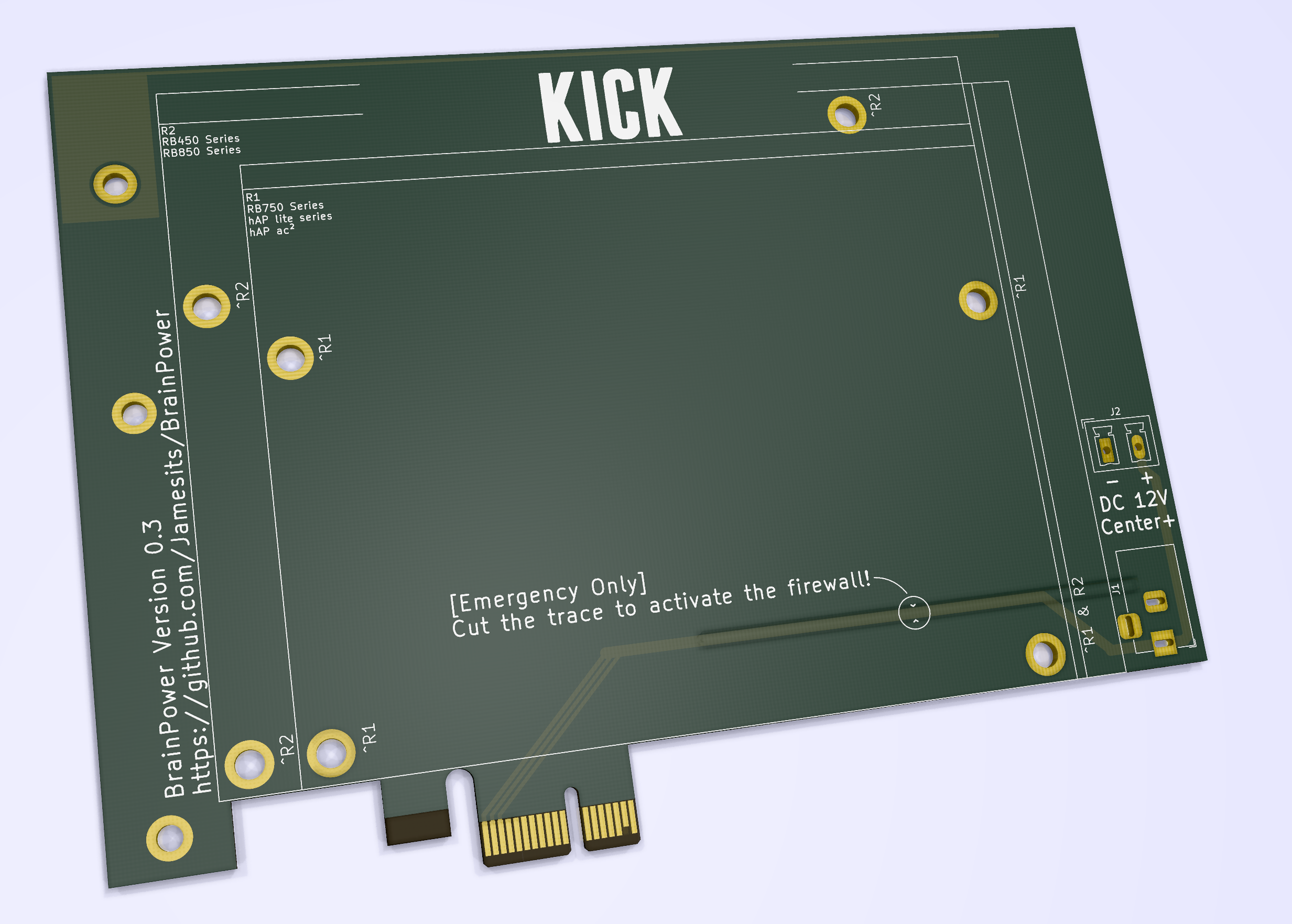
For actual photos, see:
It is compatible with the following MikroTik routers:
RB750 Series
RB450 Series
For stable or testing releases, you can go to releases to download an gerber files archive. Most PCB manufacture sites accept this format.
For development version, you can use the open-source KiCAD to open the project file located in the BrainPower sub-folder and plot the gerber files.
Mounting holes for the router are ⌀3.7mm holes, you can use M3 hexagonal column and screws. Mount the router on the B side of the PCB (the side with the "KICK" characters) to comply with PCI express standard; mounting backwards also works with some caveats (reads: we never tested it).
The PCI express I/O bracket mounting holes are of the same size and position as in Figure 6-1 and Figure 6-9, PCI Express® Card Electromechanical Specification Revision 2.0. You can use the brackets from common SAS cards (e.g. LSI SAS9217-8i).
The PCI express board shape is from x1 Desktop / Server Rec. Length Card and converted with altium2kicad. Shapes and characters are converted using svg2shenzhen.
The board's name and the fonts came from NOMA - Brain Power by Martin.
The following people provided assistance and help during the making of this product:
| Qty | Value | Footprint | References |
|---|---|---|---|
| 2 | Val** | SVGs:BRAIN POWER | Ref**, Ref** |
| 1 | DEFAULT | ||
| 1 | BarrelJack_CUI_PJ-063AH_Horizontal | Connector_BarrelJack:BarrelJack_CUI_PJ-063AH_Horizontal | J1 |
| 1 | Golden finger, PCIeX1, Dual, Opposite, Pitch 1mm, 36-Position | PCIeX1-GF-2D-1000-1K-O36 | P1 |
| 1 | Val** | SVGs:KICK | Ref** |
| 1 | Val** | SVGs:INNOVATOR | e |
| 1 | Val** | SVGs:SNARE | Ref** |
Jamesits/BrainPower
PCI express x1 (full-height, half-length) socket to 12V DC adapter with specific MikroTik router mounting holes


joeycastillo/Sensor-Watch
A board replacement for the classic Casio F-91W wristwatch

rusefi/rusefi
rusefi - GPL internal combustion engine control unit

hoglet67/RGBtoHDMI
Bare-metal Raspberry Pi project that provides pixel-perfect sampling of Retro Computer RGB/YUV video and conversion to HDMI

shanteacontrols/OpenDeck
A platform for building interactive control and sensing devices using MIDI and OSC built with Zephyr RTOS.

hackclub/OnBoard
💡 Join 1,000 teenagers and make your first PCB with a $100 grant!

dangiu/PicoMemcard
Emulating PSX Memory Card (or controller) using a Raspberry Pi Pico

OLIMEX/DIY-LAPTOP
Do It Yourself Open Source Hardware and Software Modular Hacker's Friendly Laptop
It measures 241.3 × 111.2 mm and has 2 copper layers, 1.6 mm thick.
8 parts. The full list of its parts is on this page, with links to each part's symbol and footprint where PCBKit's library has them.
From the Jamesits/BrainPower repository on GitHub, at the commit this page was made from: the board is full_length_legacy/BrainPower.kicad_pcb. PCBKit opens the board in the browser, with nothing to install.
Its repository states no licence, so its author keeps all rights: ask Jamesits before reusing the design.