
2 layers165 × 127 mm
Motherboard
slimcdk/sdb-xmas-train
Controller software for christmas train at Dagli'Brugsen Stjær
75 parts2

 izne/AA20
A small low frequency amplifier for home or office use. Uses TDA2003 and regulated linear PSU for smooth, real Class B transistor experience at low volumes.
Signal is an open-source printed circuit board by izne, from the izne/AA20 repository on GitHub. It is a 2-layer board of 63.5 × 64.3 mm with 35 parts on 18 nets, routed with 59 tracks and 0 vias.
It is built around the TDA2003. Its parts include 14 capacitors, 8 resistors, 5 connectors and 2 ICs. It belongs with the audio and music boards of this library.
A compact, high-fidelity audio amplifier PCB centered around the legendary TDA2003.
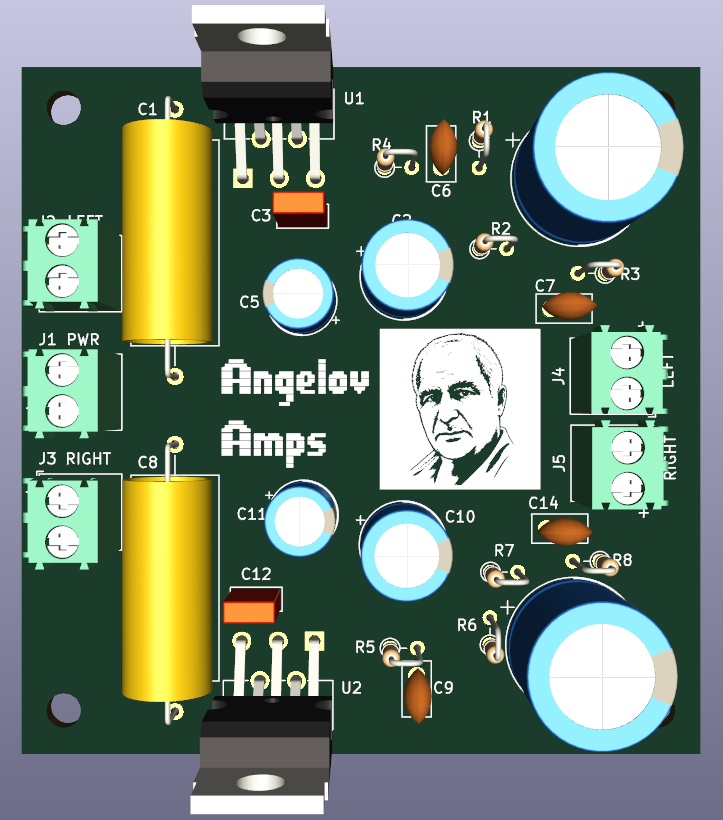
There is something undeniably cool about the TDA2003. It packs a full Class B transistor amplifier into a single, robust package—a feat of engineering that remains a cornerstone of analog audio. While it belongs to an "old-school" era of design, it delivers that unmistakable, warm, and punchy transistor sound that modern digital chips often struggle to replicate. It's simple, it's powerful, and it's pure analog soul.
The TDA2003 is a monolithic audio power amplifier IC designed as a low-frequency Class B amplifier. By utilizing a push-pull configuration, it achieves high power efficiency while maintaining low harmonic distortion. It is engineered for stability and reliability, featuring:
AA20 is designed to be a small but mighty amplifier solution. The layout is specifically optimized for thermal performance, mounting the TDA2003 ICs sideways to facilitate efficient side-mounted heatsinking.
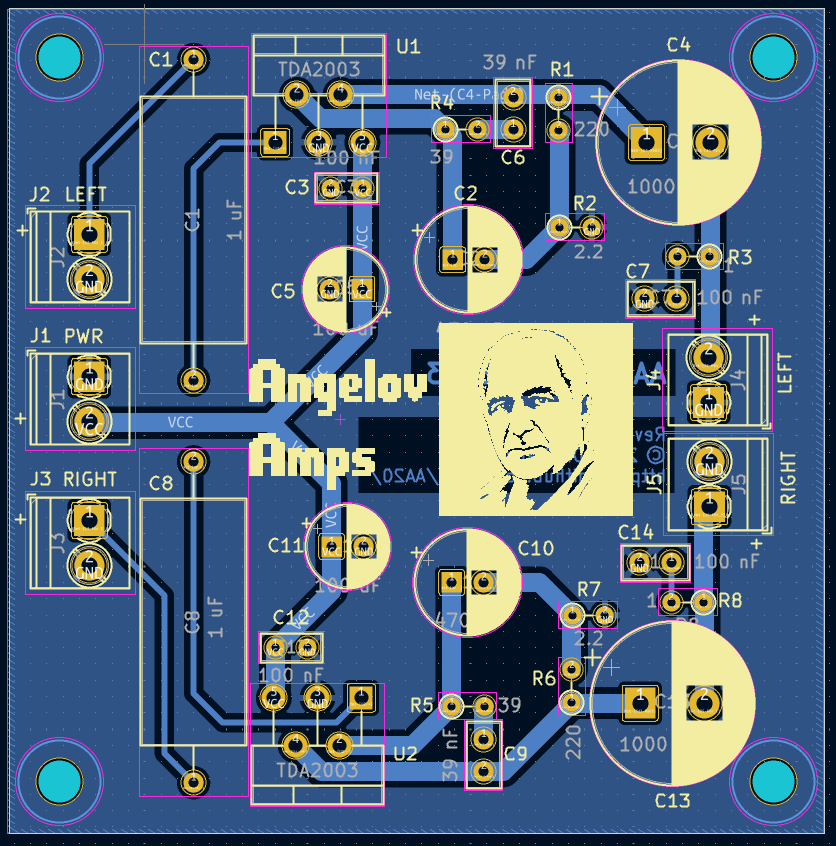
The circuit design is a direct implementation of the TDA2003 reference schematic provided in the official datasheet. To ensure maximum reliability and performance, all component values (capacitors, resistors, and diodes) are selected strictly according to the manufacturer's recommendations.
This approach guarantees that the amplifier operates within its intended stability margins, providing the expected output power and low distortion while effectively managing the Zobel network for high-frequency stability.
Based on a 12V DC supply and an 8 $\Omega$ load, the following performance characteristics are expected:
Using the relationship $P = \frac{V_{peak}^2}{2R}$, and accounting for the typical $V_{drop}$ of the TDA2003:
| Schematic | Bottom View |
|---|---|
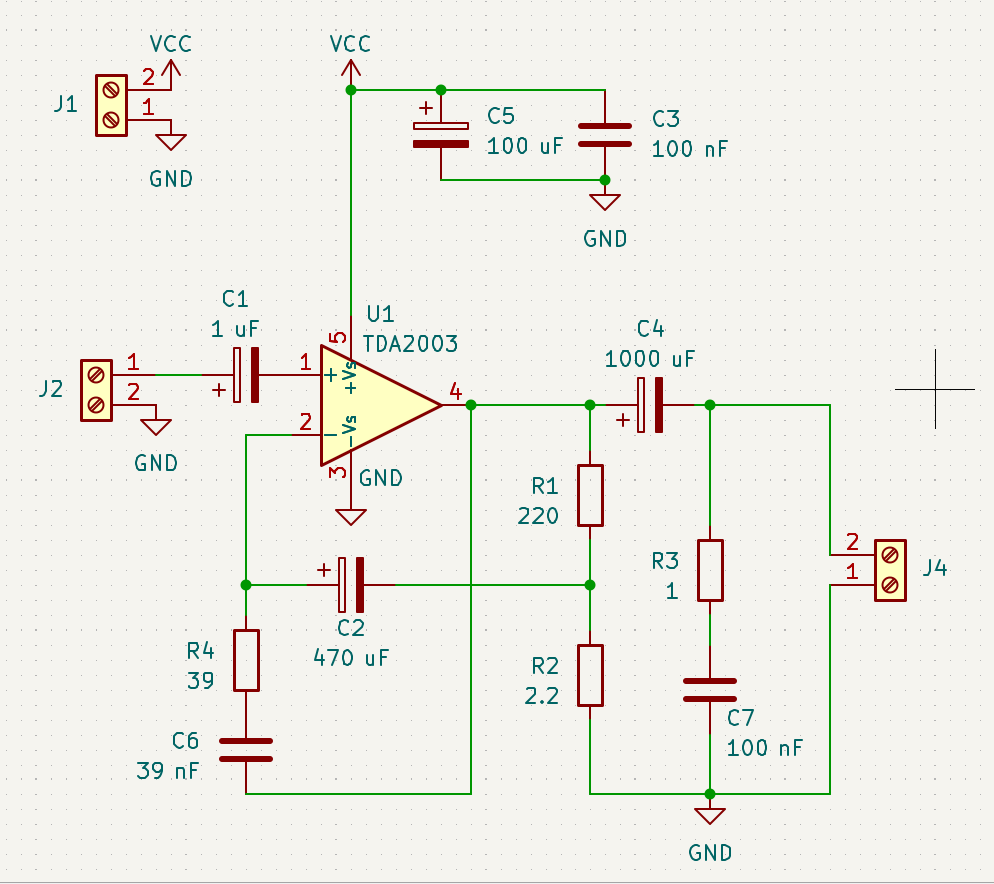 | 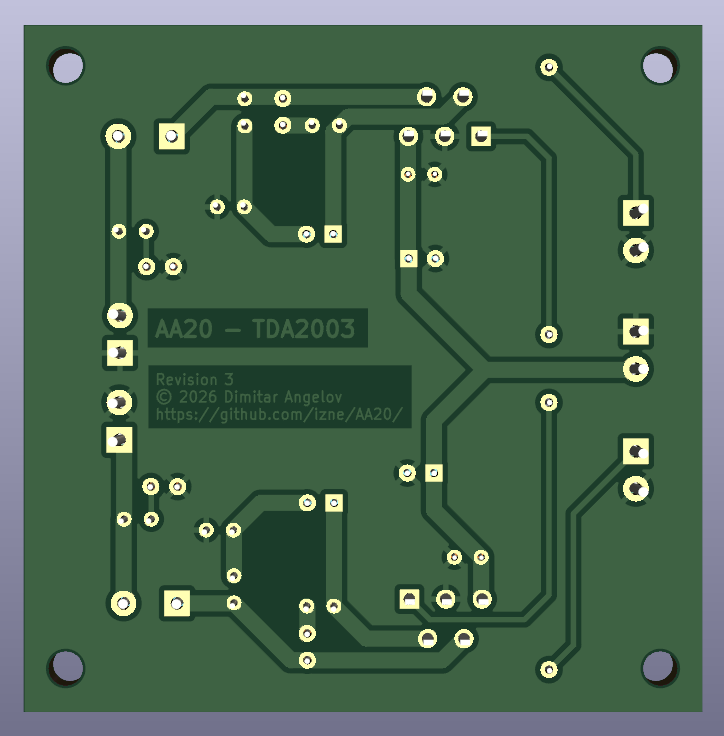 |
Signal/: KiCad project files (.kicad_pro, .kicad_sch, .kicad_pcb).Gerbers/Signal/: Production-ready Gerber files (rev3.zip).[Specify License, e.g., MIT]
| Qty | Value | Footprint | References |
|---|---|---|---|
| 5 | Screw_Terminal_01x02 | TerminalBlock_Phoenix:TerminalBlock_Phoenix_PT-1,5-2-3.5-H_1x02_P3.50mm_Horizontal | J1, J2, J3, J4, J5 |
| 4 | MountingHole | MountingHole:MountingHole_3.2mm_M3 | H1, H2, H3, H4 |
| 2 | 1 | Resistor_THT:R_Axial_DIN0204_L3.6mm_D1.6mm_P2.54mm_Vertical | R3, R8 |
| 2 | 1 uF | Capacitor_THT:C_Axial_L19.0mm_D8.0mm_P25.00mm_Horizontal | C1, C8 |
| 2 | 100 nF | Capacitor_THT:C_Disc_D5.0mm_W2.5mm_P2.50mm | C7, C14 |
| 2 | 100 nF | Capacitor_THT:C_Rect_L4.6mm_W2.0mm_P2.50mm_MKS02_FKP02 | C3, C12 |
| 2 | 100 uF | Capacitor_THT:CP_Radial_D6.3mm_P2.50mm | C5, C11 |
| 2 | 1000 uF | Capacitor_THT:CP_Radial_D12.5mm_P5.00mm | C4, C13 |
| 2 | 2.2 | Resistor_THT:R_Axial_DIN0204_L3.6mm_D1.6mm_P2.54mm_Vertical | R2, R7 |
| 2 | 220 | Resistor_THT:R_Axial_DIN0204_L3.6mm_D1.6mm_P2.54mm_Vertical | R1, R6 |
| 2 | 39 | Resistor_THT:R_Axial_DIN0204_L3.6mm_D1.6mm_P2.54mm_Vertical | R4, R5 |
| 2 | 39 nF | Capacitor_THT:C_Disc_D5.0mm_W2.5mm_P2.50mm | C6, C9 |
| 2 | 470 uF | Capacitor_THT:CP_Radial_D8.0mm_P2.50mm | C2, C10 |
| 2 | TDA2003 | Package_TO_SOT_THT:TO-220-5_P3.4x3.7mm_StaggerOdd_Lead3.8mm_Vertical | U1, U2 |
| 1 | LOGO | AA29_TDA2050:Angelov Amps Logo Baus2 | G*** |
| 1 | LOGO | AA29_TDA2050:Angelov Amps Logo | G*** |
It measures 63.5 × 64.3 mm and has 2 copper layers, 1.6 mm thick.
35 parts, built around the TDA2003. The full list of its parts is on this page, with links to each part's symbol and footprint where PCBKit's library has them.
From the izne/AA20 repository on GitHub, at the commit this page was made from: the board is Signal/Signal.kicad_pcb and its schematic Signal/Signal.kicad_sch. PCBKit opens the board in the browser, with nothing to install.
Its repository states no licence, so its author keeps all rights: ask izne before reusing the design.
slimcdk/sdb-xmas-train
Controller software for christmas train at Dagli'Brugsen Stjær

Carlos-Santos-prog/rc-car-esp32
Vehículo RC de combate con seguidor de línea basado en ESP32. Diseño electrónico completo en KiCad 10.


z0b1/nebulatune
NebulaTune is a HF reciever with a direct conversion single balanced diode product detector and a Si5351 as a local VFO. The VFO, encoder and the display are all controlled by the RP2350.


stonedDiscord/Automatenplatinen
Reverse engineerte Hardware aus deutschen Spielautomaten.