
2 layers50 × 35 mm

A tiny ARM microprocessor which fits in your USB port.
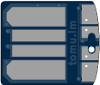
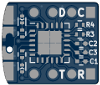
Tomu is an open-source printed circuit board by im-tomu, from the im-tomu/tomu-hardware repository on GitHub, published under the CC-BY-SA-4.0 licence. It is a 2-layer board of 13 × 9.4 mm with 17 parts on 23 nets, routed with 193 tracks and 25 vias.
Its parts include 4 resistors, 3 capacitors, 2 diodes, 1 IC and 1 connector. It belongs with the Silicon Labs (EFR32, EFM) boards of this library.
I'm Tomu a tiny ARM microprocessor which fits in your USB port. I have two buttons and two LEDs.
We're available on mailing lists and IRC:
Built out of a 3D printed part + 2 layer "thin" PCB. LCA2018 and Crowd Supply boards are 0.6mm.
Designs and documentation are available in:
The board requirements are very lo-fi:
The primary MCU is a Silicon Labs EFM32HG309 (datasheet, reference manual).
The important features are:
These make something which is almost hand solder-able fit into the tiny size.
All parts are available from Digikey, and are readily available from other suppliers.
The PCB is thinner than a USB socket, and has exposed contacts on the reverse side, so it needs a case in order to make proper contact with the USB pins, and to not short on the shield of the USB port.
Early prototypes used a business card that had been folded over, however the crowd funding campaign made enough to cut steel and make a case.
Designs are available in the case/ directory. Cases for earlier board versions tend to require higher tolerance on 3D printers.
The aim was to prove that a device which fits in your USB port could be created by hobbyists in small quantities extremely cheaply.
TOMU comes from the abbreviation "Tim's Open Micro USB".
What ever you want! If you do create something, please send me the info!
The contents of this repository excluding third_party
directory is released under your choice of the following two
licences:
| Qty | Value | Footprint | References |
|---|---|---|---|
| 2 | 100 Ohm, 1%, 1/16W, 0402 | Resistors_SMD:R_0402 | R1, R2 |
| 2 | 15 Ohm, 1%, 1/16W, 0402 | Resistors_SMD:R_0402 | R3, R4 |
| 2 | 1uF, 10V, X5R, 0402 | Capacitors_SMD:C_0402 | C1, C2 |
| 1 | 3V_PAD | usb-pcb:pads-1x1 | 3.3V |
| 1 | 4.7uF, 6.3V, X5R, 0402 | Capacitors_SMD:C_0402 | C3 |
| 1 | 5V_PAD | usb-pcb:pads-1x1 | USB power |
| 1 | Button solder mask removal | usb-pcb:soldermask-removal | XX1 |
| 1 | DEBUG | pads-1x3 | SWD headers |
| 1 | EFM32HG309 | Housings_DFN_QFN:QFN-24-1EP_5x5mm_Pitch0.65mm | U1 |
| 1 | LED Green 0402 | LEDs:LED_0402 | D1 |
| 1 | LED, Red, 0402 | LEDs:LED_0402 | D2 |
| 1 | RESET_PAD | usb-pcb:pads-1x1 | Reset |
| 1 | USART0 | pads-1x3-slim | Serial headers |
| 1 | USB-PCB | USB-PCB | P3 |


hoglet67/RGBtoHDMI
Bare-metal Raspberry Pi project that provides pixel-perfect sampling of Retro Computer RGB/YUV video and conversion to HDMI


hackclub/OnBoard
💡 Join 1,000 teenagers and make your first PCB with a $100 grant!

DDeGonge/OS-ARM
This arm is not industrial and it will not be fast, but that is not my goal. But it will hopefully be a very nice looking arm fully capable of 6dof motion, cheap enough to keep it accessable but capable enough to…


It measures 13 × 9.4 mm and has 2 copper layers, 0.6 mm thick.
17 parts. The full list of its parts is on this page, with links to each part's symbol and footprint where PCBKit's library has them.
From the im-tomu/tomu-hardware repository on GitHub, at the commit this page was made from: the board is pcb/tomu.kicad_pcb. PCBKit opens the board in the browser, with nothing to install.
Its repository publishes it under the CC-BY-SA-4.0 licence: you may reuse it on that licence's terms (keep the author's notice, and for a copyleft licence share your changes alike).