
2 layers101.6 × 55.9 mm
Clock
ifilot/sap-smd
Modular 8-bit computer built with TTL logic units to create a "Simple as Possible" system
72 parts2CERN-OHL-S-2.0

 ifilot/sap-smd2
Modular 8-bit computer built with TTL logic units to create a "Simple as Possible" system
Ramrom is an open-source printed circuit board by ifilot, from the ifilot/sap-smd repository on GitHub, published under the CERN-OHL-S-2.0 licence. It is a 2-layer board of 101.6 × 55.9 mm with 48 parts on 90 nets, routed with 1,585 tracks and 130 vias.
It is built around the 74HC245D, 74HC157D and 74HC02. Its parts include 19 diodes, 7 capacitors, 7 ICs, 4 connectors and 3 resistors. It belongs with the retro computing and games boards of this library.



This project showcases the design and construction of a modular 8-bit computer built with TTL logic units. The core principle behind the project is to create a "Simple as Possible" system, focusing on simplicity, modularity, and compactness.
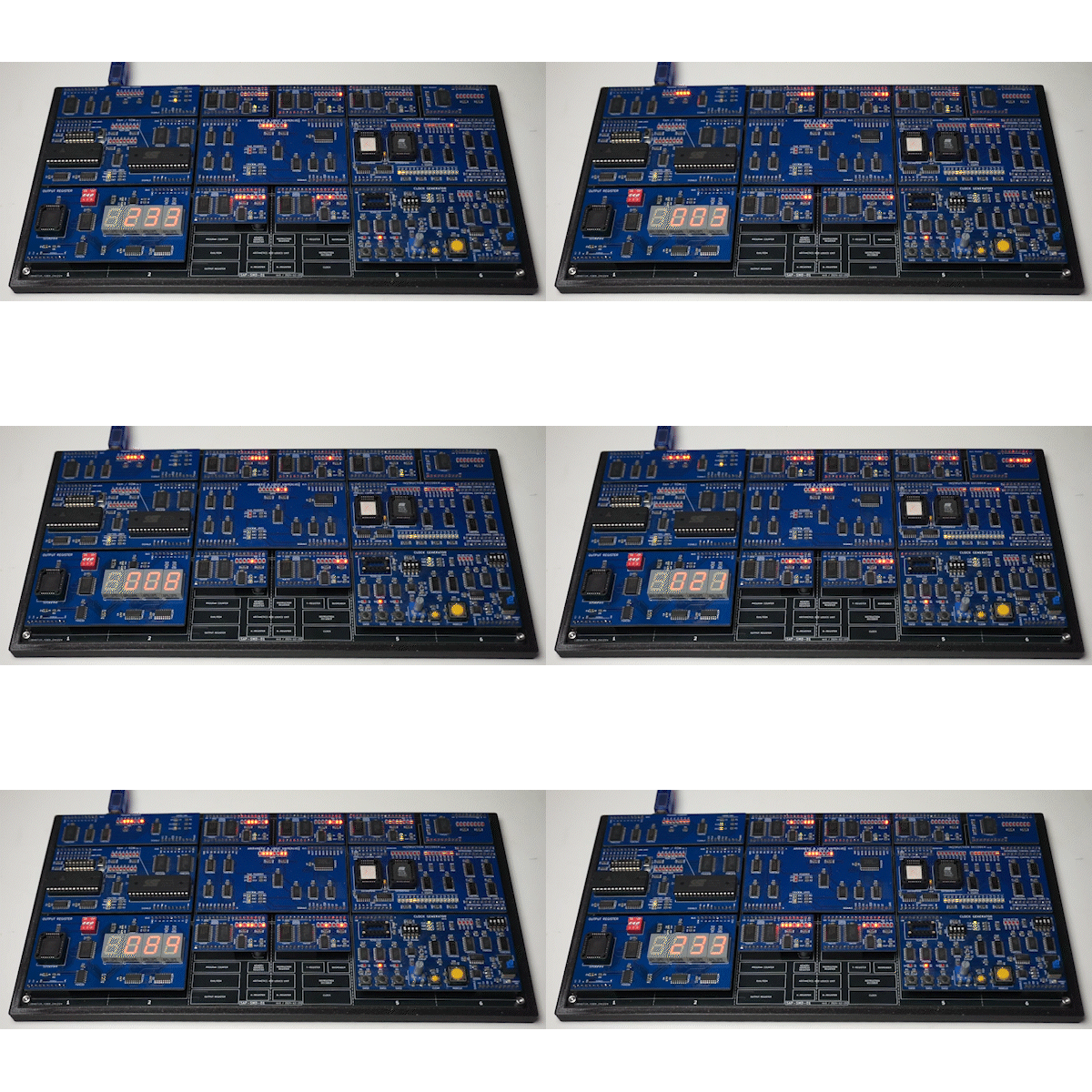
The project aims to:
SMD components offer several advantages:
This project is ideal for:
docs directory.Contributions to this project are welcome! If you have ideas for improvements, additional features, or alternative designs, feel free to fork the repository and submit a pull request.
| Qty | Value | Footprint | References |
|---|---|---|---|
| 7 | C | Capacitor_SMD:C_0805_2012Metric | C1, C2, C3, C4, C5, C6, C7 |
| 4 | 220 | Resistor_SMD:R_Array_Convex_4x0603 | RN3, RN4, RN5, RN6 |
| 3 | 330 | Resistor_SMD:R_0805_2012Metric | R1, R2, R3 |
| 2 | 10k | Resistor_SMD:R_Array_Convex_4x0603 | RN1, RN2 |
| 2 | 74HC157 | Package_SO:SO-16_3.9x9.9mm_P1.27mm | U3, U6 |
| 2 | 74HC245 | Package_SO:SO-20_12.8x7.5mm_P1.27mm | U5, U7 |
| 2 | D0 | LED_SMD:LED_0805_2012Metric | D1, D9 |
| 2 | D1 | LED_SMD:LED_0805_2012Metric | D2, D10 |
| 2 | D2 | LED_SMD:LED_0805_2012Metric | D3, D11 |
| 2 | D3 | LED_SMD:LED_0805_2012Metric | D4, D12 |
| 2 | D4 | LED_SMD:LED_0805_2012Metric | D5, D16 |
| 2 | D5 | LED_SMD:LED_0805_2012Metric | D6, D17 |
| 2 | D6 | LED_SMD:LED_0805_2012Metric | D7, D18 |
| 2 | D7 | LED_SMD:LED_0805_2012Metric | D8, D19 |
| 1 | 74HC02 | Package_SO:SO-14_3.9x8.65mm_P1.27mm | U4 |
| 1 | ADDR LOWER | Connector_PinHeader_2.54mm:PinHeader_1x10_P2.54mm_Vertical | J1 |
| 1 | ADDR UPPER | Connector_PinHeader_2.54mm:PinHeader_1x10_P2.54mm_Vertical | J2 |
| 1 | BUS | Connector_PinHeader_2.54mm:PinHeader_1x10_P2.54mm_Vertical | J3 |
| 1 | CY62256-70PC | Package_DIP:DIP-28_W15.24mm_Socket | U1 |
| 1 | RI | LED_SMD:LED_0805_2012Metric | D15 |
| 1 | RO | LED_SMD:LED_0805_2012Metric | D13 |
| 1 | RRO | LED_SMD:LED_0805_2012Metric | D14 |
| 1 | SIGNALS | Connector_PinHeader_2.54mm:PinHeader_1x10_P2.54mm_Vertical | J4 |
| 1 | SST39SF040 | Package_DIP:DIP-32_W15.24mm_Socket | U2 |
| 1 | SW_DIP_x08 | Button_Switch_THT:SW_DIP_SPSTx08_Slide_6.7x21.88mm_W7.62mm_P2.54mm_LowProfile | SW1 |
| 1 | SW_SPDT | Button_Switch_THT:SW_Slide_1P2T_CK_OS102011MS2Q | SW2 |
ifilot/sap-smd
Modular 8-bit computer built with TTL logic units to create a "Simple as Possible" system

ifilot/sap-smd
Modular 8-bit computer built with TTL logic units to create a "Simple as Possible" system

ifilot/sap-smd
Modular 8-bit computer built with TTL logic units to create a "Simple as Possible" system

ifilot/sap-smd
Modular 8-bit computer built with TTL logic units to create a "Simple as Possible" system

ifilot/sap-smd
Modular 8-bit computer built with TTL logic units to create a "Simple as Possible" system

ifilot/sap-smd
Modular 8-bit computer built with TTL logic units to create a "Simple as Possible" system

ifilot/sap-smd
Modular 8-bit computer built with TTL logic units to create a "Simple as Possible" system

ifilot/sap-smd
Modular 8-bit computer built with TTL logic units to create a "Simple as Possible" system

ifilot/sap-smd
Modular 8-bit computer built with TTL logic units to create a "Simple as Possible" system

ifilot/sap-smd
Modular 8-bit computer built with TTL logic units to create a "Simple as Possible" system

slu4coder/Minimal-64x4-Home-Computer
My DIY TTL home computer with VGA and PS/2 and 4x the processing power of a Commodore C64 or Apple II.


benanderman/spork-8
An 8-bit CPU, made with TTL chips on custom, modular PCBs. Includes board designs, and Arduino code to program its instruction set and programs.

ifilot/p2000t-ram-expansion-board
RAM expansion board for the P2000T


It measures 101.6 × 55.9 mm and has 2 copper layers, 1.6 mm thick.
48 parts, built around the 74HC245D, 74HC157D and 74HC02. The full list of its parts is on this page, with links to each part's symbol and footprint where PCBKit's library has them.
From the ifilot/sap-smd repository on GitHub, at the commit this page was made from: the board is pcb/components/ramrom/ramrom.kicad_pcb and its schematic pcb/backplates/bp-leanplate/bp-leanplate.kicad_sch. PCBKit opens the board in the browser, with nothing to install.
Its repository publishes it under the CERN-OHL-S-2.0 licence: you may reuse it on that licence's terms (keep the author's notice, and for a copyleft licence share your changes alike).