
2 layers245.1 × 160 mm
8-Bit CPU 32k
slu4coder/Minimal-64x4-Home-Computer
My DIY TTL home computer with VGA and PS/2 and 4x the processing power of a Commodore C64 or Apple II.
139 parts326

 ifilot/p2000t-simple-cartridge
Kicad source files and assembly source code for useful P2000T hardware
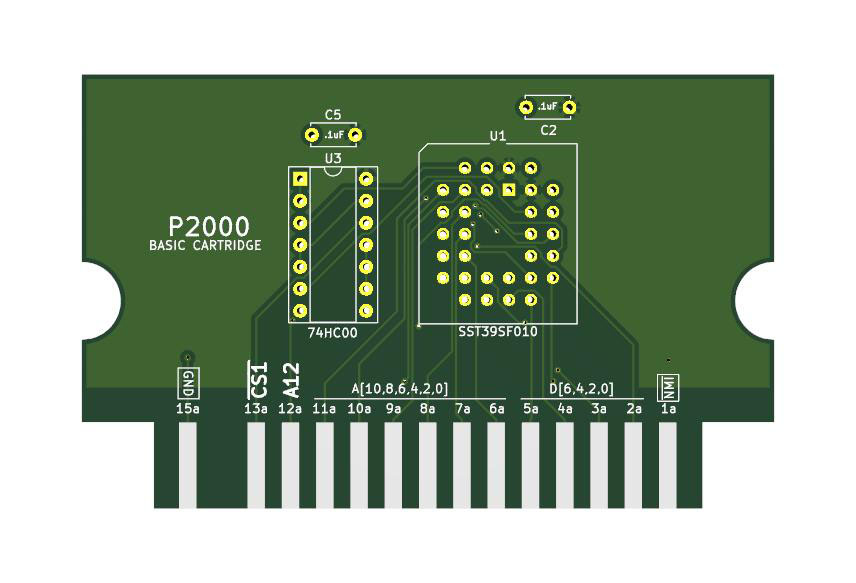
Basic cartridge is an open-source printed circuit board by ifilot, from the ifilot/p2000t-simple-cartridge repository on GitHub. It is a 2-layer board of 80 × 50.2 mm with 5 parts on 32 nets, routed with 274 tracks and 14 vias.
It is built around the 74HC00D. Its parts include 2 capacitors, 2 ICs and 1 connector. It belongs with the retro computing and games boards of this library.


This repository contains a simple example on how to build your own cartridge for the P2000T.
For more information, see this blog post.
Compile the assembly file via:
cd assembly
make
and flash the resulting hello_world.bin file to the EEPROM.
See also this repository for a cheap PICO-based SST39SF0x0 flasher.
| Qty | Value | Footprint | References |
|---|---|---|---|
| 2 | .1uF | Capacitor_THT:C_Disc_D5.0mm_W2.5mm_P5.00mm | C2, C5 |
| 1 | 74HC00 | Package_DIP:DIP-14_W7.62mm_Socket | U3 |
| 1 | P2000T_cartridge_edge | p2000t_cartridge:p2000t_cartridge_edge | J1 |
| 1 | SST39SF010 | Package_LCC:PLCC-32_THT-Socket | U1 |
slu4coder/Minimal-64x4-Home-Computer
My DIY TTL home computer with VGA and PS/2 and 4x the processing power of a Commodore C64 or Apple II.

slu4coder/Minimal-UART-Computer-1-2
Legacy: Version 1 and 2 of my TTL-only CPU featuring UART I/O, an expansion port, 512KB SSD at up to 10MHz clock speed


Kris-Sekula/EPROM-EMU-NG
EPROM Emulator Project with Arduino


tebl/BE6502-Build-a-65c02-computer
A PCB being made while watching Ben Eaters "Build a 6502 computer" video series. Includes the computer itself, a standalone slow clock and an Arduino Mega shield for the bus monitor sketch..

slu4coder/Minimal-64-Home-Computer
Legacy: Full TTL-only home computer with VGA and PS/2 and twice the processing power of a Commodore 64

It measures 80 × 50.2 mm and has 2 copper layers, 1.6 mm thick.
5 parts, built around the 74HC00D. The full list of its parts is on this page, with links to each part's symbol and footprint where PCBKit's library has them.
From the ifilot/p2000t-simple-cartridge repository on GitHub, at the commit this page was made from: the board is pcb/basic_cartridge/basic_cartridge.kicad_pcb and its schematic pcb/basic_cartridge/basic_cartridge.kicad_sch. PCBKit opens the board in the browser, with nothing to install.
Its repository states no licence, so its author keeps all rights: ask ifilot before reusing the design.