2 layers40 × 20 mm
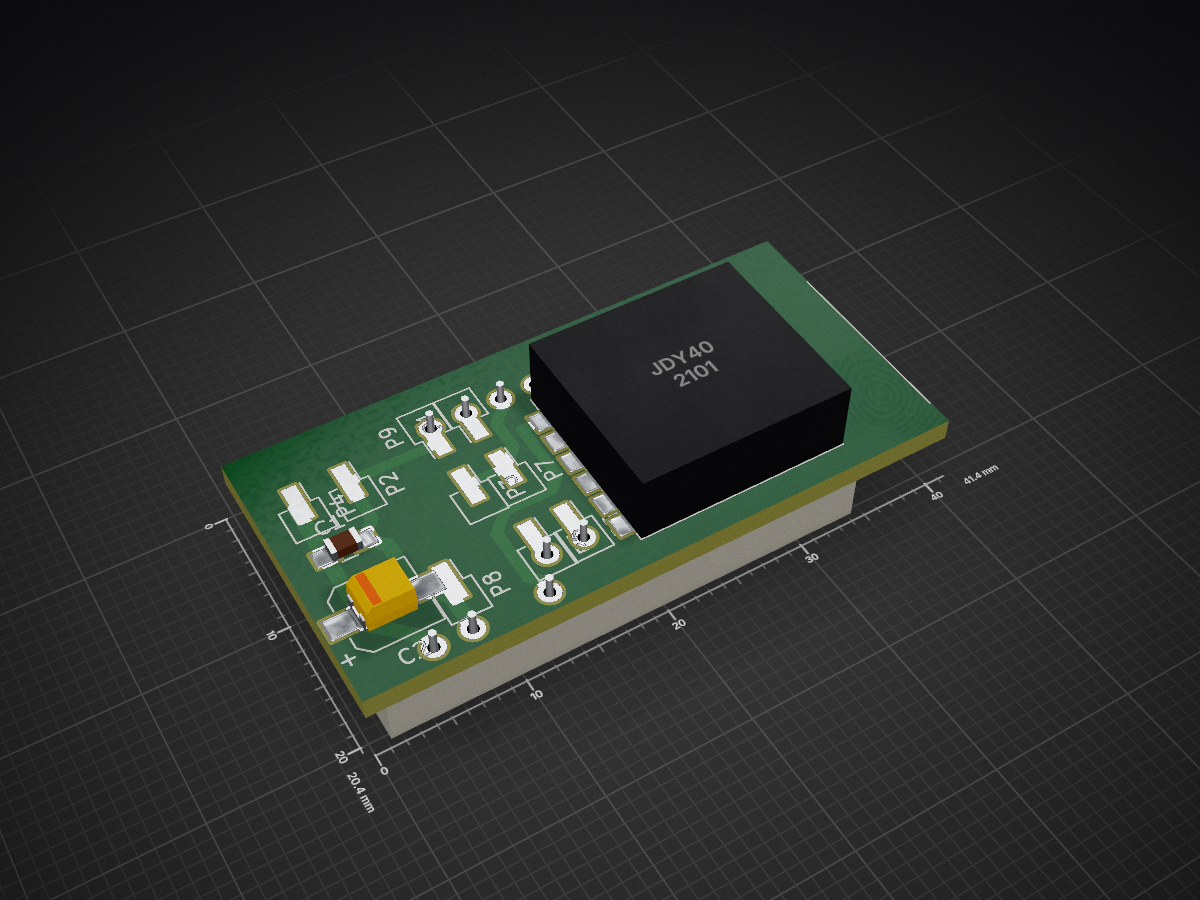
 ieb/WindSensor1
RF WindSensor device using 12bit position sensor and 2.4GHz RF emitting raw readings at 5Hz.
WindSensor is an open-source printed circuit board by ieb, from the ieb/WindSensor repository on GitHub. It is a 2-layer board with 13 parts on 11 nets, routed with 54 tracks and 0 vias.
Its parts include 9 connectors, 2 capacitors and 2 ICs. It belongs with the sensors and measurement boards of this library.
This project contains the code and designed for a long arm sailing wind sensor. Standard wind sensors are fine for most sails but they fail to acurately measure wind angle down wind where they are in the flow of the air from the mainsail. This is partically bad where the mainsail has a large flat top. (Class40, Pogo1250, etc). The solution is to put the windsensor on a 1m-1.8m carbon mast above the masthead. Commercially these sensors start at 1K GBP and for 1.8m sensors expect to pay 4K GBP. Hence this project attempts to create a wind sensor using opensource components.
Construction The housing is 3D printed in ABS. The mast is laminated in carbon fibre.
Communications Raymarine uses a 2 axis hall device generating sin/cos voltages and a pulse for speed. The circuit is complex, large and suceptable to errors in the voltages due to the length of wire run and poor connections. For that reason, although I currently have a Raymarine wind sensor I decided not to duplicate.
The device will communicates with RF using a Beken BK2491 chipset configured in the form a a JDY-40 runing at 2Mb/s bursting a serial stream at 9600 baud.
https://www.mikrocontroller.net/attachment/381910/BT-WiFi-52rf5541.pdf https://www.electrodragon.com/w/images/0/05/EY-40_English_manual.pdf
The data sent over RF has 2 forms running at between 5-10Hz, both comma seperated values with a CRC16 checksum.
The protocol is proprietary and compact. A single line of csv readings without interpretation including the reading from the possition sensor 12bit representing 0-360 and the number of nano seconds for half a revolution (64bit).
Measurements.
The measurements including writing to the serial take 4ms to complete. Resolution of the AS5600 is 0.1 degrees. The code measures the pulse period directly since at low speed counting pulses is inacurage. Slowest speed is 1 revolution every 64s which is 0.01Kn. Highest is probably limimited mechanically but is well over 100kn (tested with a drill driving the shaft)
Calibration Curve for AS5600, depends completly on the hardware setup.
    0,709,69,2070
    10,822,69,2078
    20,939,69,2083
    30,1049,69,2086
    40,1167,69,2090
    50,1283,69,2092
    60,1396,69,2098
    70,1512,69,2104
    80,1625,69,2110
    90,1736,69,2117
    100,1853,69,2117
    110,1964,69,2113
    120,2082,69,2112
    130,2196,69,2126
    140,2308,69,2122
    150,2423,69,2117
    160,2536,69,2120
    170,2649,69,2122
    180,2762,69,2119
    190,2874,69,2112
    200,2987,67,2106
    210,3103,67,2096
    220,3216,67,2087
230,3326,67,2081Conversion to degrees is 360*(m-offset)/4096. Average error is 0.3 degrees, There appears to be a sinusoidal error associated with magnet offset, although this is not large enough to be of concern or to both fixing. Just as likely to be a measurement error.
Conversion and linearisation will be done in the base station, not in the masthead sensor.
Problems encountered
FLoating dir pin on the AS5600 causes erratic readings. AGC of 50-70 and Flux magnitude of 2000+ gives very stable readings, magnet is a 6mmx4mm Samarium Cobalt Magnet magnet with 0.3kg pull https://www.magnetexpert.com/magnet-materials-standard-assemblies-c150/6mm-dia-x-4mm-thick-diametrically-magnetised-samarium-cobalt-magnet-0-3kg-pull-p3517
The 3144 needs magnets to pass 1mm or less from the surface using 3mmx1mm N35 Neodymium magnet with 0.13kg pull (using 2x)
Initial attempts to use RS-485 and RS-422 failed due to current consumption runnng the drivers exceeding the output available from the Pro Mini. Also managed to blow multiple Pro Mini's and 1 AS5600 when testing with long wires. the JDY-40 appears to have at least 50m range though walls and metal roofs with minimal data corruption.
| Qty | Value | Footprint | References |
|---|---|---|---|
| 2 | GND | Pin_Headers:Pin_Header_Straight_1x01_Pitch2.54mm_SMD_Pin1Left | P8, P9 |
| 2 | SP | Pin_Headers:Pin_Header_Straight_1x01_Pitch2.54mm_SMD_Pin1Left | P1, P4 |
| 1 | 0V | Pin_Headers:Pin_Header_Straight_1x01_Pitch2.54mm_SMD_Pin1Left | P2 |
| 1 | 10nF | Capacitors_SMD:CP_Elec_5x5.8 | C2 |
| 1 | 10nF | Capacitors_SMD:C_0805_HandSoldering | C1 |
| 1 | 3v3 | Pin_Headers:Pin_Header_Straight_1x01_Pitch2.54mm_SMD_Pin1Left | P3 |
| 1 | 5V | Pin_Headers:Pin_Header_Straight_1x01_Pitch2.54mm_SMD_Pin1Left | P7 |
| 1 | ArdinoMinPro | Divers:ArduinoProMini | U1 |
| 1 | JDY40 | Divers:JDY-40 | U3 |
| 1 | SCL | Pin_Headers:Pin_Header_Straight_1x01_Pitch2.54mm_SMD_Pin1Left | P6 |
| 1 | SDA | Pin_Headers:Pin_Header_Straight_1x01_Pitch2.54mm_SMD_Pin1Left | P5 |
13 parts. The full list of its parts is on this page, with links to each part's symbol and footprint where PCBKit's library has them.
From the ieb/WindSensor repository on GitHub, at the commit this page was made from: the board is pcb/WindSensor.kicad_pcb. PCBKit opens the board in the browser, with nothing to install.
Its repository states no licence, so its author keeps all rights: ask ieb before reusing the design.


samyk/magspoof
A portable device that can spoof/emulate any magnetic stripe, credit card or hotel card "wirelessly", even on standard magstripe (non-NFC/RFID) readers.

fossasia/pslab-scripts
Pocket Science Lab - Scripts for Sensor Experiments


willem-pennings/balancing-cube
A cube that balances itself in a corner or edge using reaction wheels

VoronDesign/Voron-Hardware
Cool Hardware designed by the Voron Design group

hoglet67/RGBtoHDMI
Bare-metal Raspberry Pi project that provides pixel-perfect sampling of Retro Computer RGB/YUV video and conversion to HDMI