2 layers64 × 78 mm
Actuator board
ieb/autopilot
An ML Autopilot designed and written almost entirely by Google AntiGravity.
37 parts
 ieb/FlowSensor
Temperature Dispersion Flow Sensor for Raw Water Cooled marine engines.
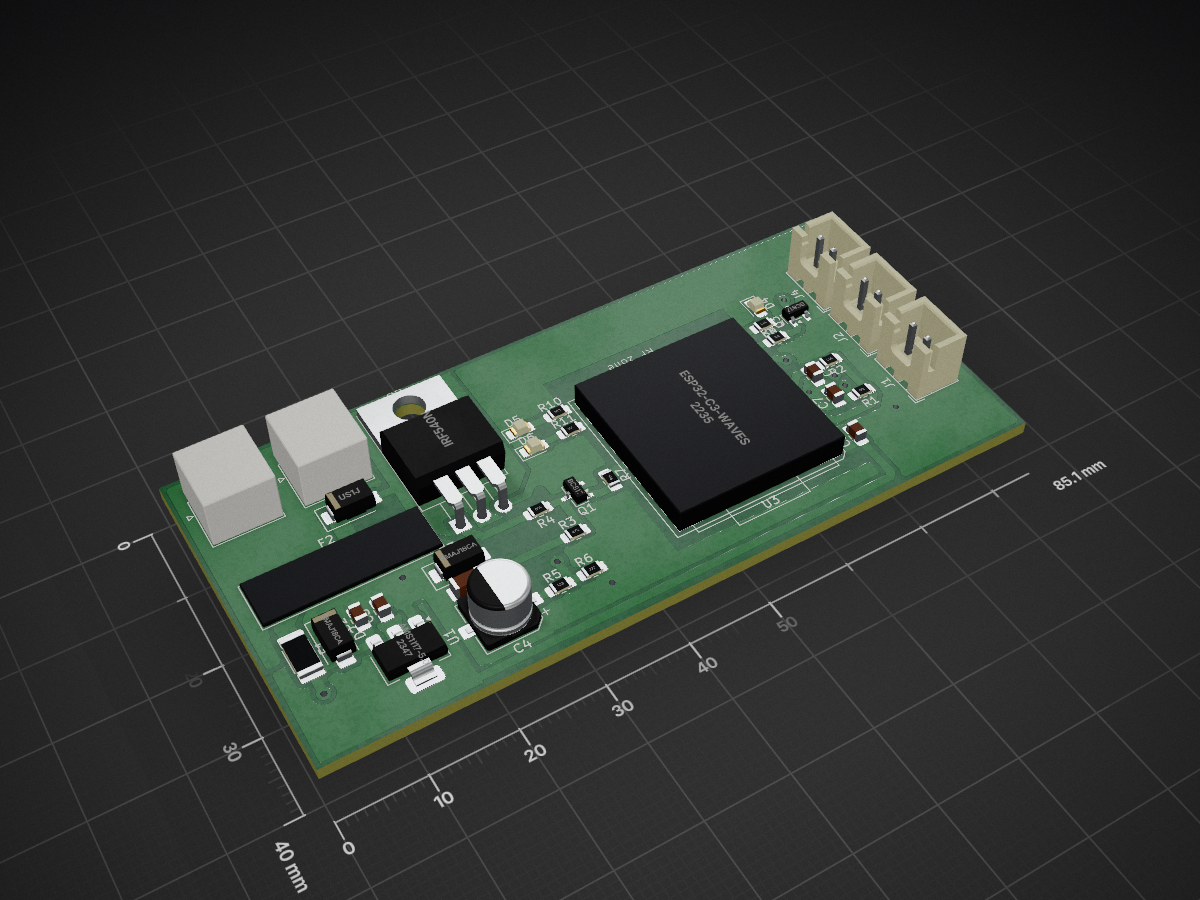
Esp32c flowsensor is an open-source printed circuit board by ieb, from the ieb/FlowSensor repository on GitHub. It is a 2-layer board of 85.1 × 40 mm with 36 parts on 30 nets, routed with 200 tracks and 10 vias.
It is built around the AMS1117-5.0, BC817 and SMAJ18CA, with the IRF540N and US1J among its other parts. Its parts include 11 resistors, 7 capacitors, 6 diodes, 5 connectors and 3 transistors. It belongs with the sensors and measurement boards and the ESP32 and RISC-V boards of this library.


This project has got to the state of building a prototype sensor, but testing has indicated that measuring the temperature and rate of change of temperature of the exaust elbow on a water cooled exhaust relative to the engine coolant temperature is a very effective early warning system. The heat source, engine exhaust is in the kw range. The cooling source is the same, when the cooling source reduces the temperature of the water cooled elbo rises rapidly triggering an alarm within 5s, evidenced by live data recorded from 2 engine overheats, one slow and one fast. On that basis, I am not taking this project further. See N2KEngine project for more details.
The aim is to build a simple temperature difussion flow sensor to monitor and warn about conditions that would permanently damage a impeller pump as used on raw water cooling for marine engines. In my case a Volvo Penta D2-40 which has a F4B-9 pump prone to running dry as a result of suction caused by the boat when sailing. If these pumps run dry for more than 30s as can happend on startup, they overhead and fail with broken vanes and damaged sealing. When they are unable to overcome the back pressure from the wet exaust system, the engine rapidly overheats within a few miniutes. The F4B pumps are more susceptable than the larger models becuase they only have 6 impeller vanes so if only 1 fails the seal is broken and they suck dry when sailing above 8kn. The service life is less than 50h although the manual states 500h or once yearly. Failure can happen at any time, typically preceded by lower flow levels when running.
| Qty | Value | Footprint | References |
|---|---|---|---|
| 8 | 10K | Resistor_SMD:R_0805_2012Metric_Pad1.20x1.40mm_HandSolder | R1, R2, R5, R7, R8, R9, R10, R11 |
| 3 | 100nF | Capacitor_SMD:C_0805_2012Metric_Pad1.18x1.45mm_HandSolder | C1, C6, C7 |
| 3 | LED | LED_SMD:LED_0805_2012Metric_Pad1.15x1.40mm_HandSolder | D4, D5, D6 |
| 2 | 10uF | Capacitor_SMD:C_0805_2012Metric_Pad1.18x1.45mm_HandSolder | C2, C3 |
| 2 | BC817 | Package_TO_SOT_SMD:SOT-23 | Q1, Q3 |
| 2 | SMAJ18CA | Diode_SMD:D_SMA | D2, D3 |
| 1 | 10R | Resistor_SMD:R_0805_2012Metric_Pad1.20x1.40mm_HandSolder | R4 |
| 1 | 12V In | Connector_JST:JST_VH_B2P-VH_1x02_P3.96mm_Vertical | J5 |
| 1 | 1uF | Capacitor_SMD:C_1206_3216Metric | C5 |
| 1 | 2K2 | Resistor_SMD:R_0805_2012Metric_Pad1.20x1.40mm_HandSolder | R6 |
| 1 | 47uF | Capacitor_SMD:CP_Elec_6.3x5.4 | C4 |
| 1 | 4K7 | Resistor_SMD:R_0805_2012Metric_Pad1.20x1.40mm_HandSolder | R3 |
| 1 | 500mA | Resistor_SMD:R_2010_5025Metric_Pad1.40x2.65mm_HandSolder | F1 |
| 1 | 5A | Fuse:Fuse_Blade_ATO_directSolder | F2 |
| 1 | ALARM | Connector_JST:JST_XH_B2B-XH-A_1x02_P2.50mm_Vertical | J4 |
| 1 | AMS1117-5.0 | Package_TO_SOT_SMD:SOT-223-3_TabPin2 | U1 |
| 1 | ESP32-C3-Waveshare | iebSpecials:ESP-C3-Zero-Waveshare | U3 |
| 1 | Heater | Connector_JST:JST_VH_B2P-VH_1x02_P3.96mm_Vertical | J3 |
| 1 | IRF540N | Package_TO_SOT_THT:TO-220-3_Horizontal_TabDown | Q2 |
| 1 | NTC1 | Connector_JST:JST_XH_B2B-XH-A_1x02_P2.50mm_Vertical | J1 |
| 1 | NTC2 | Connector_JST:JST_XH_B2B-XH-A_1x02_P2.50mm_Vertical | J2 |
| 1 | US1J | Diode_SMD:D_SMA | D1 |
It measures 85.1 × 40 mm and has 2 copper layers, 1.6 mm thick.
36 parts, built around the AMS1117-5.0, BC817, SMAJ18CA and IRF540N. The full list of its parts is on this page, with links to each part's symbol and footprint where PCBKit's library has them.
From the ieb/FlowSensor repository on GitHub, at the commit this page was made from: the board is pcb/esp32c-flowsensor/esp32c-flowsensor.kicad_pcb and its schematic pcb/esp32c-flowsensor/esp32c-flowsensor.kicad_sch. PCBKit opens the board in the browser, with nothing to install.
Its repository states no licence, so its author keeps all rights: ask ieb before reusing the design.
ieb/autopilot
An ML Autopilot designed and written almost entirely by Google AntiGravity.

emiirkaya/ThermovitalSync-PCB
A PCB project for a vital monitoring-cooling device with GUI


kwiecinski/BMS-and-offgrid-photovoltaic-management-system
Project contains BMS for lead-acid batteries and ESP-based board used to pull information from EASUN offgrid inverter, energy meters and sensors.

plewka/ESP-Solar_OpenDTU
PCB for OpenDTU in Cable Branchbox, LineSupply w. Fuses, RS485/RS232-Olimex, Relais, DS2485 OneWire, I2C-Header...

BOAB235/Design_of_1200W_LLC_DCDC
In battery electric vehicles (BEVs) and 48 V mild-hybrid architectures, a high-voltage DC-DC converter steps the 300–400 V traction battery bus down to the 48 V auxiliary rail that powers lighting, HVAC blowers…


Teille98/HVGene-OpenHardware
Open-source, digitally controlled high-voltage AC power supply for cold atmospheric plasma (CAP) research, developed with a specific focus on flexible-endoscope decontamination applications.