
2 layers40.6 × 110 mm
Europi surface mount
Allen-Synthesis/EuroPi
EuroPi: A reprogrammable Eurorack module based on the Raspberry Pi Pico
92 parts584CC0-1.0

 ibrahimjarallah/5Volt_Power_Supply2
L7805-based 5V regulated power supply PCB — designed in KiCad 9.0. Full-wave bridge rectifier, multi-stage filtering, schematic, Gerbers, BOM, 2D/3D views.
5Volt Power Supply is an open-source printed circuit board by ibrahimjarallah, from the ibrahimjarallah/5Volt_Power_Supply repository on GitHub. It is a 2-layer board of 65.8 × 27.8 mm with 16 parts on 6 nets, routed with 42 tracks and 3 vias.
It is built around the L7805. Its parts include 5 diodes, 3 capacitors, 2 connectors, 1 resistor and 1 IC. It belongs with the power boards of this library.
A classic linear regulated 5V power supply built around the L7805 voltage regulator.
Full-wave bridge rectifier input, multi-stage filtering, and power LED indicator.
Designed and laid out in KiCad 9.0 — schematic + 2-layer PCB with full fabrication outputs.
| Front | Back |
|---|---|
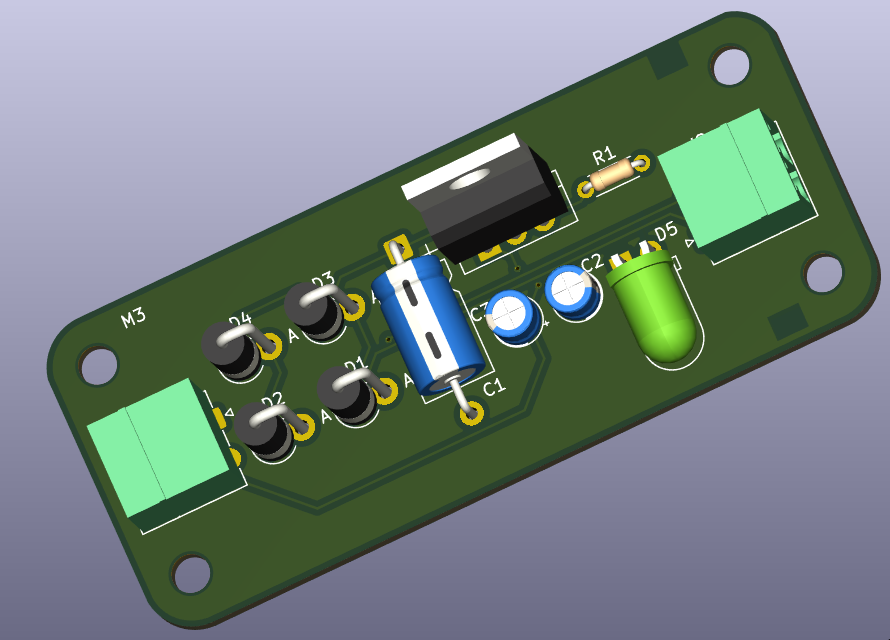 | 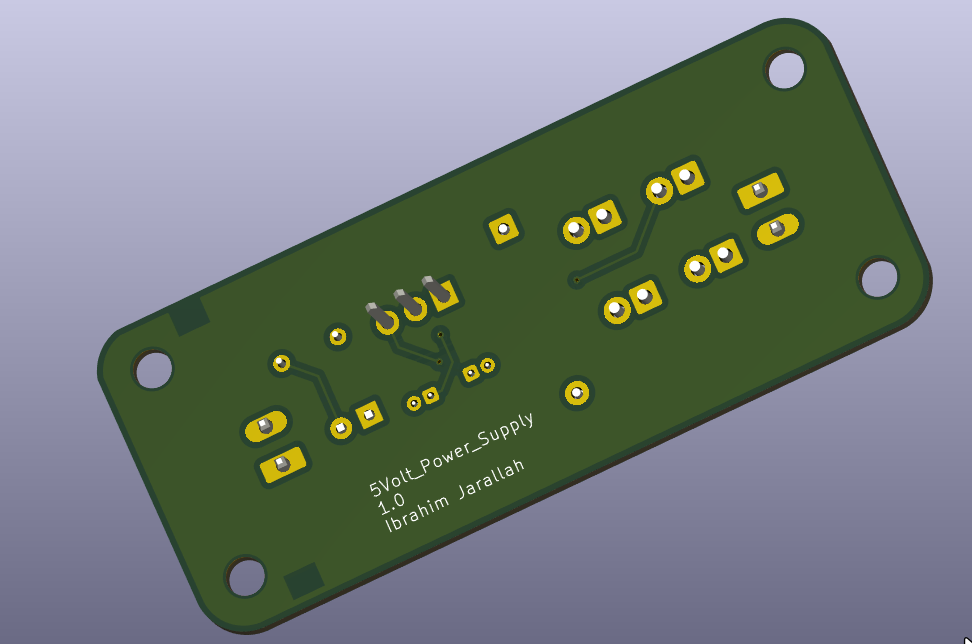 |
| Front | Back |
|---|---|
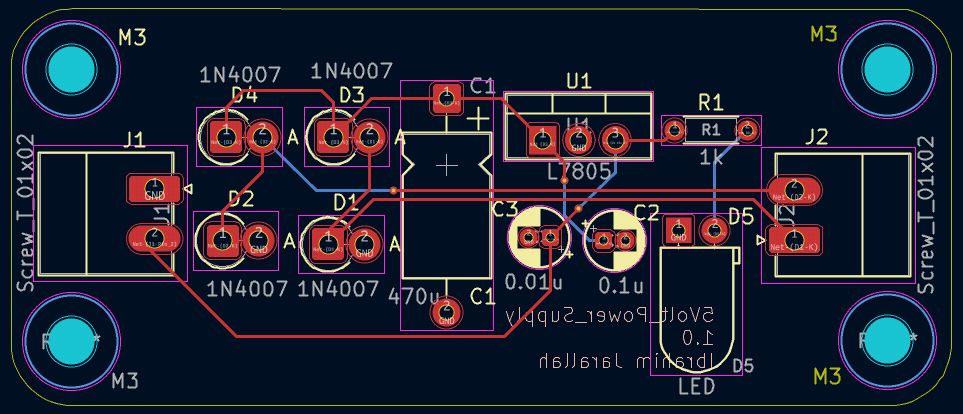 | 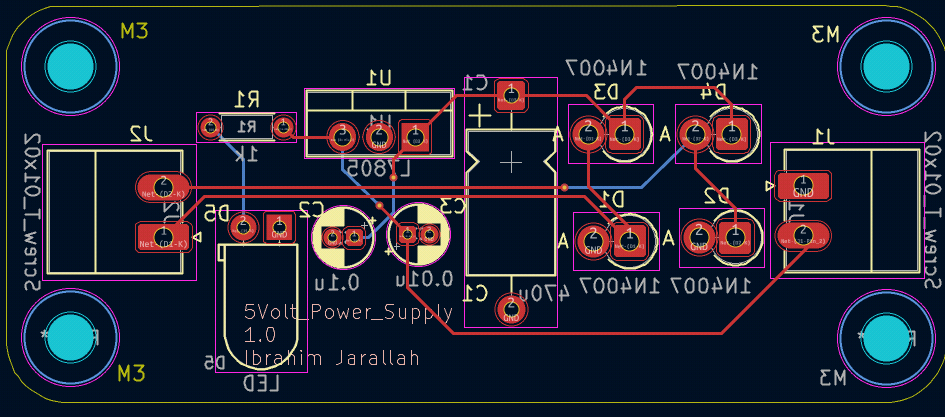 |
| Front | Back |
|---|---|
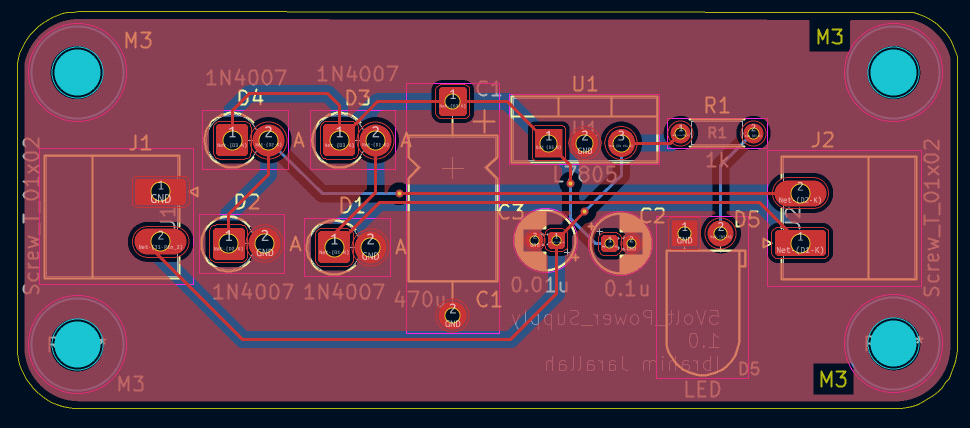 | 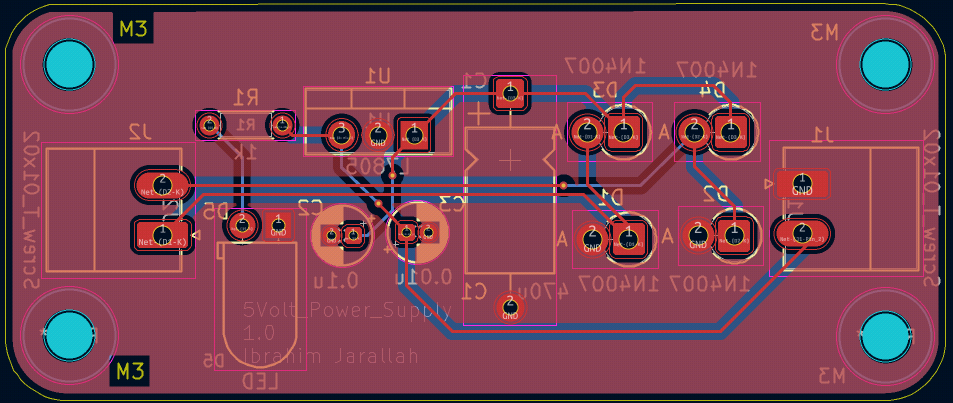 |
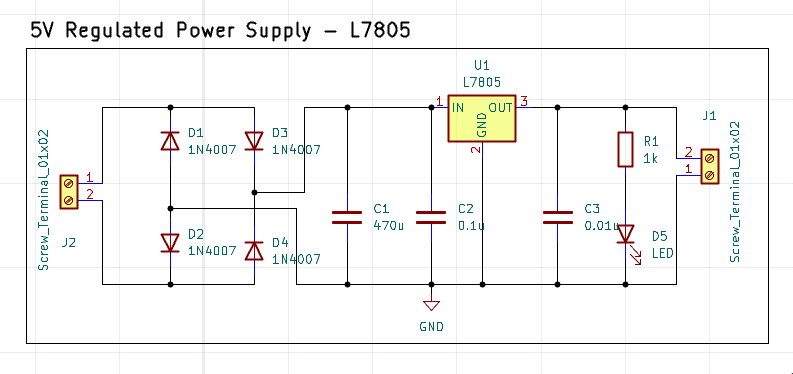
| Parameter | Value |
|---|---|
| Input Voltage (AC) | 9V AC (transformer secondary) |
| Rectified DC (unregulated) | ~12.7V DC |
| Output Voltage | 5V DC regulated |
| Max Output Current | 500mA continuous (no heatsink) |
| Regulator | L7805 (TO-220) |
| Rectifier | Full-wave bridge — 4× 1N4007 |
| Bulk Capacitance | 470µF |
| PCB Layers | 2 |
| Designed With | KiCad 9.0.7 |
Four 1N4007 diodes arranged in a full-wave bridge configuration convert the 9V AC transformer secondary into pulsating DC (~12.7V peak).
A three-stage capacitor filter smooths the rectified DC:
The L7805 linear regulator drops the unregulated ~12.7V down to a stable 5V DC output, regardless of load variations up to 500mA.
D5 (LED) with R1 (1kΩ) current-limiting resistor provides a visual power-on indication.
LED current ≈ (5V − 2V) / 1kΩ ≈ 3mA.
Two Phoenix Contact screw terminals (J1, J2) — 3.5mm pitch — for robust AC input and DC output connections.
| ID | Designator | Description | Quantity | Footprint |
|---|---|---|---|---|
| 1 | U1 | L7805 Voltage Regulator | 1 | TO-220-3 Vertical |
| 2 | D1–D4 | Diode 1N4007 (Bridge Rectifier) | 4 | DO-15 P2.54mm Vertical AnodeUp |
| 3 | D5 | LED 5mm | 1 | LED D5.0mm Horizontal |
| 4 | C1 | Capacitor 470µF electrolytic | 1 | Axial L10.0mm D6.0mm P15.00mm |
| 5 | C2 | Capacitor 0.1µF | 1 | Radial D4.0mm P1.50mm |
| 6 | C3 | Capacitor 0.01µF | 1 | Radial D4.0mm P1.50mm |
| 7 | R1 | Resistor 1kΩ | 1 | Axial DIN0204 L3.6mm P5.08mm |
| 8 | J1, J2 | Screw Terminal 2-pin 3.5mm | 2 | PhoenixContact MC 1.5/2-G-3.5 |
5Volt_Power_Supply/
├── 5Volt_Power_Supply.kicad_pro     # KiCad project file
├── 5Volt_Power_Supply.kicad_sch     # Schematic
├── 5Volt_Power_Supply.kicad_pcb     # PCB layout
├── BOM/
│   └── 5Volt_Power_Supply.csv       # Bill of materials
├── netlist/
│   └── 5Volt_Power_Supply.net       # Netlist
├── gerbers/                         # Fabrication Gerber files
│   ├── 5Volt_Power_Supply-F_Cu.gbr
│   ├── 5Volt_Power_Supply-B_Cu.gbr
│   ├── 5Volt_Power_Supply-F_Mask.gbr
│   ├── 5Volt_Power_Supply-B_Mask.gbr
│   ├── 5Volt_Power_Supply-F_Silkscreen.gbr
│   ├── 5Volt_Power_Supply-B_Silkscreen.gbr
│   ├── 5Volt_Power_Supply-F_Paste.gbr
│   ├── 5Volt_Power_Supply-B_Paste.gbr
│   ├── 5Volt_Power_Supply-Edge_Cuts.gbr
│   └── 5Volt_Power_Supply-job.gbrjob
├── drills/
│   ├── 5Volt_Power_Supply-PTH.drl   # Plated through-holes
│   └── 5Volt_Power_Supply-NPTH.drl  # Non-plated through-holes
├── 3D_VIEW/
│ ├── front_3d.pnggit clone https://github.com/ibrahimjarallah/5Volt_Power_Supply.git5Volt_Power_Supply.kicad_pro in KiCadAll fabrication outputs are ready in the gerbers/ and drills/ folders.
Compatible with standard PCB manufacturers (JLCPCB, PCBWay, OSHPark, etc.).
5Volt_Power_Supply-job.gbrjob directly into any Gerber viewer or fab upload portalPTH (plated) and NPTH (non-plated) provided separatelyThis project is licensed under the MIT License.
You are free to use, modify, and distribute it with attribution.
Ibrahim Jarallah
GitHub: ibrahimjarallah
LinkedIn: ibrahimjarallah
| Qty | Value | Footprint | References |
|---|---|---|---|
| 4 | 1N4007 | Diode_THT:D_DO-15_P2.54mm_Vertical_AnodeUp | D1, D2, D3, D4 |
| 2 | MountingHole_3.2mm_M3 | MountingHole:MountingHole_3.2mm_M3 | M3, M3 |
| 2 | Screw_T_01x02 | Connector_Phoenix_MC:PhoenixContact_MC_1,5_2-G-3.5_1x02_P3.50mm_Horizontal | J1, J2 |
| 1 | 0.01u | Capacitor_THT:CP_Radial_D4.0mm_P1.50mm | C3 |
| 1 | 0.1u | Capacitor_THT:CP_Radial_D4.0mm_P1.50mm | C2 |
| 1 | 1k | Resistor_THT:R_Axial_DIN0204_L3.6mm_D1.6mm_P5.08mm_Horizontal | R1 |
| 1 | 470u | Capacitor_THT:CP_Axial_L10.0mm_D6.0mm_P15.00mm_Horizontal | C1 |
| 1 | L7805 | Package_TO_SOT_THT:TO-220-3_Vertical | U1 |
| 1 | LED | LED_THT:LED_D5.0mm_Horizontal_O1.27mm_Z3.0mm | D5 |
The 14 most common of 16 parts.
Allen-Synthesis/EuroPi
EuroPi: A reprogrammable Eurorack module based on the Raspberry Pi Pico

peterheinrich/InternetOverSpaghetti
Transmitting IP packages over a pair of spaghetti thus demonstrating how media independent IP really is.


Tircown/ERCF-easy-brd
More informations on how to reset for flashing:\ https://wiki.seeedstudio.com/Seeeduino-XIAO/#enter-bootloader-mode

matthewcieplak/super-sixteen
Code and schematics for the Super Sixteen Eurorack sequencer

NikodemBartnik/Mini-Mars-Rover
Educational robotic platform made to look like a mini mars rover

starlightk7/OpenSFC
OSHW Reproduction Parts related to the Super Famicom / Super Nintendo game console

Redherring32/OpenTendo-TopLoader
An Open Source HardWare (OSHW) recreation of the 1993 toploading NES motherboard (Also known as NES-101)
It measures 65.8 × 27.8 mm and has 2 copper layers, 1.6 mm thick.
16 parts, built around the L7805. The full list of its parts is on this page, with links to each part's symbol and footprint where PCBKit's library has them.
From the ibrahimjarallah/5Volt_Power_Supply repository on GitHub, at the commit this page was made from: the board is 5Volt_Power_Supply.kicad_pcb and its schematic 5Volt_Power_Supply.kicad_sch. PCBKit opens the board in the browser, with nothing to install.
Its repository states no licence, so its author keeps all rights: ask ibrahimjarallah before reusing the design.