
2 layers68.3 × 57.7 mm
Sdmux4
hnz1102/sdcdmux-emmc
SD CARD and eMMC Device Multiplexer with Infrared Remote Controller
115 parts16MIT

FT232HL BREAKOUT BOARD
Power is an open-source printed circuit board by hnz1102, from the hnz1102/ft232hbrkout repository on GitHub. It is a 2-layer board of 50 × 30 mm with 52 parts on 45 nets, routed with 465 tracks and 92 vias.
It is built around the FT232HL, SPX3819M5-L and 0.1UF 50V 5*11, with the BK2125HS601-T and BLM18RK102SN1 among its other parts. Its parts include 20 capacitors, 15 resistors, 5 connectors, 4 diodes and 3 ICs. It belongs with the sensors and measurement and interfaces and adapters boards of this library.


FTDI FT232H Breakout Board with Power Out
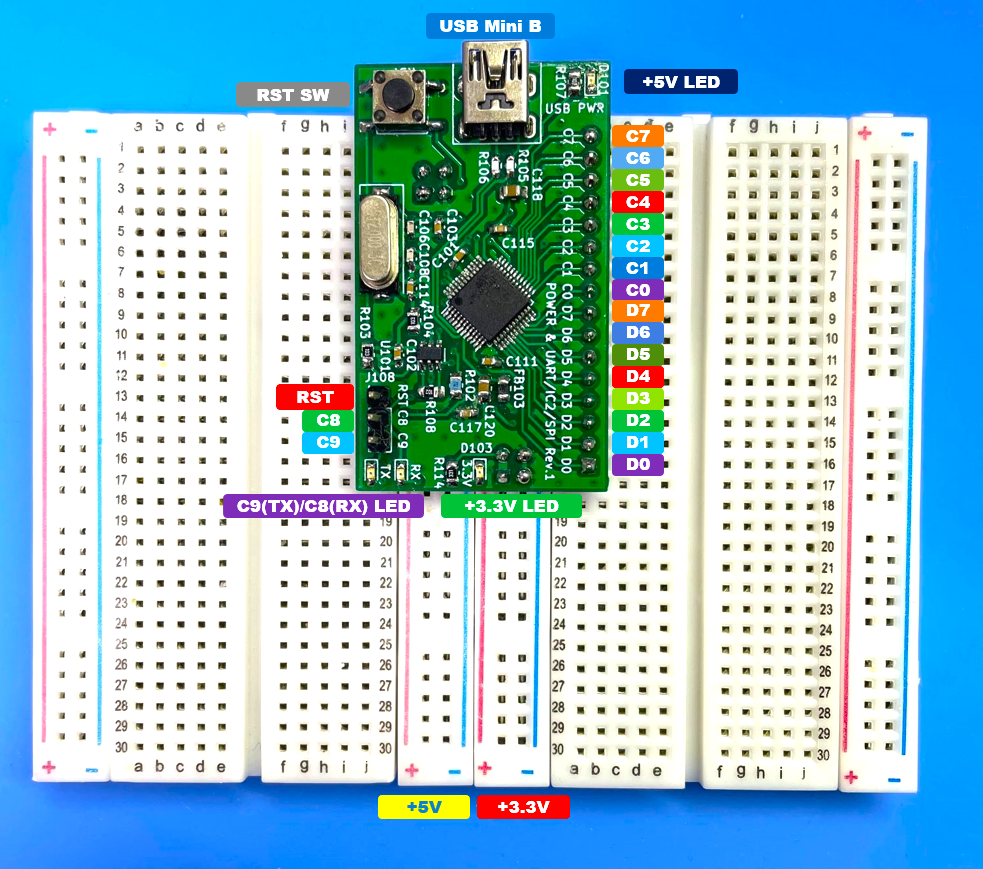
This board provides an FTDI FT232H parallel port, UART/I2C/SPI interface,+5V power, and +3.3V power.
You can put this on a breadboard.
and
You can use it with PulseView (Qt based logic analyzer).
Pulseview with this board can capture digital level from D0 - D7 port. But Show Cursors function shows time difference is wrong value. To correct this function, You need to rebuild PulseView Tools on Linux.
Ubuntu 22.04 LTS

$ sudo apt-get install git-core gcc make autoconf automake libtool

$ sudo apt-get install git gcc g++ make autoconf autoconf-archive \
  automake libtool pkg-config libglib2.0-dev libglibmm-2.4-dev libzip-dev \
  libusb-1.0-0-dev libftdi1-dev libieee1284-3-dev libvisa-dev nettle-dev libavahi-client-dev \
  libhidapi-dev check doxygen python3-numpy python3-dev python-gi-dev python-setuptools swig default-jdk

$ sudo apt-get install git-core g++ make cmake libtool pkg-config \
  libglib2.0-dev libboost-test-dev libboost-serialization-dev \
  libboost-filesystem-dev libboost-system-dev libqt5svg5-dev qtbase5-dev\
  qttools5-dev sdcc

$ git clone git://sigrok.org/sigrok-util
Patch divider value in ftdi-la driver.
$ git clone https://github.com/hnz1102/ft232hbrkout.git
$ cp ft232hbrkout/doc/patch.ftdi-la-api.linux sigrok-util/cross-compile/linux
$ cd sigrok-util/cross-compile/linux
$ patch < patch.ftdi-la-api.linux
Build
$ ./sigrok-cross-linux
$ cd sigrok-util/cross-compile/linux/build/libsigrok
$ ./autogen.sh
$ ./configure
$ sudo make installTo build for Windows, you have to rebuild code on Linux.
$ git clone git://sigrok.org/sigrok-util
$ git clone https://github.com/mxe/mxe.git mxe-git
$ git clone https://github.com/hnz1102/ft232hbrkout.git
$ cp ft232hbrkout/doc/patch.ftdi-la-api.mingw sigrok-util/cross-compile/mingw
$ cp ft232hbrkout/doc/patch.sigrok-cross-mingw.* igrok-util/cross-compile/mingw
$ cd mxe-git
$ patch -p1 < ../sigrok-util/cross-compile/mingw/libusb1_upgrade.patch
$ sudo ln -s /usr/bin/python3 /usr/bin/python
$ sudo apt install p7zip-full autopoint intltool libtool lzip python3-mako ruby libtool-bin bison flex gperf libssl-dev nsis ruby-asciidoctor-pdf
$ make MXE_TARGETS=i686-w64-mingw32.static.posix MXE_PLUGIN_DIRS=plugins/examples/qt5-freeze gcc glib libzip libusb1 libftdi1 hidapi glibmm qtbase qtimageformats qtsvg qttranslations boost check gendef libieee1284 qtbase_CONFIGURE_OPTS='-no-sql-mysql'
$ cd sigrok-util/cross-compile/mingw
$ patch < patch.sigrok-cross-mingw.1First build with normal.
$ ./sigrok-cross-mingwPatch divider value in ftdi-la driver.
$ patch < patch.ftdi-la-api.mingwSecond build with patch.
$ patch < patch.sigrok-cross-mingw.2
$ ./sigrok-cross-mingw
After the build is successful, you can use the Pulseview Installer for Windows with the driver fixed.
sigrok-util/cross-compile/mingw/build_release_32/pulseview/contrib/pulseview-0.5.0-git-3903edb-installer.exeHardware Schematic documents are licensed under CC-BY-SA V4.0.
PulseView(sigrok) Software is GNU GPL, version 3 or later. Please refer to this
i2c-test directory codes are MIT.
| Qty | Value | Footprint | References |
|---|---|---|---|
| 13 | 0.1uF/50v | Capacitor_SMD:C_0603_1608Metric_Pad1.08x0.95mm_HandSolder | C101, C102, C103, C104, C105, C109, C110, C111, C113, C114, C115, C116, C117 |
| 5 | 10K | tbctl:R_0805_2012Metric_Pad1.20x1.40mm_HandSolder | R101, R103, R104, R109, R112 |
| 4 | LED RED | tbctl:LED_0603_1608Metric_Pad1.05x0.95mm_HandSolder | D101, D102, D103, D104 |
| 3 | 4.7uF/50v | Capacitor_SMD:C_0805_2012Metric_Pad1.18x1.45mm_HandSolder | C118, C119, C120 |
| 2 | 0R | Resistor_SMD:R_0603_1608Metric_Pad0.98x0.95mm_HandSolder | R105, R106 |
| 2 | 10uF/16v | Capacitor_SMD:C_0805_2012Metric_Pad1.18x1.45mm_HandSolder | C107, C112 |
| 2 | 12K 1% | tbctl:R_0805_2012Metric_Pad1.20x1.40mm_HandSolder | R102, R111 |
| 2 | 220 | tbctl:R_0805_2012Metric_Pad1.20x1.40mm_HandSolder | R113, R115 |
| 2 | 27pF/50v | Capacitor_SMD:C_0603_1608Metric_Pad1.08x0.95mm_HandSolder | C106, C108 |
| 2 | BK2125HS601-T | Inductor_SMD:L_0805_2012Metric_Pad1.15x1.40mm_HandSolder | FB102, FB103 |
| 1 | 1K | tbctl:R_0805_2012Metric_Pad1.20x1.40mm_HandSolder | R107 |
| 1 | 20K 1% | tbctl:R_0805_2012Metric_Pad1.20x1.40mm_HandSolder | R110 |
| 1 | 2K | tbctl:R_0805_2012Metric_Pad1.20x1.40mm_HandSolder | R108 |
| 1 | 330 | tbctl:R_0805_2012Metric_Pad1.20x1.40mm_HandSolder | R114 |
| 1 | 93LCxxBxxOT | Package_TO_SOT_SMD:SOT-23-6 | U101 |
| 1 | BLM18RK102SN1 | tbctl:L_0603_1608Metric_Pad1.05x0.95mm_HandSolder | FB101 |
| 1 | Crystal 12MHz | Crystal:Crystal_SMD_HC49-SD | Y101 |
| 1 | FT232HL | Package_QFP:LQFP-48_7x7mm_P0.5mm | U102 |
| 1 | PinHeader 01x16 DOWN-PORT | Connector_PinHeader_2.54mm:PinHeader_1x16_P2.54mm_Vertical | J105 |
| 1 | PinHeader 02x02 3.3V | Connector_PinHeader_2.54mm:PinHeader_2x02_P2.54mm_Vertical | J107 |
| 1 | PinHeader 02x02 5V | Connector_PinHeader_2.54mm:PinHeader_2x02_P2.54mm_Vertical | J102 |
| 1 | PinHeader_01x03_vertical_2.54mm | Connector_PinHeader_2.54mm:PinHeader_1x03_P2.54mm_Vertical | J108 |
| 1 | SPX3819M5-L | Package_TO_SOT_SMD:SOT-23-5 | U103 |
| 1 | TS-06104 | tbctl:TS-06104 | SW101 |
| 1 | USB_B_Mini | tbctl:usb mini B connector c2235 dim 2 | J101 |
hnz1102/sdcdmux-emmc
SD CARD and eMMC Device Multiplexer with Infrared Remote Controller

hnz1102/current-logger
This tool provides a logging function that gets data on voltage, current and power consumption. Voltage input range is from 0 to 85V, Maximum current input is 15A.

hnz1102/temp-logger
Logging Thermocouple Temperature and Send Data to InfluxDB system.

yosihisa/LoadCell-Logger
4ch load cell logger board using Raspberry Pi Pico and HX711. (Wakame Edition)

hnz1102/shared-usb-memory
USB Memory with One-touch Switching Between Two Device Connections

Polprzewodnikowy/SummerCart64
SummerCart64 - a fully open source N64 flashcart

tomkinsc/open-spectrometer
Code, mechanical designs, and electronic plans related to the OpenSpectrometer project.

Epicjoy/SC64
This project's hardware and casing are modified based on the SummerCart64 project.
It measures 50 × 30 mm and has 2 copper layers, 1.6 mm thick.
52 parts, built around the FT232HL, SPX3819M5-L, 0.1UF 50V 5*11 and BK2125HS601-T. The full list of its parts is on this page, with links to each part's symbol and footprint where PCBKit's library has them.
From the hnz1102/ft232hbrkout repository on GitHub, at the commit this page was made from: the board is power.kicad_pcb and its schematic power.kicad_sch. PCBKit opens the board in the browser, with nothing to install.
Its repository states no licence, so its author keeps all rights: ask hnz1102 before reusing the design.