
2 layers68.8 × 53.6 mm
ZArduino
zmaker/arduino_cookbook
gli sketch del nuovo progetto Arduino Cookbook e dei video di YouTube
46 parts269

 hhhug000/octoboard
An 8 bit microcontroller dev board for the ATMEGA328P-PU
Octoboard is an open-source printed circuit board by hhhug000, from the hhhug000/octoboard repository on GitHub, published under the Apache-2.0 licence. It is a 2-layer board of 45 × 74.5 mm with 32 parts on 32 nets, routed with 279 tracks and 47 vias.
It is built around the ATMEGA328P-PU. Its parts include 8 capacitors, 8 connectors, 4 diodes, 3 resistors and 2 ICs. It belongs with the microcontroller boards boards and the AVR (ATmega, ATtiny) boards of this library.
An ATmega328P-PU development board designed from scratch in KiCad for prototyping AVR projects without breadboard mess. It uses only THT components to simplify soldering, and does not use an onboard serial chip to save on cost and simplicity
Octoboard breaks out all the GPIO from the chip, and provides all power management and supporting hardware.
The BOM is for 5 boards, as that is the minimum I can buy from JLCPCB and some parts
Built for the Hack Club Stardance YSWS program
| Front | Back | Angle |
|---|---|---|
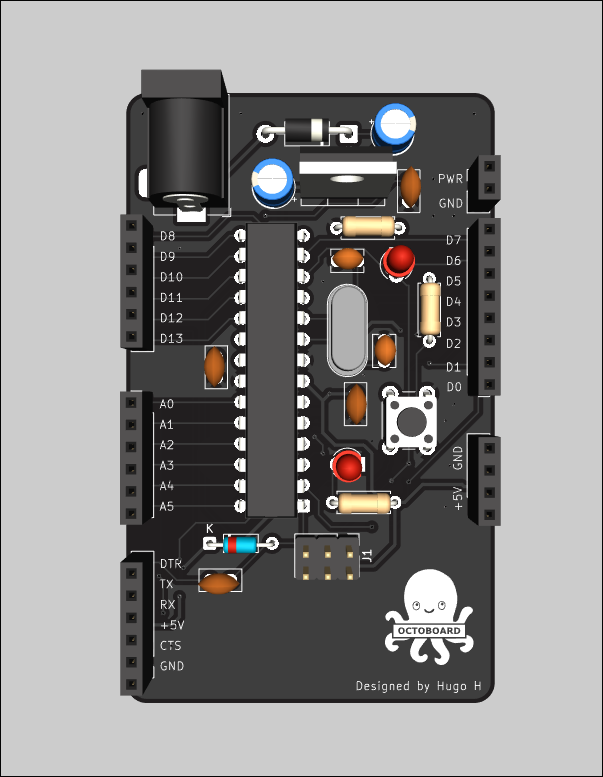 | 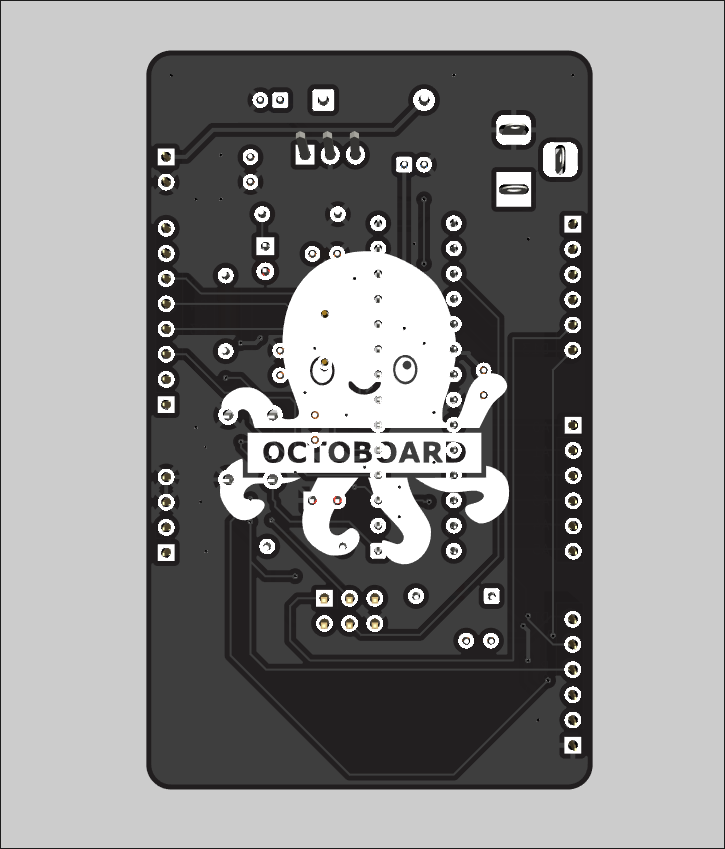 | 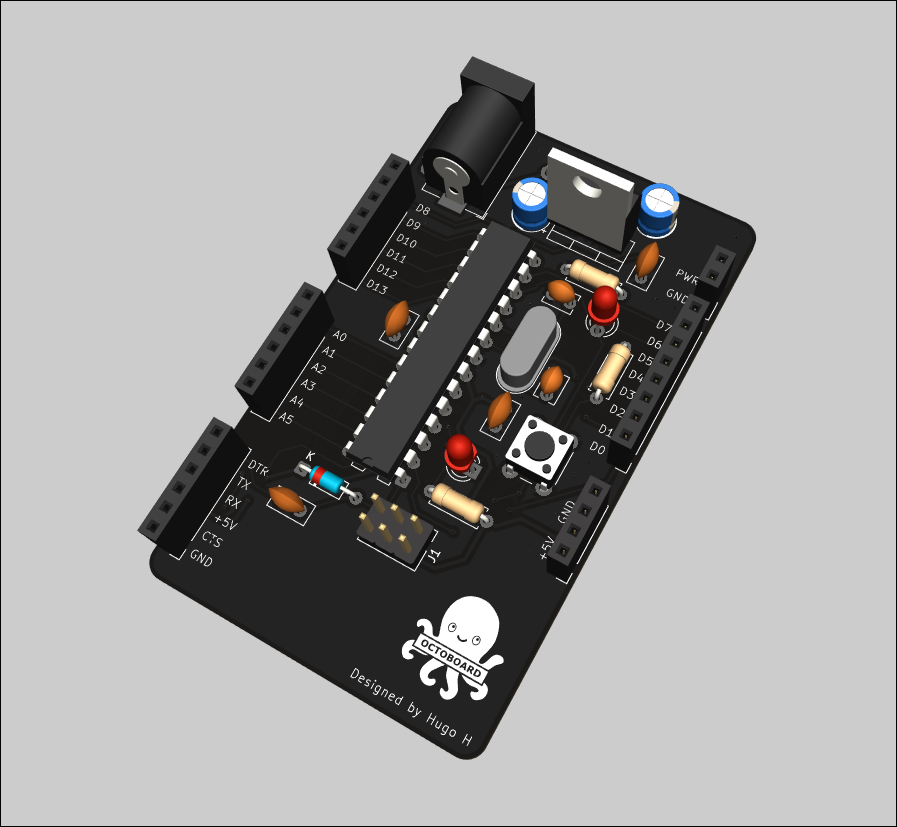 |
| All Layers | Front Layer | Back Layer |
|---|---|---|
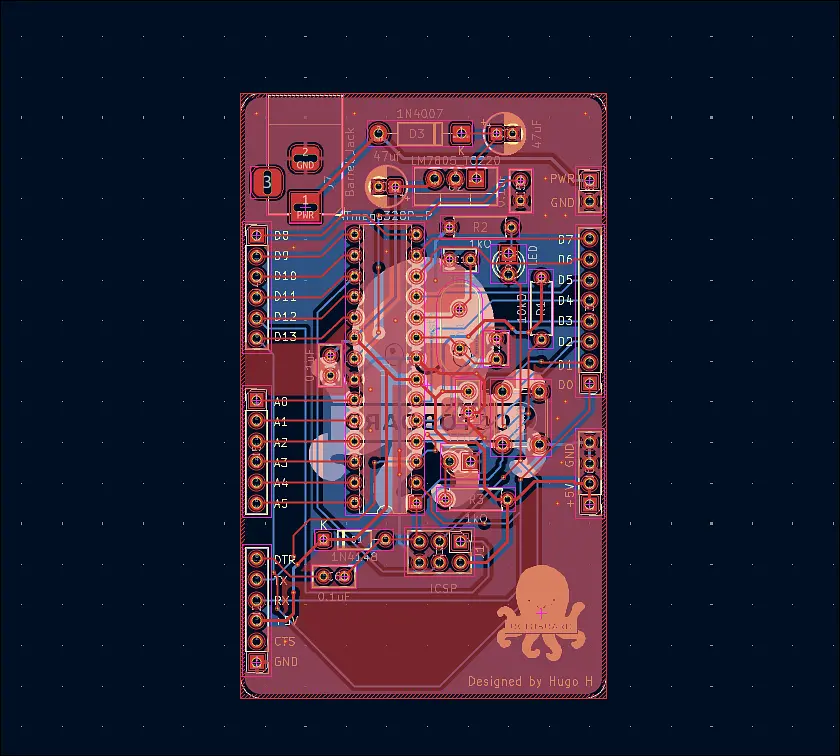 | 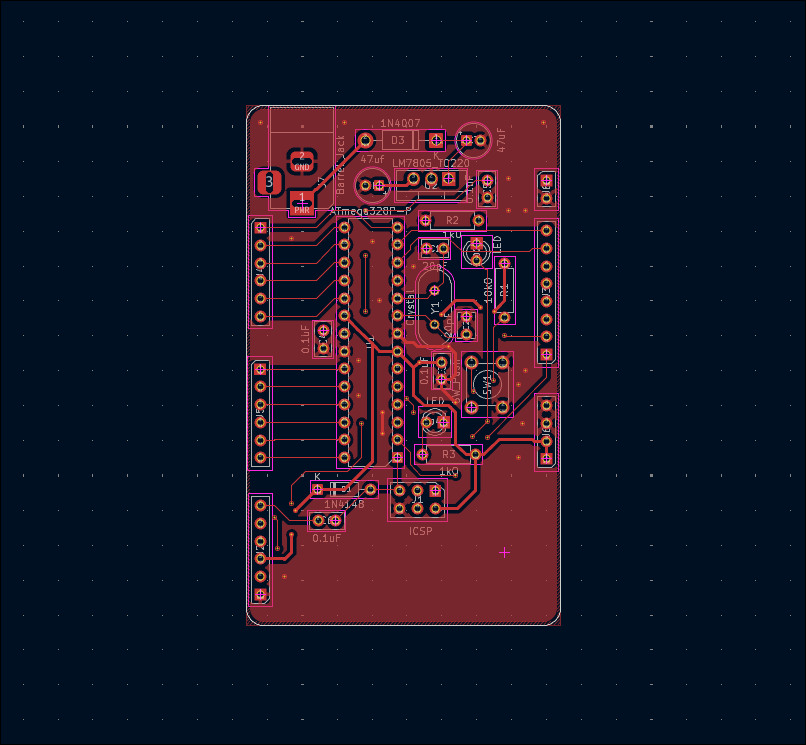 | 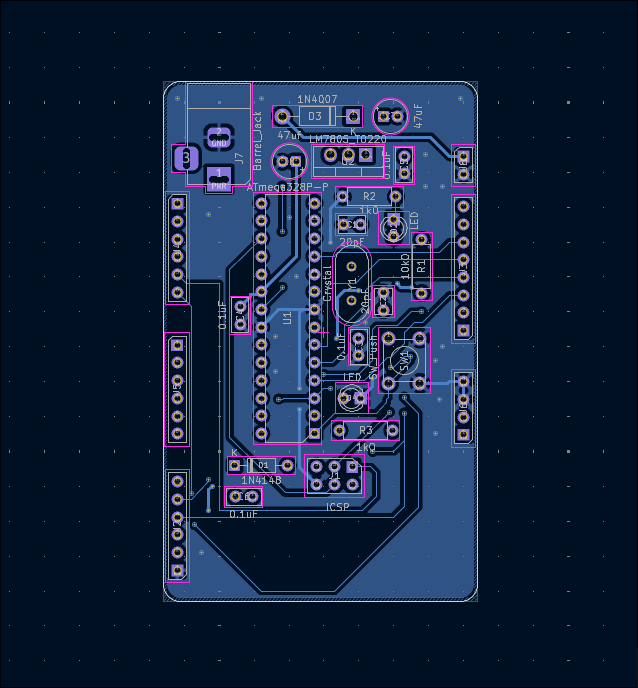 |
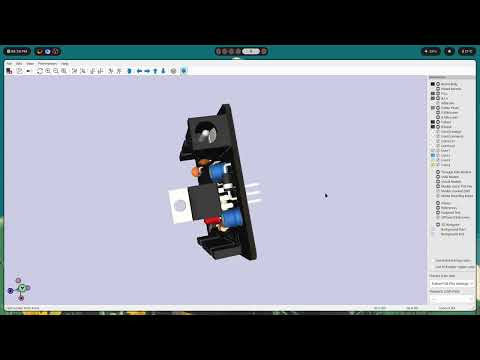
Make sure to flash the bootloader to the board in Arduino IDE even if you will only use ICSP. This is because it programs the fuses, and programs will not work properly without it.
The device can be programmed in a variety of languages. I have personally tested it with Arduino C++ and my own blockly based system. The device can be programmed with avrdude or the arduino ide.
| Qty | Value | Footprint | References |
|---|---|---|---|
| 4 | 0.1uF | Capacitor_THT:C_Disc_D5.0mm_W2.5mm_P2.50mm | C3, C4, C5, C6 |
| 3 | MountingHole | MountingHole:MountingHole_2.2mm_M2 | H1, H2, H3 |
| 2 | 1kO | Resistor_THT:R_Axial_DIN0207_L6.3mm_D2.5mm_P7.62mm_Horizontal | R2, R3 |
| 2 | 20pF | Capacitor_THT:C_Disc_D3.8mm_W2.6mm_P2.50mm | C1, C2 |
| 2 | Conn_01x06 | Connector_PinHeader_2.54mm:PinHeader_1x06_P2.54mm_Vertical | J4, J5 |
| 2 | LED | LED_THT:LED_D3.0mm | D2, D4 |
| 2 | LOGO | LOGO | G***, G*** |
| 1 | 10kO | Resistor_THT:R_Axial_DIN0207_L6.3mm_D2.5mm_P7.62mm_Horizontal | R1 |
| 1 | 1N4007 | Diode_THT:D_DO-41_SOD81_P10.16mm_Horizontal | D3 |
| 1 | 1N4148 | Diode_THT:D_DO-35_SOD27_P7.62mm_Horizontal | D1 |
| 1 | 47uF | Capacitor_THT:CP_Radial_D5.0mm_P2.00mm | C7 |
| 1 | 47uf | Capacitor_THT:CP_Radial_D5.0mm_P2.00mm | C8 |
| 1 | ATmega328P-P | Package_DIP:DIP-28_W7.62mm | U1 |
| 1 | Barrel_Jack | Connector_BarrelJack:BarrelJack_Horizontal | J7 |
| 1 | Conn_01x02 | Connector_PinHeader_2.54mm:PinHeader_1x02_P2.54mm_Vertical | J8 |
| 1 | Conn_01x04 | Connector_PinHeader_2.54mm:PinHeader_1x04_P2.54mm_Vertical | J6 |
| 1 | Conn_01x08 | Connector_PinHeader_2.54mm:PinHeader_1x08_P2.54mm_Vertical | J3 |
| 1 | Crystal | Crystal:Crystal_HC49-4H_Vertical | Y1 |
| 1 | ICSP | Connector_PinHeader_2.54mm:PinHeader_2x03_P2.54mm_Vertical | J1 |
| 1 | LM7805_TO220 | Package_TO_SOT_THT:TO-220-3_Vertical | U2 |
| 1 | SW_Push | Button_Switch_THT:SW_PUSH_6mm | SW1 |
| 1 | Serial Board | Connector_PinHeader_2.54mm:PinHeader_1x06_P2.54mm_Vertical | J2 |
zmaker/arduino_cookbook
gli sketch del nuovo progetto Arduino Cookbook e dei video di YouTube

coseyfannitutti/discipad
17-key numpad assembled with only through hole components, including usb type-c

matthewcieplak/super-sixteen
Code and schematics for the Super Sixteen Eurorack sequencer

coseyfannitutti/romeo
Staggered 40% keyboard pcb that can be assembled with only through hole components, including USB Type-C

mattybrad/drumkid
Version 4 was the first successful working design, with full code, schematics, Gerbers, etc available on GitHub.


leomil72/LM80C
A Z80-based homebrew computer withTMS9918, AY-3-8910, Z80 CTC, Z80 PIO, and Z80 SIO

It measures 45 × 74.5 mm and has 2 copper layers, 1.6 mm thick.
32 parts, built around the ATMEGA328P-PU. The full list of its parts is on this page, with links to each part's symbol and footprint where PCBKit's library has them.
From the hhhug000/octoboard repository on GitHub, at the commit this page was made from: the board is pcb/octoboard.kicad_pcb and its schematic pcb/octoboard.kicad_sch. PCBKit opens the board in the browser, with nothing to install.
Its repository publishes it under the Apache-2.0 licence: you may reuse it on that licence's terms (keep the author's notice, and for a copyleft licence share your changes alike).