2 layers18.5 × 26 mm
24g2usb rp2350zero
joypad-ai/joypad-os
Universal controller firmware for building adapters, dongles, and custom controllers.
4 parts1.7kApache-2.0

 Heber-co-uk/Multisystem80
The MiSTer Multisystem console Hardware PCB - FPGA platform
Multisystem Cart is an open-source printed circuit board by Heber-co-uk, from the Heber-co-uk/Multisystem repository on GitHub, published under the GPL-3.0 licence. It is a 2-layer board of 72 × 59.5 mm with 4 parts on 38 nets, routed with 59 tracks and 35 vias.
KiCad templates for cartridges for the Multisystem and Multisystem2 / Future Multisystems.
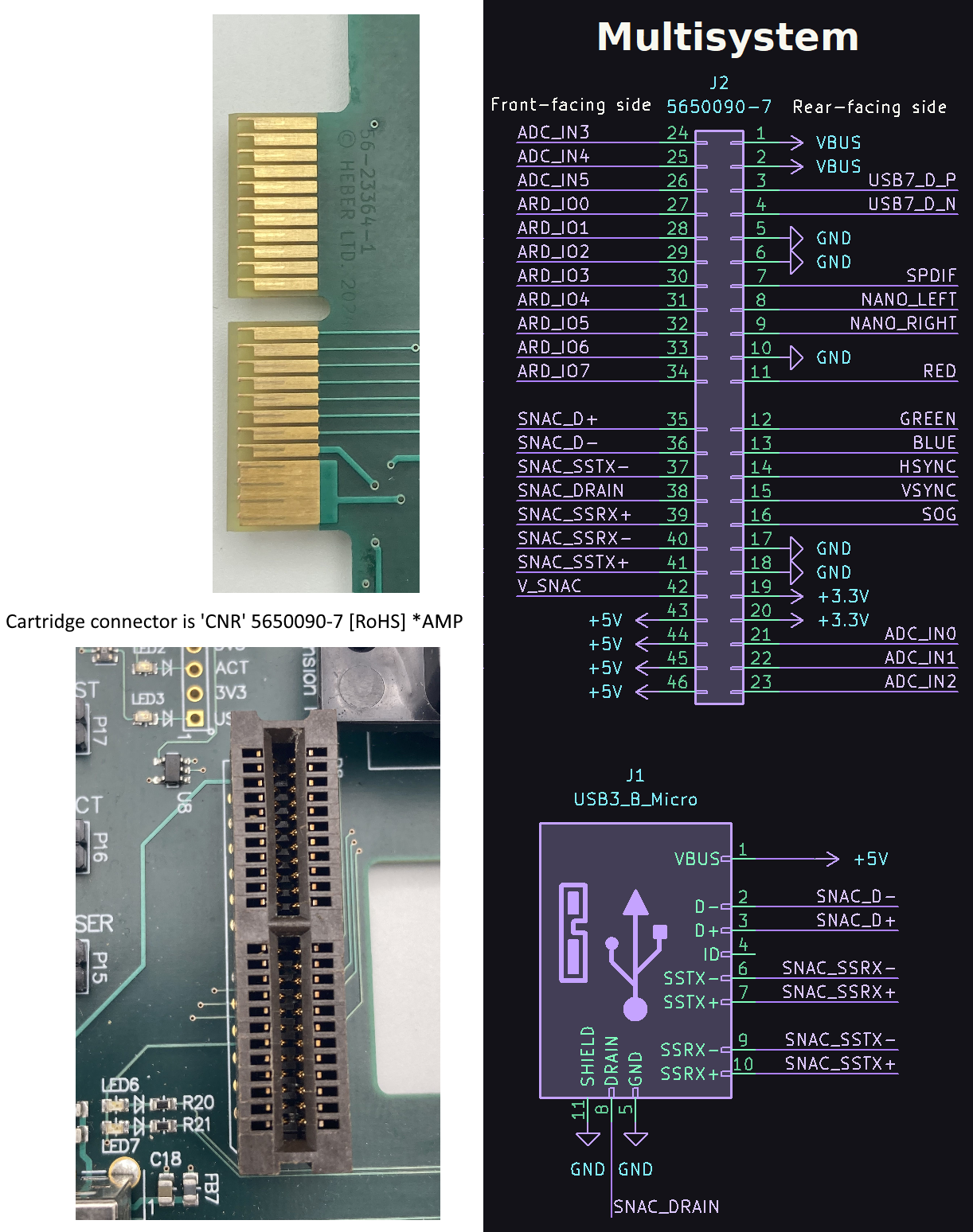
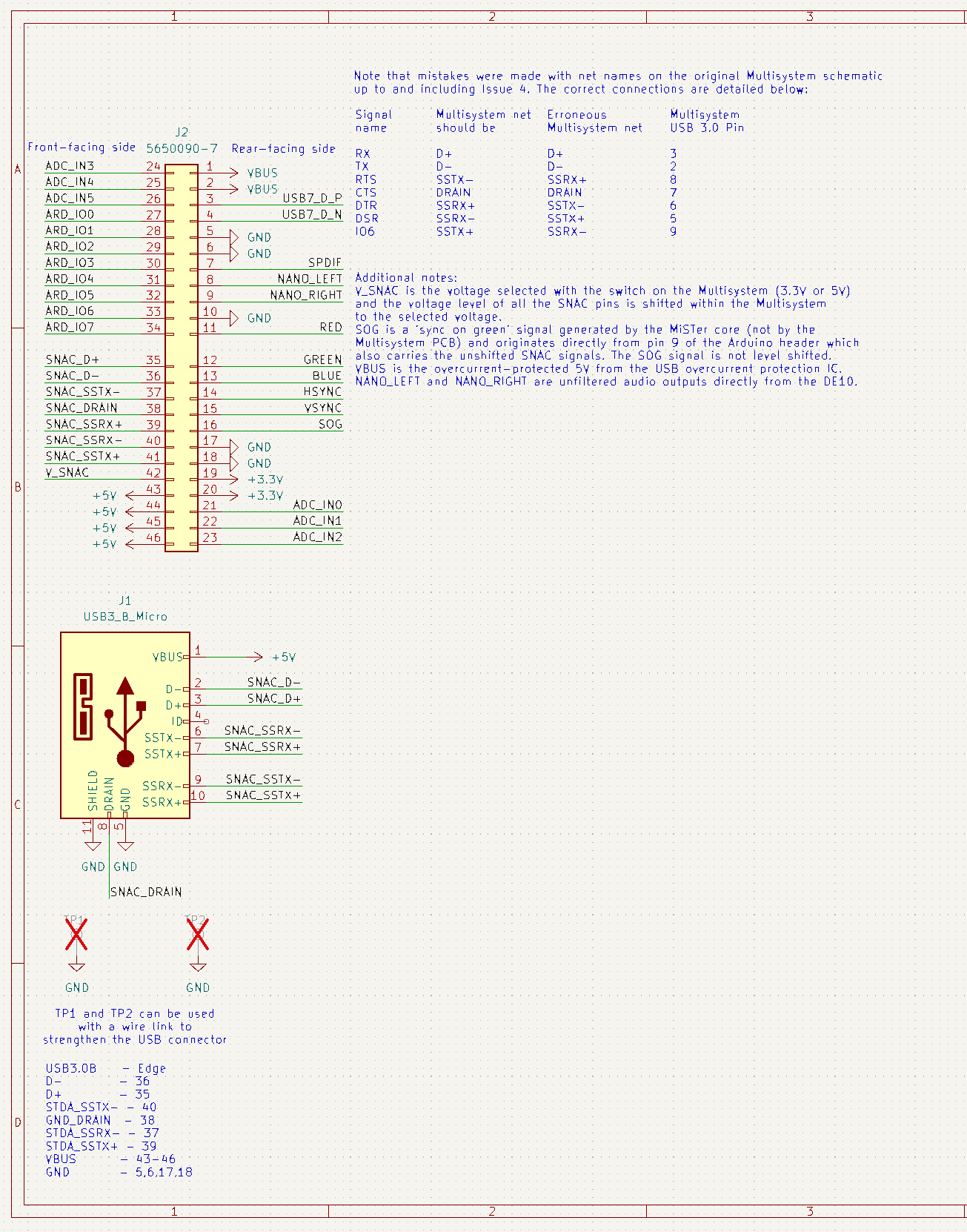
Schematic includes the edge connector with appropriately labelled nets.
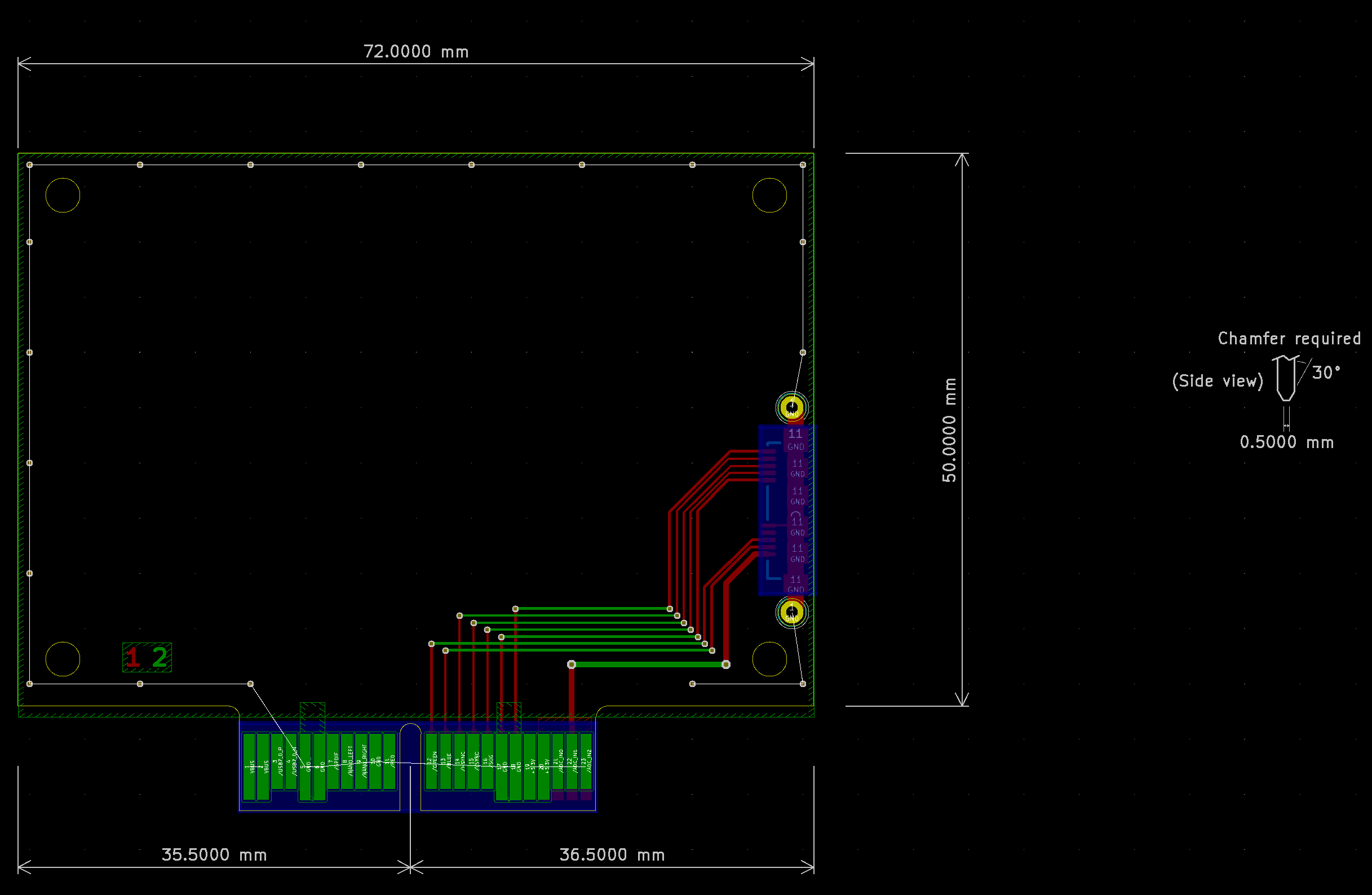
PCB includes the edge connector and a board outline.
The Multisystem cartridge also includes a micro USB 3.0 connector, which enables SNAC cartridges to be connected to other MiSTer FPGA systems. On the Multisystem, the V_SNAC signal from the edge connector and power from the USB connector will be at 5V or 3.3V depending on the voltage setting on the Multisystem, but on other MiSTer systems, the voltage from the USB connector is always 5V even when a level shifter is used. VBUS on the edge connector is current-limited 5V from the USB current limiting IC whereas 5V on the edge connector is from the main power input protected only by the main polyfuse. Also note that the SSRX and SSTX pairs are swapped in the micro USB connector; this is because the SSRX pins at the USB end connect to SSTX at the micro USB end of the cable and vice versa.
On Multisystem 2, V_SNAC is fixed at 3.3V and the level of the signals from the system are 3.3V. We recommend designing any SNAC cartridge for 5V devices with on-board level shifters so that they will be compatible with Multisystem and Multisystem 2. The common BSS138 level shifting circuit is sufficient and the pull-ups on the system side should be connected to V_SNAC for correct signal levels on the system side regardless of the position of the 5V/3.3V switch on Multisystem.
If you wish to make your own Cartridges for the Multisystem/Multisystem2, please use this template so they will be compatible.
Never use HASL. Use ENIG.
All official Heber cartridges feature hard gold plating on the edge contacts to improve the long term reliability of the contacts. This is an extra cost option available from most PCB manufacturers and is quite expensive to add if you are ordering prototypes; the boards will of course work without hard gold plating, but standard gold plating will wear off the pads quickly and reduce the reliability over the long term.
| Qty | Value | Footprint | References |
|---|---|---|---|
| 2 | TestPoint | Connector_Pin:Pin_D1.0mm_L10.0mm | TP1, TP2 |
| 1 | 5650090-7 | Heber:PCI_EDGE_AMC_RISER_MULTISYSTEM | J2 |
| 1 | USB3_B_Micro | Heber:CONN-MICRO-USB-3 | J1 |
It measures 72 × 59.5 mm and has 2 copper layers, 1.6 mm thick.
4 parts. The full list of its parts is on this page, with links to each part's symbol and footprint where PCBKit's library has them.
From the Heber-co-uk/Multisystem repository on GitHub, at the commit this page was made from: the board is Multisystem-Cart-Templates/Multisystem-Cart.kicad_pcb and its schematic Multisystem-Cart-Templates/Multisystem-Cart.kicad_sch. PCBKit opens the board in the browser, with nothing to install.
Its repository publishes it under the GPL-3.0 licence: you may reuse it on that licence's terms (keep the author's notice, and for a copyleft licence share your changes alike).
joypad-ai/joypad-os
Universal controller firmware for building adapters, dongles, and custom controllers.


hackclub/OnBoard
💡 Join 1,000 teenagers and make your first PCB with a $100 grant!

tardate/LittleArduinoProjects
a collection of "Little Electronic & Arduino Projects", most involving electronics or an Arduino in one way or another!

drandyhaas/KiCadRoutingTools
A set of Python/Rust tools to aid routing in KiCad

osy/XG_Mobile_Station
Open source eGPU dock for ROG Ally and ROG Flow

Luos-io/luos_engine
Open-source and real-time orchestrator for cyber-physical-systems, to easily design, test and deploy embedded applications and digital twins.

NVNTLabs/switch2-SDEX2M2
Micro SD Express to M.2 NVME Adapter for Nintendo Switch 2