4 layers89 × 58 mm

 hatlabs/SH-ESP32-hardware49
Sailor Hat for ESP32 hardware
SH ESP32-HAT Proto is an open-source printed circuit board by hatlabs, from the hatlabs/SH-ESP32-hardware repository on GitHub. It is a 2-layer board of 83 × 55.5 mm with 417 parts on 38 nets, routed with 320 tracks and 34 vias.
It belongs with the ESP32 and RISC-V boards of this library.
This repository contains the Sailor Hat for ESP32 (SH-ESP32) hardware design. SH-ESP32 is a powerful microcontroller development board designed for marine environments.
Special emphasis has been placed on electrical compliance: the board can handle most power surges ever present on an automotive or marine 12V or 24V power system. Equally importantly, the inputs and outputs have protection for electrostatic discharges (static electricity), and are designed to not produce electromagnetic emissions (disturb other sensitive devices such as VHF radios or GPS antennas), and to be protected against electromagnetic interference (will not be disturbed by a VHF, SSB, or a radar).
SH-ESP32 can be used to easily create different types of sensors and control devices for boats. Use scenarios include:
Some of these applications require a small amount of additional components. Simple add-on boards and designs for these will be made available.
Since the board has native WiFi and NMEA 2000 compatible CAN bus connectivity, it can be used to create boards with either Signal K or native NMEA 2000 connectivity (or both!).
The main design features include:
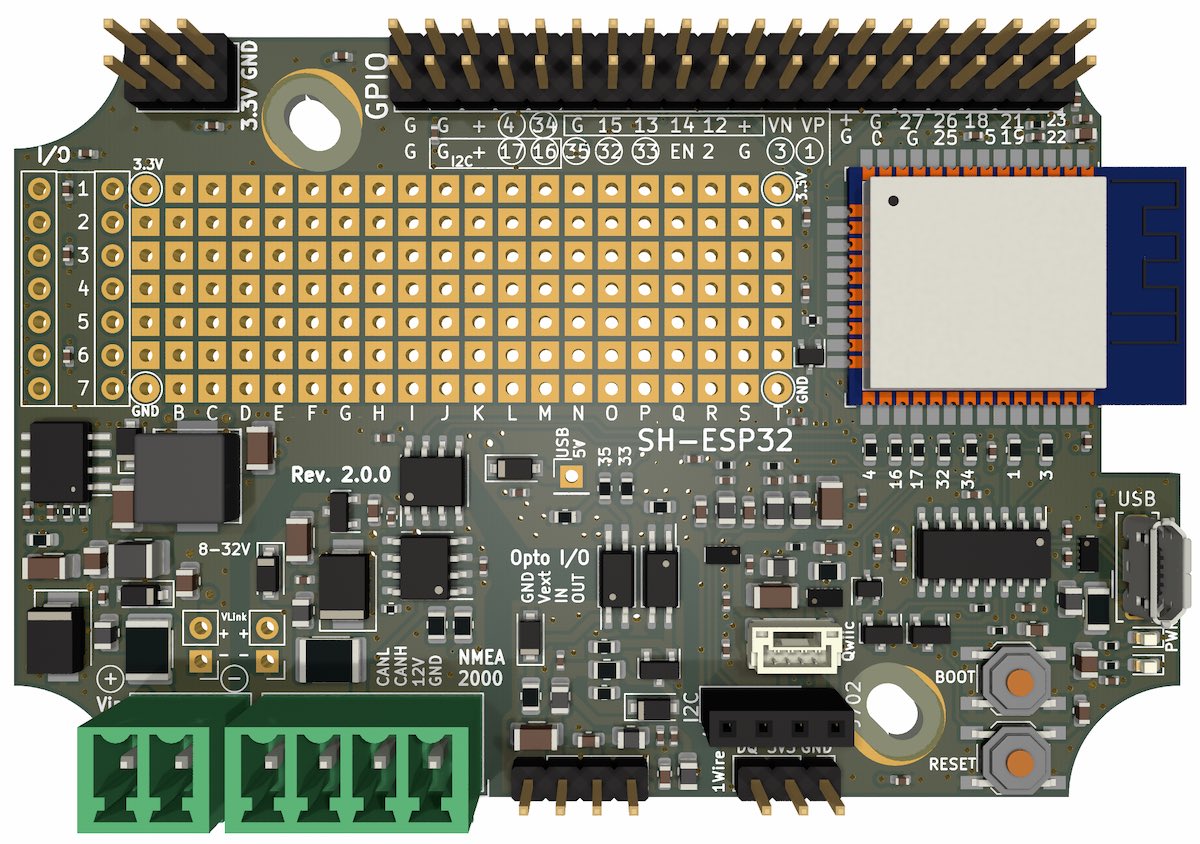
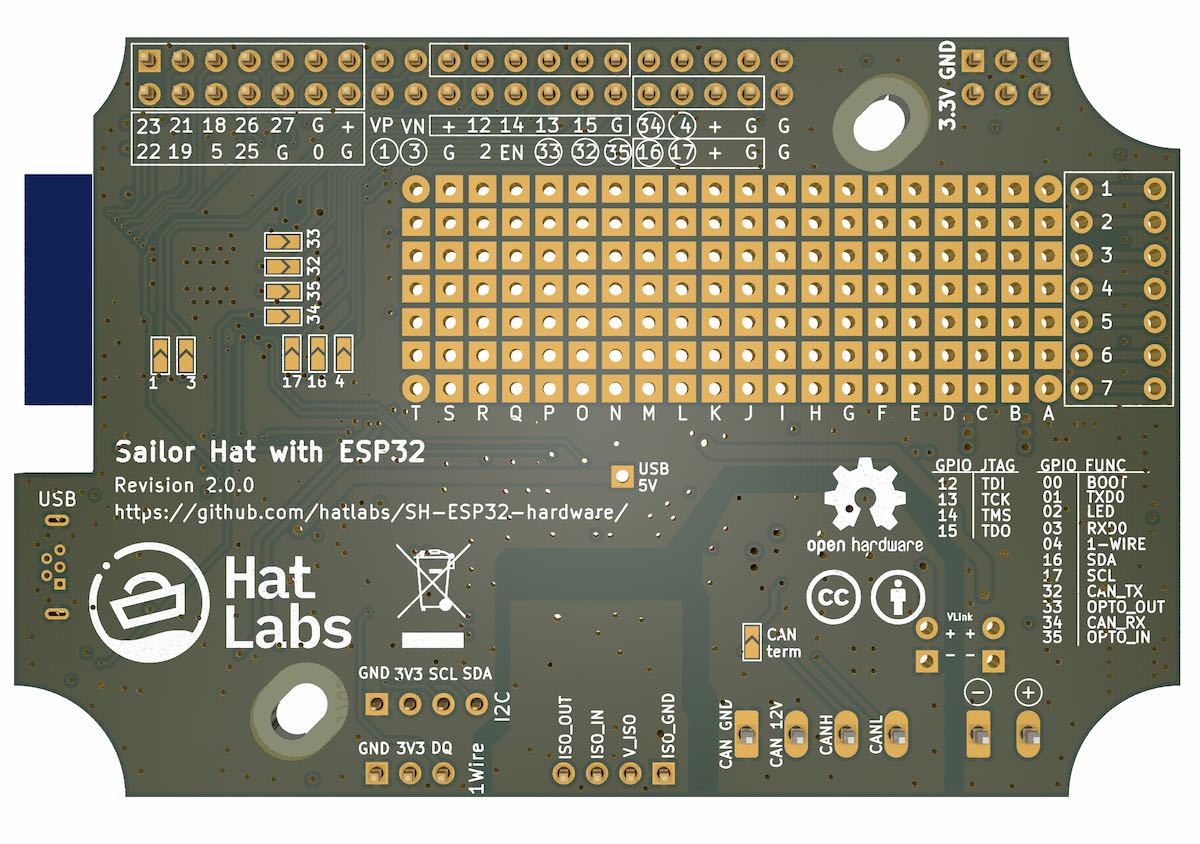
Rendering of a revision 2.0.0 board:
Front side.
Back side.
SH-ESP32 is available for purchase at the Hat Labs web store.
SH-ESP32 documentation is available at the project GitHub Pages.
| Qty | Value | Footprint | References |
|---|---|---|---|
| 6 | Conn_01x01_Male | ESP32-HAT:ProtoPad-Drill1mm | P301, P302, P303, P304, P305, P306 |
| 2 | GPIO | Connector_PinHeader_2.54mm:PinHeader_2x20_P2.54mm_Vertical | J302, J307 |
| 2 | I2C | Connector_PinHeader_2.54mm:PinHeader_1x04_P2.54mm_Vertical | J303, J305 |
| 2 | MountingHole | SH-ESP32:MountingSlot_3.2mm_M3_Unplated | H1001, H1002 |
| 1 | Conn_01x02 | Connector_JST:JST_XH_B2B-XH-A_1x02_P2.50mm_Vertical | J301 |
| 1 | Conn_01x04 | Connector_JST:JST_XH_B4B-XH-A_1x04_P2.50mm_Vertical | J306 |
The 14 most common of 417 parts.


Xenoah/pcb-z80-2sc1815
2SC1815トランジスタでZ80互換CPUを目指すKiCad設計。RTL・レジスタ・ALUの検証基板を収録。 / KiCad designs toward a Z80-compatible CPU using 2SC1815 transistors, with RTL, register and ALU test boards.

unicab369/ESP-MESS
I am building a Wireless Bridge System that can manage multiple devices using a variety of wireless technologies.

RunTheBot/NotAHackPad
Basically a hack pad but with a lot more keys and a lot more LEDs.


freeDSP/freeDSPx-AnalogIO-x8
Expansionboard with 8 analog balanced inputs and 8 analog balanced outputs
It measures 83 × 55.5 mm and has 2 copper layers, 1.6 mm thick.
417 parts. The full list of its parts is on this page, with links to each part's symbol and footprint where PCBKit's library has them.
From the hatlabs/SH-ESP32-hardware repository on GitHub, at the commit this page was made from: the board is SH-ESP-HAT-Proto/SH-ESP32-HAT-Proto.kicad_pcb and its schematic ESP32.kicad_sch. PCBKit opens the board in the browser, with nothing to install.
Its repository states no licence, so its author keeps all rights: ask hatlabs before reusing the design.