2 layers148.6 × 192.2 mm
Badge
NuttyShell/NuttyBadge
NuttyBadge: A NuttyShell crafted multi-tool. Opensourced Hardawre and Software
169 parts31GPL-3.0

 HackerSchool/pico-synth5
Pico based I2S Synthesizer
Pico synth is an open-source printed circuit board by HackerSchool, from the HackerSchool/pico-synth repository on GitHub, published under the GPL-3.0 licence. It is a 2-layer board of 164 × 82.4 mm with 151 parts on 181 nets, routed with 831 tracks and 237 vias.
It is built around the PCF8574T, AMS1117-3.3 and 1N4148WS. Its parts include 44 resistors, 32 diodes, 21 capacitors, 20 switches and 13 connectors. It belongs with the audio and music boards and the RP2040 boards of this library.


The Pico-Synth Board v0.1 is the first version of the synthesizer, featuring a DAC with line-out, a 4x4 switch matrix with individual LEDs, four rotary encoders with switches, an OLED screen, and an SD card slot for optional storage. This fist iteration of the board was designed with a focus on low cost and component availability.
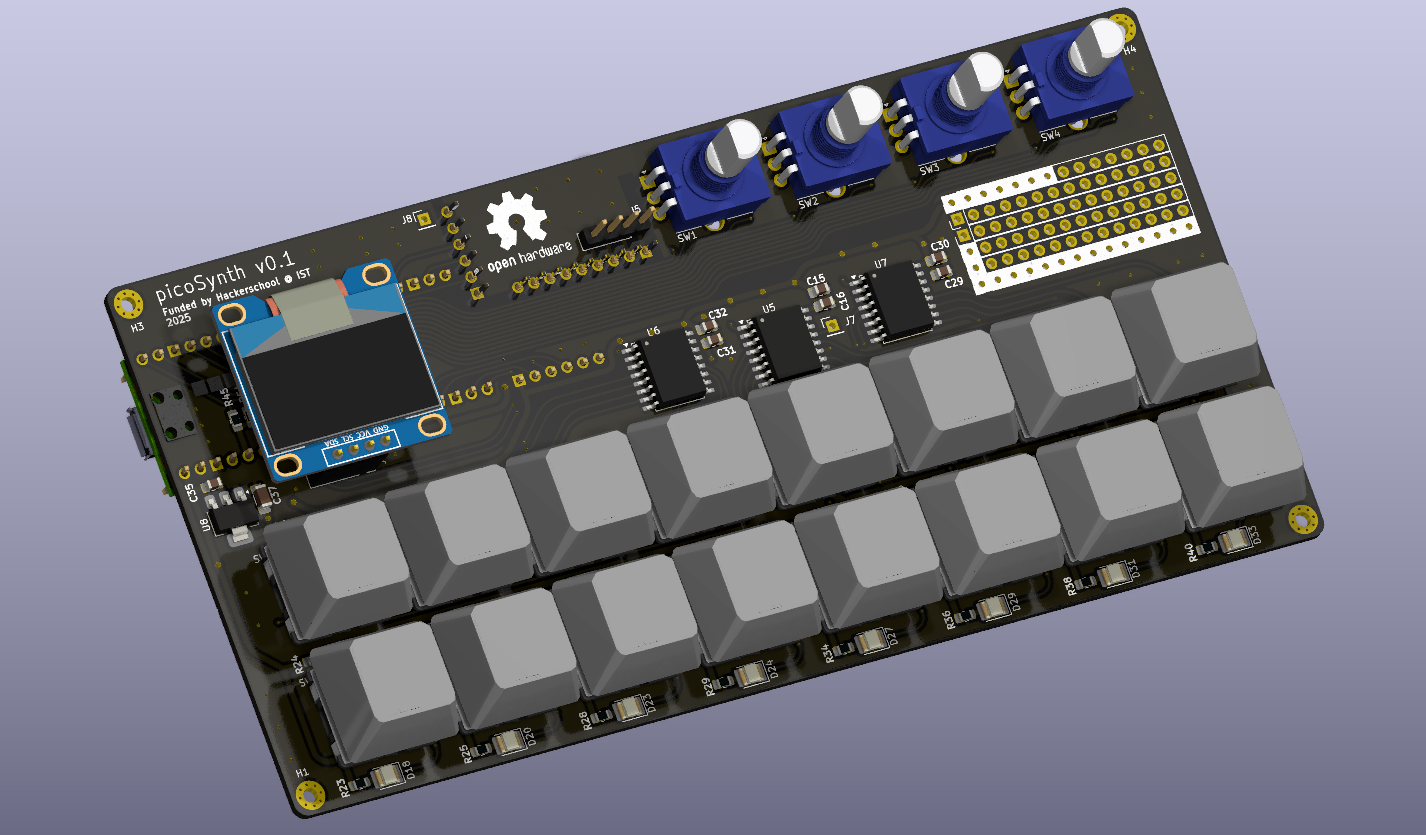
| Qty | Value | Footprint | References |
|---|---|---|---|
| 28 | 1k | Cern_Ignition:R_0805_2012Metric_Pad1.20x1.40mm_HandSolder_modif | R10, R11, R12, R13, R14, R15, R16, R17, R18, R19, R20, R23, R24, R25, R26, R27 +12 |
| 16 | 100nF | Cern_Ignition:C_0805_2012Metric_Pad1.18x1.45mm_HandSolder_modif | C15, C17, C18, C19, C20, C21, C22, C23, C24, C25, C26, C27, C28, C30, C32, C36 |
| 16 | 1N4148WS | Diode_SMD:D_0805_2012Metric_Pad1.15x1.40mm_HandSolder | D2, D3, D4, D5, D6, D7, D8, D9, D10, D11, D12, D13, D14, D15, D16, D17 |
| 16 | LED | LED_SMD:LED_1210_3225Metric_Pad1.42x2.65mm_HandSolder | D18, D19, D20, D21, D22, D23, D24, D25, D26, D27, D28, D29, D30, D31, D32, D33 |
| 16 | SW_Push_45deg | Cherry_MX_switches:Cherry-MX_PCB-Mounted_LTST-A683CEGBW_Kailh_Socket_modif | SW5, SW6, SW7, SW8, SW9, SW10, SW11, SW12, SW13, SW14, SW15, SW16, SW17, SW18, SW19, SW20 |
| 12 | 10k | Cern_Ignition:R_0805_2012Metric_Pad1.20x1.40mm_HandSolder_modif | R31, R32, R45, R46, R47, R48, R49, R50, R51, R52, R53, R54 |
| 6 | Conn_01x14_Socket | Connector_PinHeader_2.54mm:PinHeader_1x14_P2.54mm_Vertical | J9, J10, J11, J12, J13, J14 |
| 4 | 2.2uF | Cern_Ignition:C_0805_2012Metric_Pad1.18x1.45mm_HandSolder_modif | C16, C29, C31, C35 |
| 4 | 4.7k | Cern_Ignition:R_0805_2012Metric_Pad1.20x1.40mm_HandSolder_modif | R7, R8, R21, R22 |
| 4 | A2_Jumper | Jumper:SolderJumper-3_P1.3mm_Open_RoundedPad1.0x1.5mm_NumberLabels | JP7, JP10, JP13, JP14 |
| 4 | MountingHole_Pad | MountingHole:MountingHole_2.2mm_M2_Pad_Via | H1, H2, H3, H4 |
| 4 | RotaryEncoder_Switch_MP | Lame_Lib:RotaryEncoder_Alps_EC11E-Switch_Vertical_H20mm_CircularMountingHoles | SW1, SW2, SW3, SW4 |
| 3 | A0_Jumper | Jumper:SolderJumper-3_P1.3mm_Open_RoundedPad1.0x1.5mm_NumberLabels | JP5, JP8, JP11 |
| 3 | A1_Jumper | Jumper:SolderJumper-3_P1.3mm_Open_RoundedPad1.0x1.5mm_NumberLabels | JP6, JP9, JP12 |
| 3 | PCF8574 | Package_SO:SOIC-16W_7.5x10.3mm_P1.27mm | U5, U6, U7 |
| 2 | Conn_01x01_Socket | Connector_PinHeader_2.54mm:PinHeader_1x01_P2.54mm_Vertical | J7, J8 |
| 2 | Conn_01x06_Socket | Connector_PinSocket_2.54mm:PinSocket_1x06_P2.54mm_Vertical | J1, J6 |
| 1 | 10uF | Cern_Ignition:C_1206_3216Metric_Pad1.33x1.80mm_HandSolder_modif | C37 |
| 1 | AMS1117-3.3 | Package_TO_SOT_SMD:SOT-223-3_TabPin2 | U8 |
| 1 | Conn_01x04_Socket | Connector_PinSocket_2.54mm:PinSocket_1x04_P2.54mm_Vertical | J3 |
| 1 | Conn_01x09_Socket | Connector_PinSocket_2.54mm:PinSocket_1x09_P2.54mm_Vertical | J4 |
| 1 | Line_Out | Connector_PinHeader_2.54mm:PinHeader_1x04_P2.54mm_Vertical | J5 |
| 1 | Pico | Pi_Pico:RPi_Pico_SMD_TH_No_Debug | U1 |
| 1 | SolderJumper_2_Open | Jumper:SolderJumper-2_P1.3mm_Open_RoundedPad1.0x1.5mm | JP15 |
The 150 most common of 151 parts.
NuttyShell/NuttyBadge
NuttyBadge: A NuttyShell crafted multi-tool. Opensourced Hardawre and Software


alextrical/ESP8266-Sentinel-Kinetic-Wired-Remote
ESP8266 based Re-implementation of the Vent-Axia Sentinel Kinetic Wired Remote Controller

electron-rare/DMX_ESP_Stepper-controller
contrôle de moteur pas à pas selon commande DMX, pour l'opéra de Montpellier

gschwaer/sodastream-power-mod
Because the Internet of Things needed a smart soda maker.


It measures 164 × 82.4 mm and has 2 copper layers, 1.6 mm thick.
151 parts, built around the PCF8574T, AMS1117-3.3 and 1N4148WS. The full list of its parts is on this page, with links to each part's symbol and footprint where PCBKit's library has them.
From the HackerSchool/pico-synth repository on GitHub, at the commit this page was made from: the board is hardware/electronics/PicoSynth.kicad_pcb and its schematic hardware/electronics/PicoSynth.kicad_sch. PCBKit opens the board in the browser, with nothing to install.
Its repository publishes it under the GPL-3.0 licence: you may reuse it on that licence's terms (keep the author's notice, and for a copyleft licence share your changes alike).