2 layers33.7 × 97.8 mm
HAN ESP TSS721
UtilitechAS/amsreader-firmware
ESP8266 and ESP32 compatible firmware to read, interpret and publish data to MQTT from smart electrical meters, both DLMS and DSMR is supported
29 parts470

 gugray/Shizhong10
Source code and circuit design for the Remarkably Accurate Quartz Clock, a timepiece with ±10 sec annual accuracy
Main v1 is an open-source printed circuit board by gugray, from the gugray/Shizhong repository on GitHub, published under the MIT licence. It is a 2-layer board of 82 × 52 mm with 15 parts on 16 nets, routed with 104 tracks and 5 vias.
It is built around the ATMEGA88V-10PU and DS18B20. Its parts include 3 resistors, 3 switches, 2 capacitors, 2 ICs and 1 diode. It belongs with the lEDs and displays boards and the AVR (ATmega, ATtiny) boards of this library.


This repository has all the code and design files for the Remarkably Accurate Quartz Clock documented on Hackaday.
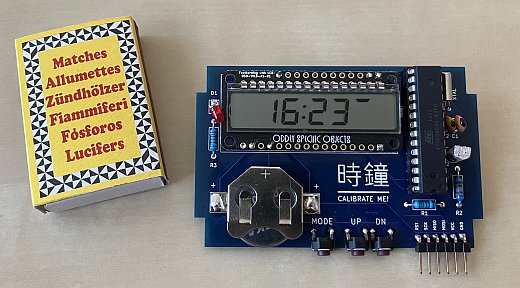
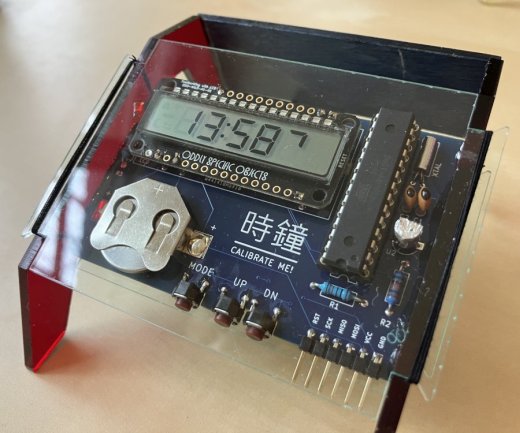
Can I use cheap, everyday components and build a quartz clock that beats specialized RTCs and matches the best commercial timepieces? Let's find out!
32kHz quartz crystals typically have a ±20ppm (parts per million) frequency tolerance, which translates to drift potentially in excess of 10 minutes per year. Specialized RTCs like DS3231 promise ±2ppm, or about ±1 minute per year.
RAQC aims for drift below 10 seconds per year. To achieve this, it implements fine-grained frequency correction in software. It has a screen to adjust time with subsecond precision, and it measures the temperature at 10-minute intervals to compensate for dynamic drift. After calibrating repeatedly at incresingly long intervals, RAQC knows the crystal's static error with a 0.01ppm precision.
Energy-saving programming techniques and a low-power LCD display keep the clock's current draw under 15μA, promising 1.5 years of uptime on a CR2032 coin cell.
The KiCad 5.1.9 schematic and PCB are in /electronics. The ZIP file there is the Gerber export that I submitted to the PCB fab.
The frame is laser-cut from 3mm acryclic; the top and bottom covers are 1mm transparent acrylic. The front panel with the engraved overview of the clock's menu is laser-cut from 2mm birch. The vector files for this are in /design. The .ai file is the original, but I included a version re-saved as Inkscape .svg as well.
The source code is in /code/board. I developed it using the PlatformIO extension for Visual Studio Code, so if you want to explore the code and build it yourself, that might be the easiest way to get started. The code uses the Arduino framework. It has only one dependency, the Wire library for I2C communication.
| Qty | Value | Footprint | References |
|---|---|---|---|
| 3 | SW_Push | Connector:PushButton5mm | SW1, SW2, SW3 |
| 2 | 6pF | Resistor_THT:R_Axial_DIN0204_L3.6mm_D1.6mm_P2.54mm_Vertical | C1, C2 |
| 1 | 10k | Resistor_THT:R_Axial_DIN0207_L6.3mm_D2.5mm_P10.16mm_Horizontal | R1 |
| 1 | 1k | Resistor_THT:R_Axial_DIN0207_L6.3mm_D2.5mm_P10.16mm_Horizontal | R3 |
| 1 | 32kHz | Crystal:Crystal_C38-LF_D3.0mm_L8.0mm_Horizontal | XTAL |
| 1 | 3V Coin | Battery:BatteryHolder_Keystone_3002_1x2032 | BT1 |
| 1 | 5k | Resistor_THT:R_Axial_DIN0207_L6.3mm_D2.5mm_P10.16mm_Horizontal | R2 |
| 1 | ATmega88V-10PU | Package_DIP:DIP-28_W7.62mm | U1 |
| 1 | DS18B20 | Package_TO_SOT_THT:TO-92_Inline_Wide | U2 |
| 1 | LCD_Feather | Connector:LCD_Feather | LCD |
| 1 | LED | LED_THT:LED_D2.0mm_W4.0mm_H2.8mm_FlatTop | D1 |
| 1 | Port | Connector_PinHeader_2.54mm:PinHeader_1x06_P2.54mm_Vertical | J1 |
UtilitechAS/amsreader-firmware
ESP8266 and ESP32 compatible firmware to read, interpret and publish data to MQTT from smart electrical meters, both DLMS and DSMR is supported

pablozg/freeds
Derivador de energía solar excedente creado por Pablo Zerón, Diseño PCB por Amcalo, Tester original por Aeizoon, Wiki por Zoilo Mora

AK-Homberger/NMEA2000WifiGateway-with-ESP32
This repository shows how to build a NMEA2000 WiFi Gateway with voltage and temperature alarms.

fehlfarbe/arduino-motorfocus
Arduino motorfocus with moonlite protocol for telescopes


felixwittwer/homeassistant_automaic_greenhouse
A cool Project to make your greenhouse smart. What about automaic irrigation and collecting enviromental data right from your garden.

Neumi/fastLOGIC
An affordable Arduino-based board designed for straightforward (industrial) logic control, ideal for building small-scale automation and control solutions.
It measures 82 × 52 mm and has 2 copper layers, 1.6 mm thick.
15 parts, built around the ATMEGA88V-10PU and DS18B20. The full list of its parts is on this page, with links to each part's symbol and footprint where PCBKit's library has them.
From the gugray/Shizhong repository on GitHub, at the commit this page was made from: the board is electronics/main-v1/main.kicad_pcb. PCBKit opens the board in the browser, with nothing to install.
Its repository publishes it under the MIT licence: you may reuse it on that licence's terms (keep the author's notice, and for a copyleft licence share your changes alike).