
4 layers182 × 150 mm

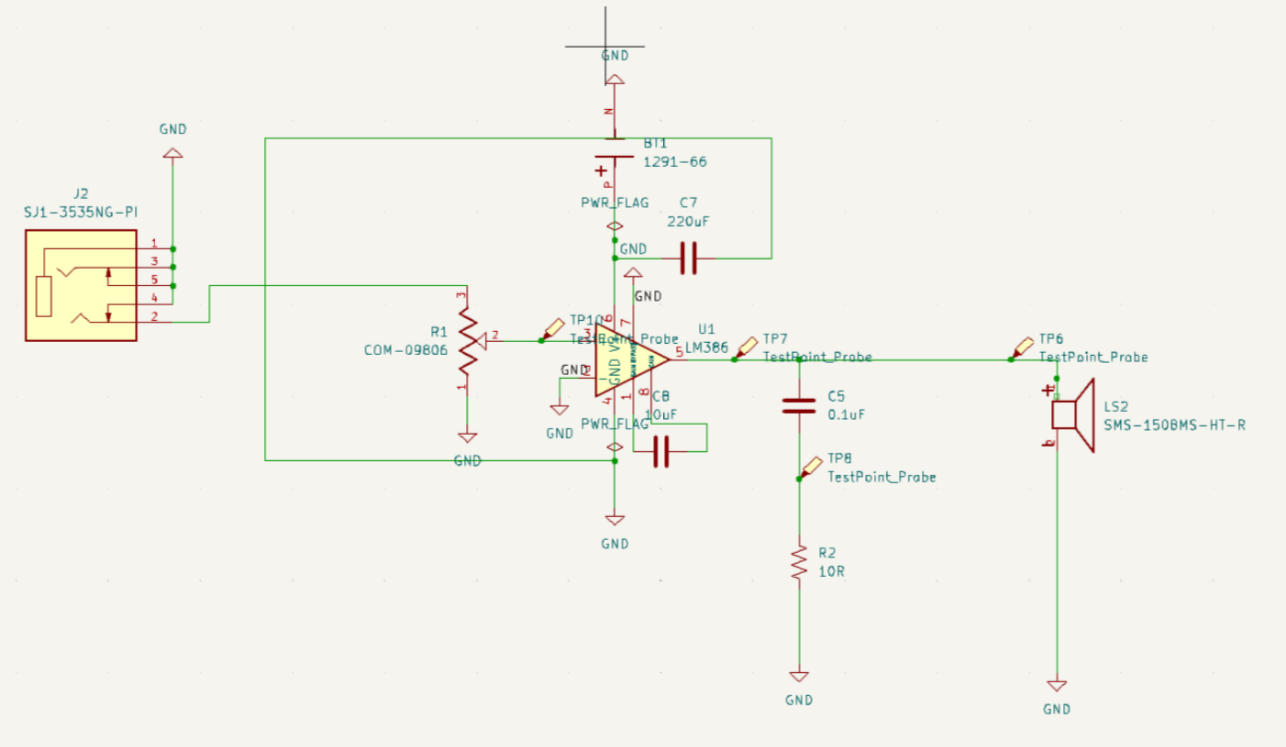
The circuit takes in a signal from an audio jack, that is of a frequency from about 40 Hz to 22 kHz (the range of human hearing). The LM 378 is supplied with 9 volts and the gain is at most 200 times.
Speaker is an open-source printed circuit board by gregory-chekler, from the gregory-chekler/Volume-Adjusting-Speaker-PCB repository on GitHub. It is a 2-layer board of 76.2 × 76.2 mm with 12 parts on 8 nets, routed with 79 tracks and 0 vias.
It is built around the LM386, SJ1-3535NG-PI and SMS-1508MS-HT-R. Its parts include 3 capacitors, 2 resistors, 1 IC and 1 connector. It belongs with the audio and music boards of this library.


The circuit takes in a signal from an audio jack, that is of a frequency from about 40 Hz to 22 kHz (the range of human hearing). The LM 378 is supplied with 9 volts and the gain is at most 200 times. There is a 10k potentiometer which can modify the gain in a range such that there is no output sound to the point where the sound is 200 times the initial amplitude of the signal. We chose the values shown below as specified in the LM378 datasheet in order to get a maximum of 200 times gain. We chose a potentiometer to regulate how much of the audio signal we want to pass through. The output is governed by this equation: Vout = 200*(10k - R) * Vin The variable resistance was connected to the inverting input so the amount of voltage to the terminal could be changed.
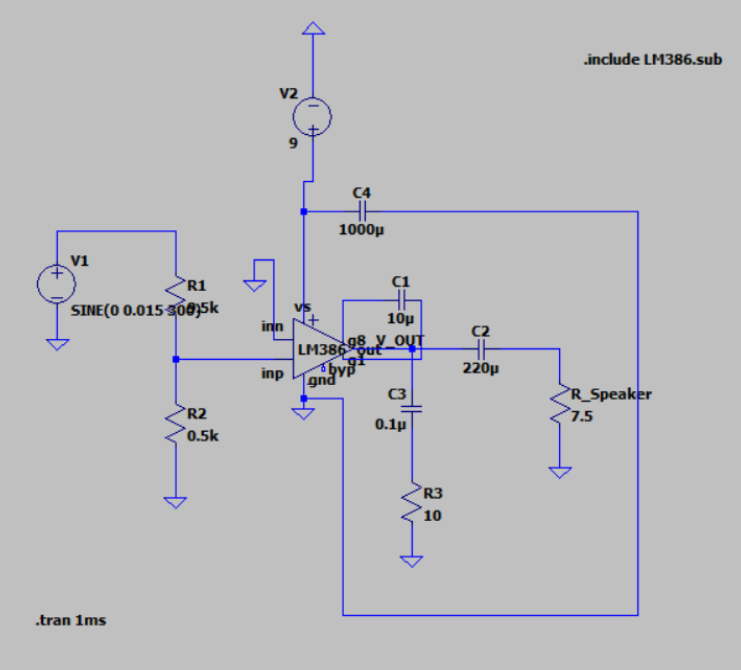
Input to speaker:

Output From Amplifier:

Voltage Across Speaker:

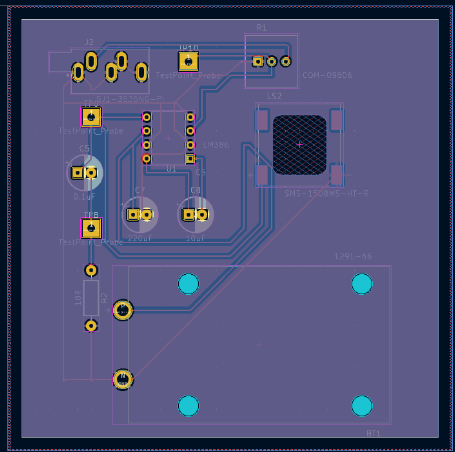
| Qty | Value | Footprint | References |
|---|---|---|---|
| 3 | TestPoint_Probe | elec240_ornament_footprint:TestPoint_THTPad_3.0x3.0mm_Drill1.5mm | TP6, TP8, TP10 |
| 1 | 0.1uF | elec240_ornament_footprint:CP_Radial_D6.3mm_P2.50mm | C5 |
| 1 | 10R | elec240_ornament_footprint:R_Axial_DIN0207_L6.3mm_D2.5mm_P10.16mm_Horizontal | R2 |
| 1 | 10uF | elec240_ornament_footprint:CP_Radial_D6.3mm_P2.50mm | C8 |
| 1 | 1291-66 | elec240_ornament_footprint:BAT_1291-66 | BT1 |
| 1 | 220uF | elec240_ornament_footprint:CP_Radial_D6.3mm_P2.50mm | C7 |
| 1 | COM-09806 | elec240_ornament_footprint:TRIM_COM-09806 | R1 |
| 1 | LM386 | elec240_ornament_footprint:DIP794W45P254L959H508Q8 | U1 |
| 1 | SJ1-3535NG-PI | elec240_ornament_footprint:CUI_SJ1-3535NG-PI | J2 |
| 1 | SMS-1508MS-HT-R | elec240_ornament_footprint:SPKR_SMS-1508MS-HT-R | LS2 |


profdc9/RFBitBanger
A QRP digital transceiver created from readily available parts for off-the-grid maintenance

mattybrad/drumkid
Version 4 was the first successful working design, with full code, schematics, Gerbers, etc available on GitHub.

leomil72/LM80C
A Z80-based homebrew computer withTMS9918, AY-3-8910, Z80 CTC, Z80 PIO, and Z80 SIO


oskitone/poly555
The POLY555 is a polyphonic, analog, square wave synth based on the 555 timer chip.

robfinch/Cores
Cores ===== RTF's Cores Use at your own risk. Welcome to my galaxy of cores. Contained in the directories are IP cores, source code for digital circuits.
It measures 76.2 × 76.2 mm and has 2 copper layers, 1.6 mm thick.
12 parts, built around the LM386, SJ1-3535NG-PI and SMS-1508MS-HT-R. The full list of its parts is on this page, with links to each part's symbol and footprint where PCBKit's library has them.
From the gregory-chekler/Volume-Adjusting-Speaker-PCB repository on GitHub, at the commit this page was made from: the board is Speaker.kicad_pcb and its schematic Speaker.kicad_sch. PCBKit opens the board in the browser, with nothing to install.
Its repository states no licence, so its author keeps all rights: ask gregory-chekler before reusing the design.