

4 layers68.6 × 53.3 mm

A VERY small FPGA based 10 pixel POV module.
PpPOV is an open-source printed circuit board by gregdavill, from the gregdavill/Perplexingly-Petite-Pov repository on GitHub, published under the MIT licence. It is a 4-layer board of 6.3 × 6.4 mm with 25 parts on 33 nets, routed with 238 tracks and 17 vias.
It is built around the SIT8008BI and TLV733PDBV. Its parts include 10 diodes, 7 connectors, 5 ICs, 2 capacitors and 1 resistor. It belongs with the FPGA and CPLD boards of this library.
Current Status: Design Proof of concept.
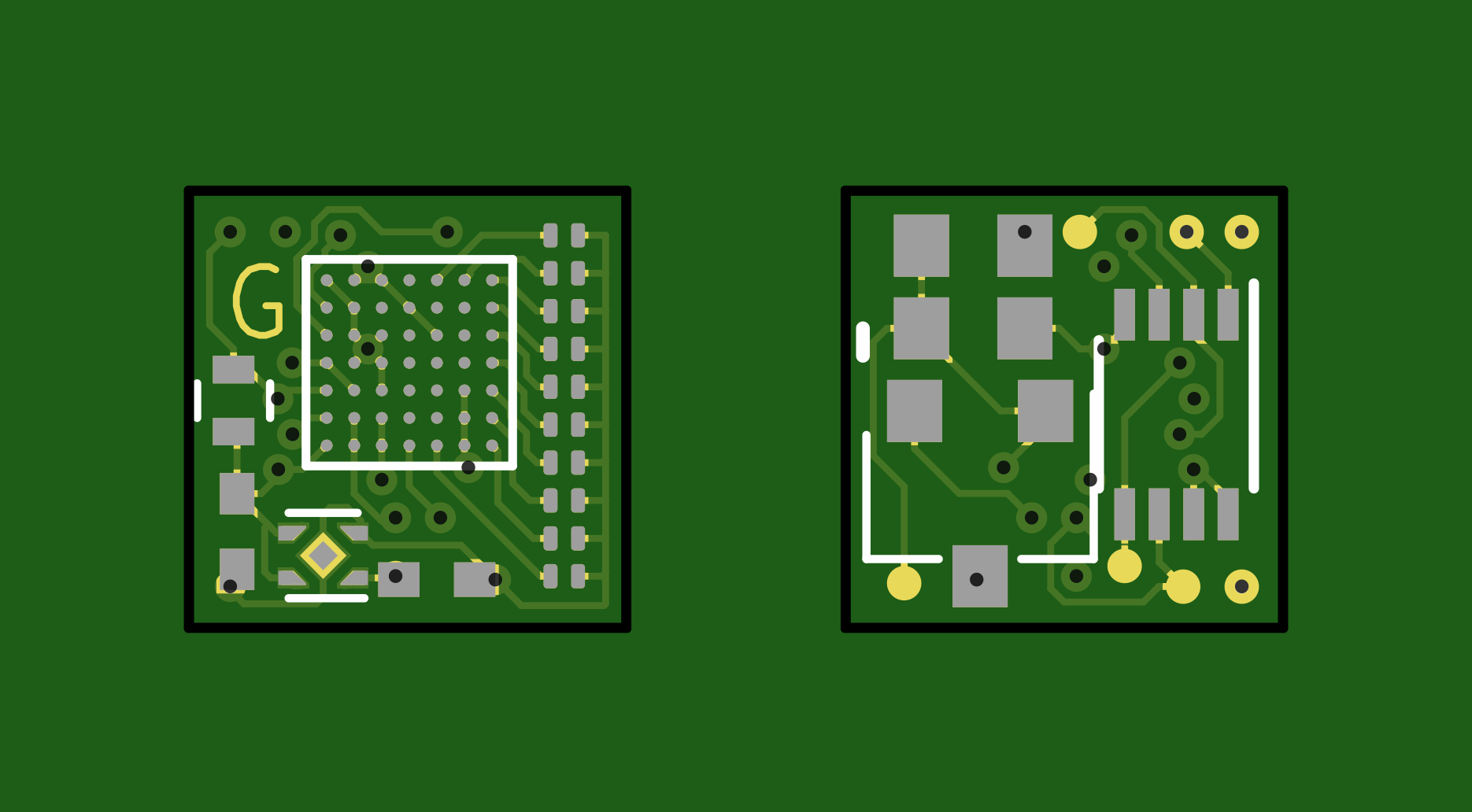
The PCB is intended to be mounted at the edge of a computer fan, it should have all the hardware required to syncronise to the RPM, and keep time, display a rolling text Marquee.
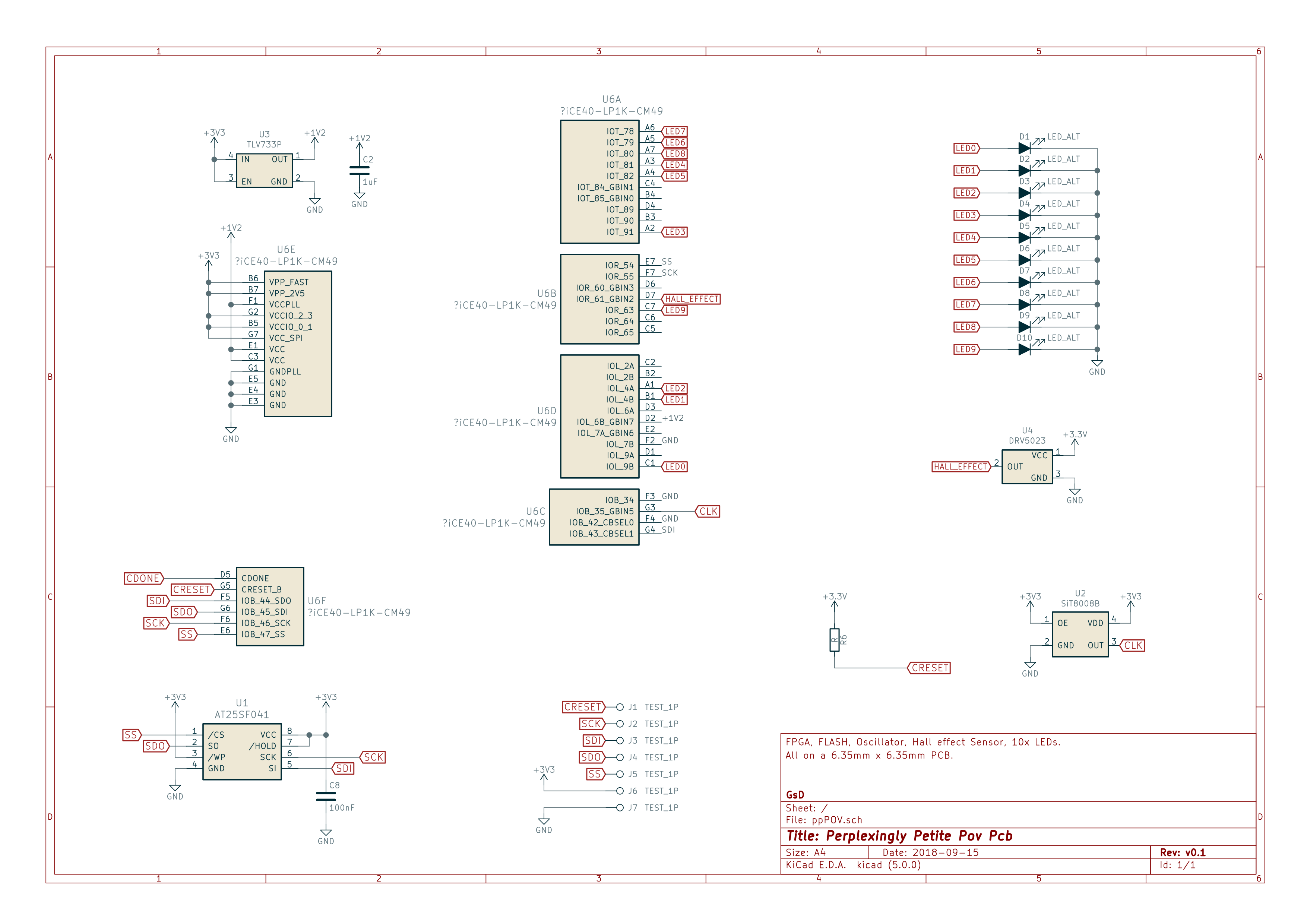
The Firmware has not been written yet, once the hardware is prototyped we can throw this over the cubicle wall to the firmware team.
| Qty | Value | Footprint | References |
|---|---|---|---|
| 10 | LED_ALT | tinyfpga:0201_led | D1, D2, D3, D4, D5, D6, D7, D8, D9, D10 |
| 7 | TEST_1P | Measurement_Points:Measurement_Point_Round-SMD-Pad_Small | J1, J2, J3, J4, J5, J6, J7 |
| 1 | 100nF | Capacitors_SMD:C_0402_NoSilk | C8 |
| 1 | 1uF | Capacitors_SMD:C_0402_NoSilk | C2 |
| 1 | AT25SF041 | Housings_DFN_QFN:DFN-8-1EP_3x2mm_Pitch0.5mm | U1 |
| 1 | DRV5023 | TO_SOT_Packages_SMD:SC-59 | U4 |
| 1 | R | Resistors_SMD:R_0402 | R6 |
| 1 | SiT8008B | tinyfpga:CDFN3225-4LD-PL-1 | U2 |
| 1 | TLV733P | Housings_SON:TI_X2SON-4_1x1mm_Pitch0.65mm | U3 |
| 1 | iCE40-LP1K-CM49 | tinyfpga:VFBGA-49 | U6 |
It measures 6.3 × 6.4 mm and has 4 copper layers, 0.8 mm thick.
25 parts, built around the SIT8008BI and TLV733PDBV. The full list of its parts is on this page, with links to each part's symbol and footprint where PCBKit's library has them.
From the gregdavill/Perplexingly-Petite-Pov repository on GitHub, at the commit this page was made from: the board is hw/idea_001/ppPOV.kicad_pcb. PCBKit opens the board in the browser, with nothing to install.
Its repository publishes it under the MIT licence: you may reuse it on that licence's terms (keep the author's notice, and for a copyleft licence share your changes alike).


EasternEdgeRobotics/Electrical_2019
Repository for holding PCB designs, Pspice files, and other shocking thigns!


oomlout/oomlout_oomp_project_bot_v_2

menloresearch/asimov-1
v1 of Asimov, an open-source humanoid robot

opentac/opentac
OpenTac: open tools to design, fabricate, read and simulate flex-PCB tactile skins that sense normal and shear force, for any robot surface.