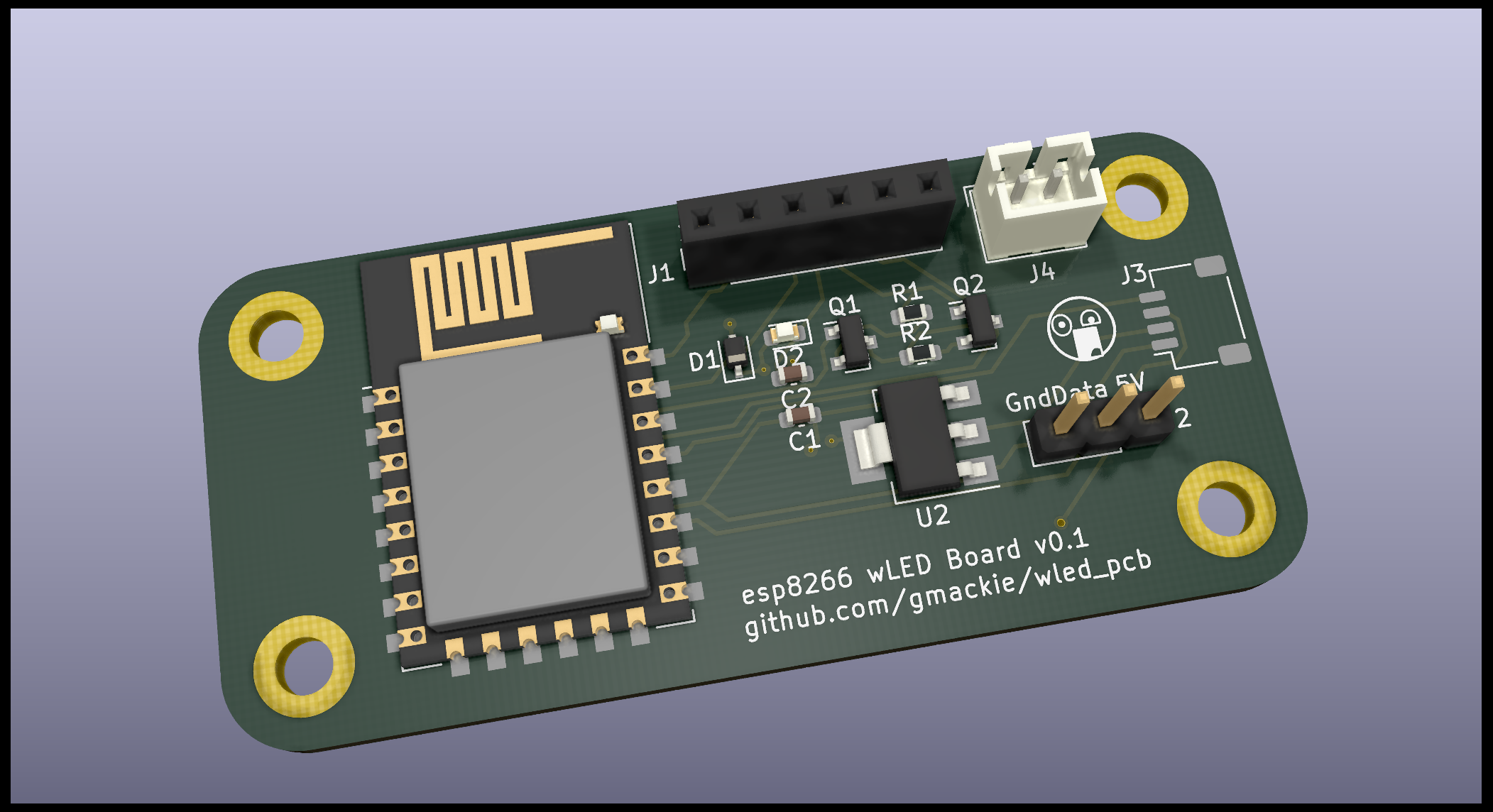
2 layers49.4 × 35.8 mm
WS2812Controller
klein0r/pcb-ws2812-wifi-controller
WiFi Controller for WS2812 LED Stripes
22 parts82MIT

 gmackie/wled_pcb
A PCB for running wLED on an ESP8266
Wled is an open-source printed circuit board by gmackie, from the gmackie/wled_pcb repository on GitHub, published under the MIT licence. It is a 2-layer board of 61.5 × 28.4 mm with 23 parts on 15 nets, routed with 167 tracks and 27 vias.
It is built around the ESP-12F and AMS1117-3.3. Its parts include 5 resistors, 4 diodes, 4 connectors, 2 capacitors and 2 ICs. It belongs with the ESP8266 boards of this library.


| Qty | Value | Footprint | References |
|---|---|---|---|
| 4 | MountingHole | MountingHole:MountingHole_3.2mm_M3_DIN965_Pad | H1, H2, H3, H4 |
| 3 | 10K | Resistor_SMD:R_0603_1608Metric_Pad0.98x0.95mm_HandSolder | R1, R2, R4 |
| 3 | LED | LED_SMD:LED_0603_1608Metric | D2, D3, D4 |
| 2 | 10uF | Capacitor_SMD:C_0603_1608Metric | C1, C2 |
| 2 | 250 | Resistor_SMD:R_0603_1608Metric_Pad0.98x0.95mm_HandSolder | R3, R5 |
| 1 | 1N5819 | Diode_SMD:D_SOD-323 | D1 |
| 1 | AMS1117-3.3 | Package_TO_SOT_SMD:SOT-223-3_TabPin2 | U2 |
| 1 | ESP-12F | RF_Module:ESP-12E | U1 |
| 1 | FLASH | Button_Switch_SMD:SW_SPST_B3S-1000 | SW2 |
| 1 | LED0 | Connector_PinHeader_2.54mm:PinHeader_1x03_P2.54mm_Vertical | J2 |
| 1 | POWER | Connector_JST:JST_XH_B2B-XH-A_1x02_P2.50mm_Vertical | J4 |
| 1 | PROGRAM_HEADER | Connector_JST:JST_XH_B6B-XH-A_1x06_P2.50mm_Vertical | J1 |
| 1 | QWIIC | Connector_JST:JST_SH_SM04B-SRSS-TB_1x04-1MP_P1.00mm_Horizontal | J3 |
| 1 | RESET | Button_Switch_SMD:SW_SPST_B3S-1000 | SW1 |
klein0r/pcb-ws2812-wifi-controller
WiFi Controller for WS2812 LED Stripes


klein0r/pcb-ttl-ftdi-esp-adapter
PCB to connect a TTL reader either to an FTDI or ESP12-E/F (WiFi)


piwko28/smart-home-ebus-adapter
eBUS adapter PCB for use with ebusd-esp firmware as well as with other UART devices.


alextrical/ESP8266-Sentinel-Kinetic-Wired-Remote
ESP8266 based Re-implementation of the Vent-Axia Sentinel Kinetic Wired Remote Controller
It measures 61.5 × 28.4 mm and has 2 copper layers, 1.6 mm thick.
23 parts, built around the ESP-12F and AMS1117-3.3. The full list of its parts is on this page, with links to each part's symbol and footprint where PCBKit's library has them.
From the gmackie/wled_pcb repository on GitHub, at the commit this page was made from: the board is wled.kicad_pcb and its schematic wled.kicad_sch. PCBKit opens the board in the browser, with nothing to install.
Its repository publishes it under the MIT licence: you may reuse it on that licence's terms (keep the author's notice, and for a copyleft licence share your changes alike).