2 layers131.2 × 132.5 mm

 GLOXIOU/MIDI-controller-DIY2
A DIY project for a MIDI controller designed to control lights, featuring knobs, faders, and buttons.
KiCad - MIDI controller is an open-source printed circuit board by GLOXIOU, from the GLOXIOU/MIDI-controller-DIY repository on GitHub. It is a 2-layer board of 241 × 107.8 mm with 73 parts on 92 nets, routed with 1,876 tracks and 286 vias.
Its parts include 23 switches, 20 diodes and 3 ICs. It belongs with the audio and music boards and the ESP32 boards of this library.
A DIY project for a MIDI controller designed to control lights, featuring knobs, faders, and buttons.
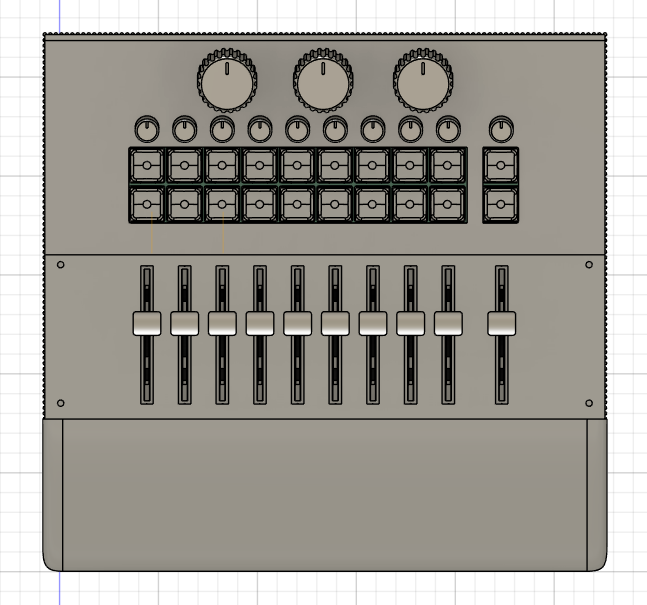
The project is designed to manage stage lighting systems with up to 10 faders, including a master one, 20 keyboard keys, 10 potards, and 3 rotary encoders.
The goal is to not pay hundreds of dollars for an already existing product, and learn! MIDI controller DIY is also intended to be a hardware platform for a future open-source lighting-control system.
And the design is made to be upgradable/updatable easily if necessary, so it will be able to last over time.
The ESP32-S3 is the central processor of the system. It handles USB-C communication and MIDI processing. To connect the ESP32 with all of the 43 components, there are 2 MUX units at the right of the box. 43 buttons, faders, etc., are fully customizable and you can use them as you want.
The current design uses the following main components:
| Component | Quantity | Price |
|---|---|---|
| Kailh Choc V1 1350 | 20 | 9.86$ |
| RV09 B10K 9 mm vertical | 10 | 7.90$ |
| EC11 through-hole with push-button, 20 mm shaft | 3 | 5.36$ |
| CD4067BE in DIP-24 | 2 | 6.69$ |
| 1N4148 diodes | 20 | 1.64$ |
| faders SC6021N 10k | 10 | 9$ |
| ESP32-S3 N16R8 | 1 | 8.02$ |
| Knobs cap | 10 | 2.68$ |
| PCB | 1 | 16,60$ |
| Lowprofile keycaps | 20 | 17.34$ |
| Total | --- | 85.09$ |
The complete component list is available in BOM.csv.
I selected the ESP32-S3 because the project requires a bit of processing power for MIDI handling, though not a huge amount. That’s why it’s better suited for the task than a Raspberry Pi.
It is responsible for:
All the data, saves, and other settings are stored in the internal storage system of the ESP32.
The MIDI controller is designed to support lighting control software like grandMA onPC, QLC+, or others via standard MIDI remote commands.
Each hardware input reads multiple analog faders, push buttons, and encoders through multiplexers or direct GPIO pins on the ESP32.
Standard USB-MIDI and serial communication protocols are used, handled by the hardware USB/UART interfaces on the microcontroller.
The MIDI data rate operates at standard MIDI baud rates or high-speed USB-MIDI.
For example, moving a physical fader transmits a Control Change (CC) message to precisely control lighting playback levels in software.
There is a PCB in this project because it's required. Here are all the components included:
Here's a screenshot of the PCB with some of the components:
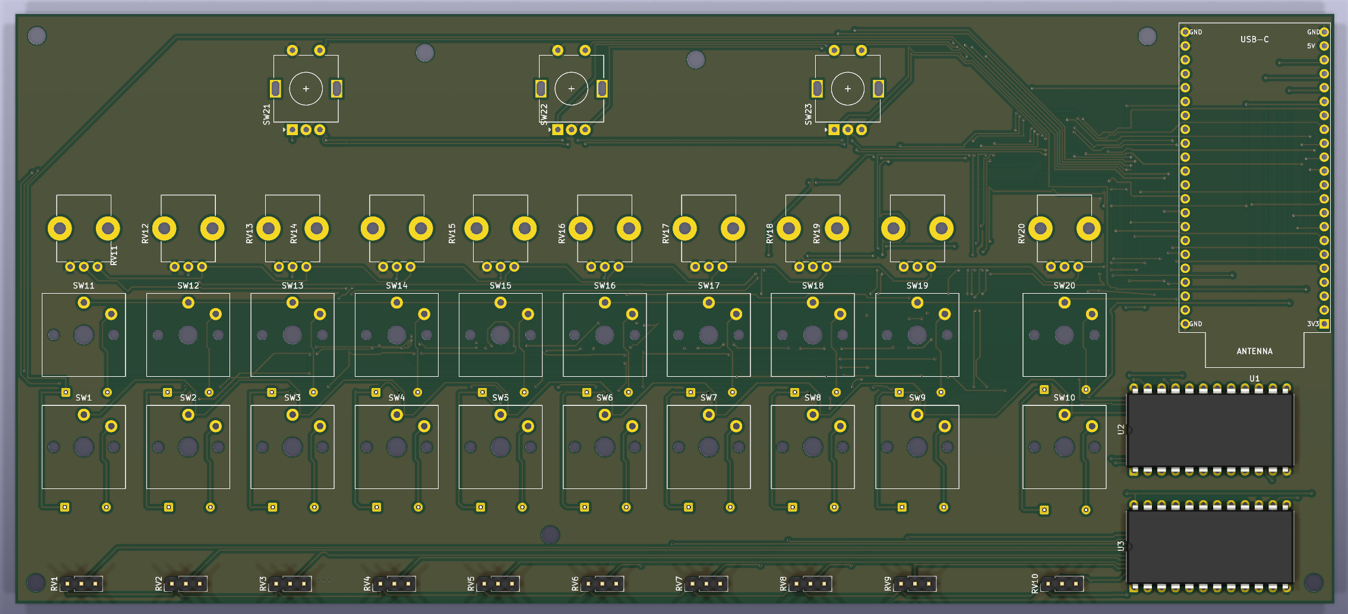
The PCB file is here. And you can modify it using KiCad with this folder.
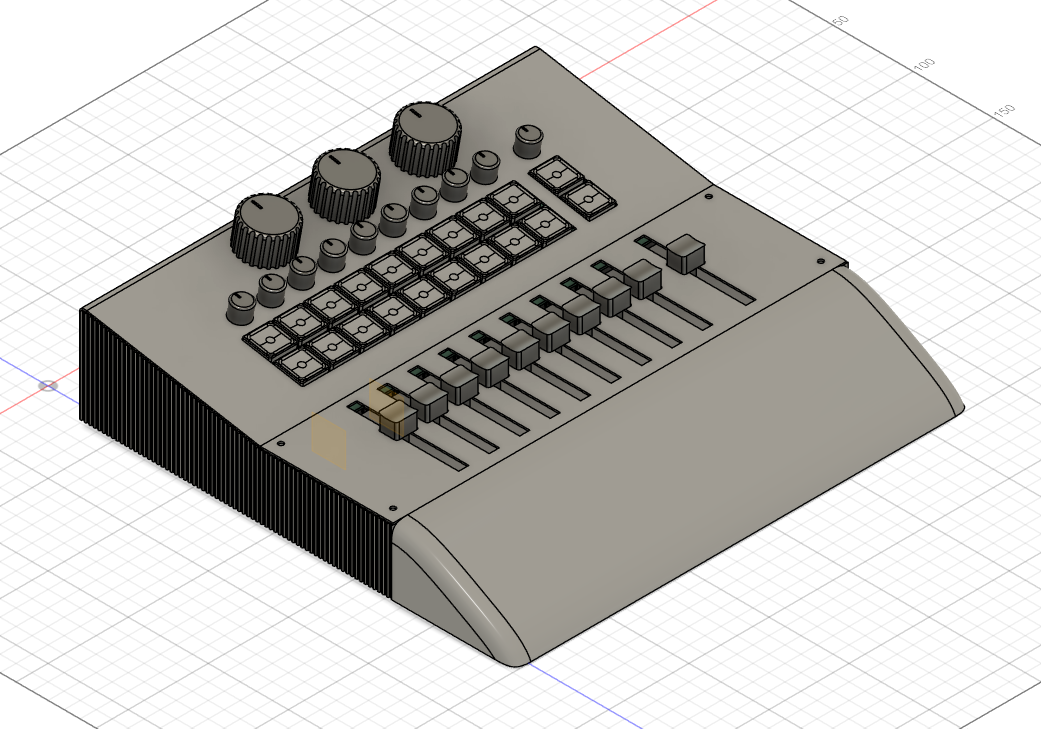
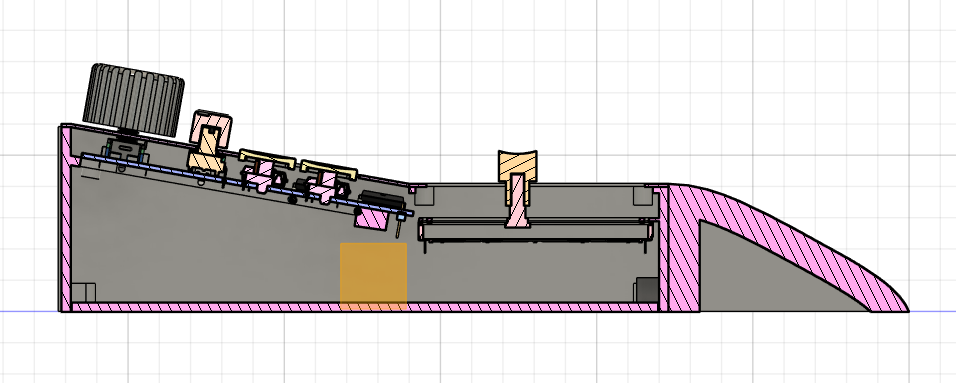
The case is 283mm x 250mm x 60mm, and is designed to perfectly house all components, be easy to install, not take up much space, and be durable.
Here's a look at it:
Assembly file: assembly-Midi-controller-DIY.step
Print file: to print
The current estimate is $85.09 of components. This does not include assembly, enclosure parts, future design changes, or the print filament that I already have.
The development process is documented in JOURNAL.md.
It includes in-depth design, configuration, part of the code, enclosure design, BOM creation, and the problems encountered during development.
The MIDI Controller DIY project was inspired by the GrandMa Wing.
The MIDI Controller DIY is an independent design developed from this inspiration.
Credits:
| Qty | Value | Footprint | References |
|---|---|---|---|
| 20 | 1N4148 | Diode_THT:D_DO-35_SOD27_P7.62mm_Horizontal | D1, D2, D3, D4, D5, D10, D11, D12, D13, D14, D15, D16, D17, D18, D19, D20 +4 |
| 20 | Kailh Choc V1 | MIDI-controller:SW_Kailh_Choc_V1_1.00u | SW1, SW2, SW3, SW4, SW5, SW10, SW11, SW12, SW13, SW14, SW15, SW16, SW17, SW18, SW19, SW20 +4 |
| 10 | RV09 10k | Potentiometer_THT:Potentiometer_Bourns_PTV09A-1_Single_Vertical | RV11, RV12, RV13, RV14, RV15, RV16, RV17, RV18, RV19, RV20 |
| 10 | SC1009G 10k | Connector_PinHeader_2.54mm:PinHeader_1x03_P2.54mm_Vertical | RV1, RV2, RV3, RV4, RV5, RV6, RV7, RV8, RV9, RV10 |
| 7 | M3 | MountingHole:MountingHole_3.2mm_M3 | H1, H2, H3, H4, H5, H6, H7 |
| 3 | EC11 (THT, switch) | Rotary_Encoder:RotaryEncoder_Alps_EC11E-Switch_Vertical_H20mm | SW21, SW22, SW23 |
| 2 | CD4067BE | Package_DIP:DIP-24_W15.24mm | U2, U3 |
| 1 | ESP32-S3 DevKit N16R8 | MIDI-controller:ESP32-S3-DevKitC-1_44P_W25.4mm | U1 |
It measures 241 × 107.8 mm and has 2 copper layers, 1.6 mm thick.
73 parts. The full list of its parts is on this page, with links to each part's symbol and footprint where PCBKit's library has them.
From the GLOXIOU/MIDI-controller-DIY repository on GitHub, at the commit this page was made from: the board is KiCad - MIDI-controller/KiCad - MIDI-controller.kicad_pcb and its schematic KiCad - MIDI-controller/KiCad - MIDI-controller.kicad_sch. PCBKit opens the board in the browser, with nothing to install.
Its repository states no licence, so its author keeps all rights: ask GLOXIOU before reusing the design.


hackclub/OnBoard
💡 Join 1,000 teenagers and make your first PCB with a $100 grant!


eddyem/stm32samples
Code samples and ready projects based on bare-metal STM32

