
2 layers
Nrf bga
github-linguist/linguist
Language Savant. If your repository's language is being reported incorrectly, send us a pull request!
12 parts14kMIT
 github-linguist/linguist14k
Language Savant. If your repository's language is being reported incorrectly, send us a pull request!
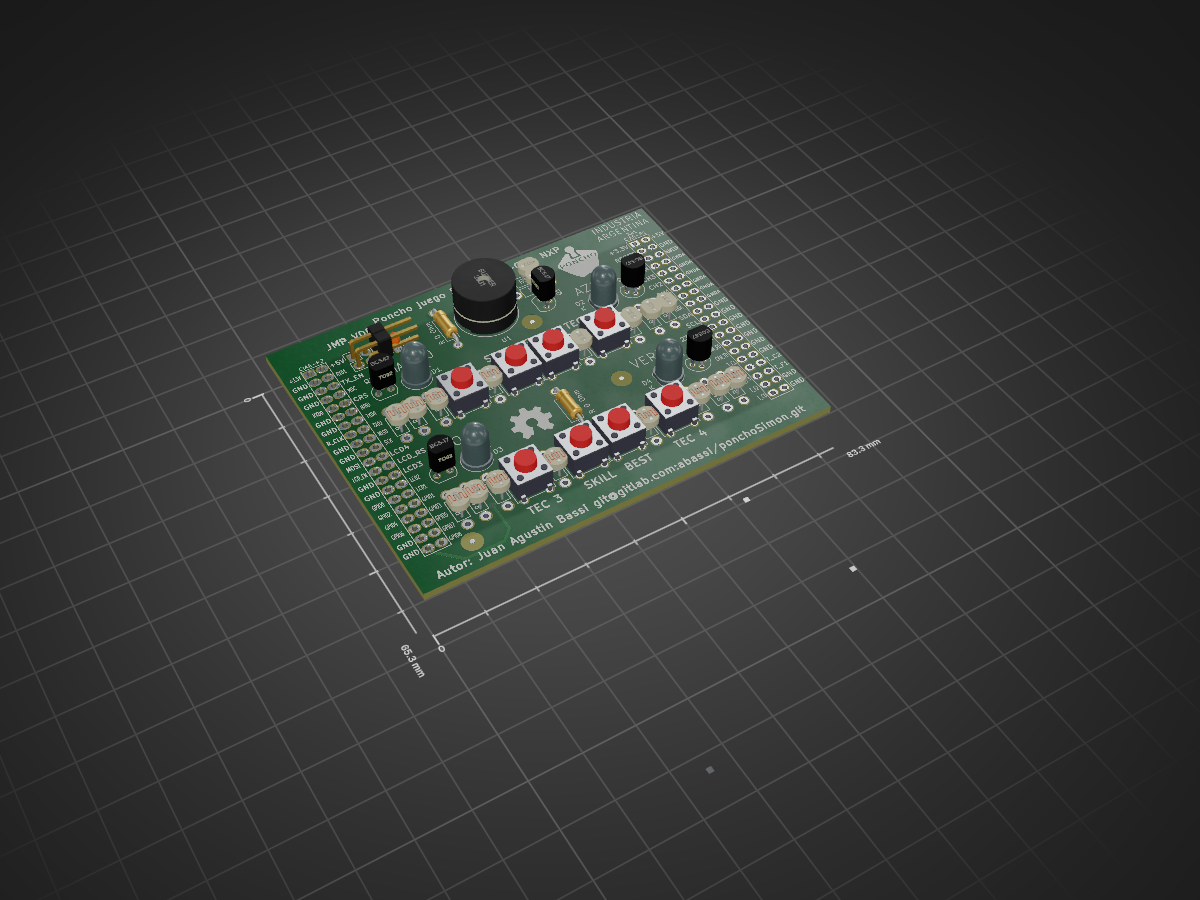
SimonShield is an open-source printed circuit board by github-linguist, from the github-linguist/linguist repository on GitHub, published under the MIT licence. It is a 2-layer board of 83.3 × 65.3 mm with 46 parts on 97 nets, routed with 426 tracks and 17 vias.
It is built around the BC547. Its parts include 18 resistors, 8 switches, 5 transistors, 4 diodes and 3 fuses.


This library is used on GitHub.com to detect blob languages, ignore binary or vendored files, suppress generated files in diffs, and generate language breakdown graphs.
Install the gem:
gem install github-linguistLinguist is a Ruby library so you will need a recent version of Ruby installed.
There are known problems with the macOS/Xcode supplied version of Ruby that causes problems installing some of the dependencies.
Accordingly, we highly recommend you install a version of Ruby using Homebrew, rbenv, rvm, ruby-build, asdf or other packaging system, before attempting to install Linguist and the dependencies.
Linguist uses charlock_holmes for character encoding and rugged for libgit2 bindings for Ruby.
These components have their own dependencies.
You may need to install missing dependencies before you can install Linguist. For example, on macOS with Homebrew:
brew install cmake pkg-config icu4cOn Ubuntu:
sudo apt-get install build-essential cmake pkg-config libicu-dev zlib1g-dev libcurl4-openssl-dev libssl-dev ruby-devLinguist can be used in your application as follows:
require 'rugged'
require 'linguist'

repo = Rugged::Repository.new('.')
project = Linguist::Repository.new(repo, repo.head.target_id)
project.language       #=> "Ruby"
project.languages #=> { "Ruby" => 119387 }The github-linguist executable operates in two distinct modes:
A repository's languages stats can be assessed from the command line using the github-linguist executable.
Without any options, github-linguist will output the language breakdown by percentage and file size.
cd /path-to-repository
github-linguist
You can try running github-linguist on the root directory in this repository itself:
$ github-linguist
66.84%  264519     Ruby
24.68%  97685      C
6.57%   25999      Go
1.29%   5098       Lex
0.32%   1257       Shell
0.31% 1212 Dockerfile--rev REVThe --rev REV flag will change the git revision being analyzed to any gitrevisions(1) compatible revision you specify.
This is useful to analyze the makeup of a repo as of a certain tag, or in a certain branch.
For example, here is the popular Jekyll open source project.
$ github-linguist jekyll

70.64%  709959     Ruby
23.04%  231555     Gherkin
3.80%   38178      JavaScript
1.19%   11943      HTML
0.79%   7900       Shell
0.23%   2279       Dockerfile
0.13%   1344       Earthly
0.10%   1019       CSS
0.06%   606        SCSS
0.02%   234        CoffeeScript
0.01%   90         Hack
And here is Jekyll's published website, from the gh-pages branch inside their repository.
$ github-linguist jekyll --rev origin/gh-pages
100.00% 2568354 HTML--breakdownThe --breakdown or -b flag will additionally show the breakdown of files by language.
You can try running github-linguist on the root directory in this repository itself:
$ github-linguist --breakdown
66.84%  264519     Ruby
24.68%  97685      C
6.57%   25999      Go
1.29%   5098       Lex
0.32%   1257       Shell
0.31%   1212       Dockerfile

Ruby:
Gemfile
Rakefile
bin/git-linguist
bin/github-linguist
ext/linguist/extconf.rb
github-linguist.gemspec
lib/linguist.rb
…--strategiesThe --strategies or -s flag will show the language detection strategy used for each file. This is useful for understanding how Linguist determined the language of specific files. Note that unless the --json flag is specified, this flag will set the --breakdown flag implicitly.
You can try running github-linguist on the root directory in this repository itself with the strategies flag:
$ github-linguist --breakdown --strategies
66.84%  264519     Ruby
24.68%  97685      C
6.57%   25999      Go
1.29%   5098       Lex
0.32%   1257       Shell
0.31%   1212       Dockerfile

Ruby:
  Gemfile [Filename]
  Rakefile [Filename]
  bin/git-linguist [Extension]
  bin/github-linguist [Extension]
  lib/linguist.rb [Extension]
  …
If a file's language is affected by .gitattributes, the strategy will show the original detection method along with a note indicating whether the gitattributes setting changed the result or confirmed it.
For instance, if you had the following .gitattributes overrides in your repo:
*.ts linguist-language=JavaScript
*.js linguist-language=JavaScript
the output of Linguist would be something like this:
100.00% 217        JavaScript

JavaScript:
  demo.ts [Heuristics (overridden by .gitattributes)]
demo.js [Extension (confirmed by .gitattributes)]--jsonThe --json or -j flag output the data into JSON format.
$ github-linguist --json
{"Dockerfile":{"size":1212,"percentage":"0.31"},"Ruby":{"size":264519,"percentage":"66.84"},"C":{"size":97685,"percentage":"24.68"},"Lex":{"size":5098,"percentage":"1.29"},"Shell":{"size":1257,"percentage":"0.32"},"Go":{"size":25999,"percentage":"6.57"}}
This option can be used in conjunction with --breakdown to get a full list of files along with the size and percentage data.
$ github-linguist --breakdown --json
{"Dockerfile":{"size":1212,"percentage":"0.31","files":["Dockerfile","tools/grammars/Dockerfile"]},"Ruby":{"size":264519,"percentage":"66.84","files":["Gemfile","Rakefile","bin/git-linguist","bin/github-linguist","ext/linguist/extconf.rb","github-linguist.gemspec","lib/linguist.rb",...]}}
NB. The --strategies flag has no effect, when the --json flag is present.
Alternatively you can find stats for a single file using the github-linguist executable.
You can try running github-linguist on files in this repository itself:
$ github-linguist grammars.yml
grammars.yml: 884 lines (884 sloc)
  type:      Text
  mime type: text/x-yaml
language: YAML--breakdownThis flag has no effect in Single file mode.
--strategiesWhen using the --strategies or -s flag with a single file, you can see which detection method was used:
$ github-linguist --strategies lib/linguist.rb
lib/linguist.rb: 105 lines (96 sloc)
  type:      Text
  mime type: application/x-ruby
  language:  Ruby
  strategy:  Extension
If a file's language is affected by .gitattributes, the strategy will show whether the gitattributes setting changed the result or confirmed it:
In this fictitious example, it says "confirmed by .gitattributes" since the detection process (using the Filename strategy) would have given the same output as the override:
.devcontainer/devcontainer.json: 27 lines (27 sloc)
  type:      Text
  mime type: application/json
  language:  JSON with Comments
  strategy:  Filename (confirmed by .gitattributes)
In this other fictitious example, it says "overridden by .gitattributes" since the gitattributes setting changes the detected language to something different:
test.rb: 13 lines (11 sloc)
  type:      Text
  mime type: application/x-ruby
  language:  Java
  strategy:  Extension (overridden by .gitattributes)
Here, the .rb file would normally be detected as Ruby by the Extension strategy, but .gitattributes overrides it to be detected as Java instead.
--jsonUsing the --json flag will give you the output for a single file in JSON format:
$ github-linguist --strategies --json  lib/linguist.rb
{"lib/linguist.rb":{"lines":105,"sloc":96,"type":"Text","mime_type":"application/x-ruby","language":"Ruby","large":false,"generated":false,"vendored":false}}
NB. The --strategies has no effect, when the --json flag is present.
If you have Docker installed you can either build or use our pre-built images and run Linguist within a container:
$ docker run --rm -v $(pwd):$(pwd):Z -w $(pwd) -t ghcr.io/github-linguist/linguist:latest
66.84%  264519     Ruby
24.68%  97685      C
6.57%   25999      Go
1.29%   5098       Lex
0.32%   1257       Shell
0.31% 1212 Dockerfile$ docker build -t linguist .
$ docker run --rm -v $(pwd):$(pwd):Z -w $(pwd) -t linguist
66.84% 264519 Ruby
24.68% 97685 C
6.57% 25999 Go
1.29% 5098 Lex
0.32% 1257 Shell
0.31% 1212 Dockerfile
$ docker run --rm -v $(pwd):$(pwd) -w $(pwd) -t linguist github-linguist --breakdown
66.84% 264519 Ruby
24.68% 97685 C
6.57% 25999 Go
1.29% 5098 Lex
0.32% 1257 Shell
0.31% 1212 Dockerfile
Ruby:
Gemfile
Rakefile
bin/git-linguist
bin/github-linguist
ext/linguist/extconf.rb
github-linguist.gemspec
lib/linguist.rb
…Please check out our contributing guidelines.
The language grammars included in this gem are covered by their repositories' respective licenses.
vendor/README.md lists the repository for each grammar.
All other files are covered by the MIT license, see LICENSE.
| Qty | Value | Footprint | References |
|---|---|---|---|
| 9 | 3K3 | simonShield:Resistor_Horizontal_RM7mm | R1, R2, R3, R4, R5, R6, R7, R8, R9 |
| 8 | SW_PUSH | simonShield:SW_PUSH_SMALL | SW1, SW2, SW3, SW4, SW5, SW6, SW7, SW8 |
| 5 | BC547 | simonShield:TO-92_Molded_Narrow | Q1, Q2, Q3, Q4, Q5 |
| 4 | 10K | simonShield:Resistor_Horizontal_RM7mm | R11, R13, R15, R17 |
| 4 | 680 | simonShield:Resistor_Horizontal_RM7mm | R12, R14, R16, R18 |
| 3 | FIDUCIAL | simonShield:Fiducial_1mm | F1, F2, F3 |
| 2 | R | Resistors_THT:R_Axial_DIN0207_L6.3mm_D2.5mm_P10.16mm_Horizontal | R 0 Ohm, R 0 Ohm |
| 1 | 1K | simonShield:Resistor_Horizontal_RM7mm | R10 |
| 1 | AMARILLO | simonShield:LED-5MM | D1 |
| 1 | AZUL | simonShield:LED-5MM | D2 |
| 1 | BUZZER | simonShield:MagneticBuzzer_ProSignal_ABT-410-RC | U1 |
| 1 | C_100nF | simonShield:C_Disc_D3_P2.5 | C1 |
| 1 | Conn_Poncho2P_2x_20x2 | simonShield:Conn_Poncho_SinBorde | XA1 |
| 1 | LOGO | simonShield:Logo_Poncho | G*** |
| 1 | Logo_OSHWA | simonShield:Logo_OSHWA | G101 |
| 1 | PWR_JUMPER | simonShield:Pin_Header_Straight_2x02 | P1 |
| 1 | ROJO | simonShield:LED-5MM | D3 |
| 1 | VERDE | simonShield:LED-5MM | D4 |
github-linguist/linguist
Language Savant. If your repository's language is being reported incorrectly, send us a pull request!

dotnet/iot
This repo includes .NET Core implementations for various IoT boards, chips, displays and PCBs.

peterheinrich/InternetOverSpaghetti
Transmitting IP packages over a pair of spaghetti thus demonstrating how media independent IP really is.

tebl/RC6502-Apple-1-Replica
An expandable SBC-version of the Apple 1 computer, easy to get started with and lot of cool stuff that can be added to it!


ZeroPhone/ZeroPhone-PCBs
PCB files for ZeroPhone - for gerbers and schematics, go to "Releases" tab!


AK-Homberger/NMEA2000WifiGateway-with-ESP32
This repository shows how to build a NMEA2000 WiFi Gateway with voltage and temperature alarms.
It measures 83.3 × 65.3 mm and has 2 copper layers, 1.6 mm thick.
46 parts, built around the BC547. The full list of its parts is on this page, with links to each part's symbol and footprint where PCBKit's library has them.
From the github-linguist/linguist repository on GitHub, at the commit this page was made from: the board is samples/KiCad Layout/simonShield.kicad_pcb and its schematic samples/KiCad Schematic/rpi-cm4-carrier-template.kicad_sch. PCBKit opens the board in the browser, with nothing to install.
Its repository publishes it under the MIT licence: you may reuse it on that licence's terms (keep the author's notice, and for a copyleft licence share your changes alike).