2 layers335 × 218.6 mm

 gilkeidar/ByteFrost5
Software Tools for ByteFrost - A Breadboard 8-Bit Computer
ByteFrost is an open-source printed circuit board by gilkeidar, from the gilkeidar/ByteFrost repository on GitHub. It is a 2-layer board with 36 parts on 81 nets.
It is built around the 74HC374, 74HC00D and 74HC02, with the 74HC139D, 74HC14 and 74HC153D among its other parts. Its parts include 14 resistors, 14 ICs, 4 diodes and 4 switches. It belongs with the retro computing and games boards of this library.


 The Breadboard 8-bit CPU and Computer
Be sure to check out the YouTube channel for more in-depth explanations of how the ByteFrost works!
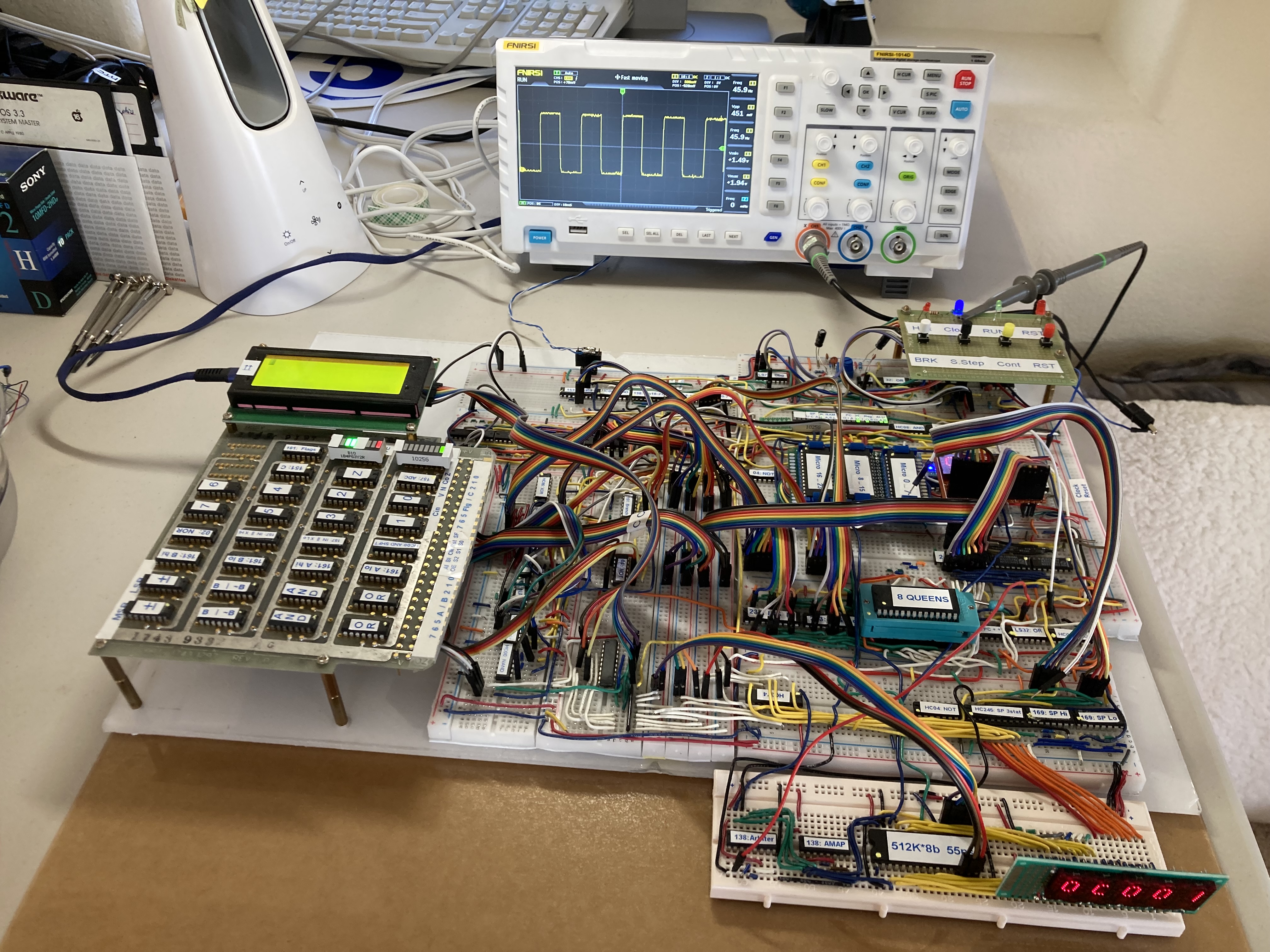 ByteFrost under development
In this Github repository are software tools for using the ByteFrost computer:
Assembler program that converts Assembly code to ByteFrost machine language.
Note: The Assembler/ directory contains the deprecated assembler;
Assembler V2/ contains the new assembler, which also has new preprocessing
features, assembly instructions that can be translated to multiple ISA
instructions, and support for the new 16-bit memory address space expansion.
Arduino code for the ByteFrost's display card (an Arduino Nano) for a 2004A LCD display.
Arduino code for the ByteFrost's disk controller (an Arduino MKR Zero) for a micro SD card that serves as the ByteFrost's disk.
Also included is software for handling ByteFrost disk files using the ByteFrost FileSystem (BFSv1), a very rudimentary filesystem with one root directory.
Documentation for the ByteFrost computer. Includes hardware documentation (i.e. schematics) and software documentation (instruction set specifications, control signal lists, each instruction's micro-code and structure, and assembly syntax). For more documentation, see the wiki.
Arduino code for programming the three microcode EEPROMs (using Ben Eater's EEPROM programmer as a basis).
Programs written in ByteFrost assembly that can be compiled using the assembler and run on the ByteFrost computer. Each program comes with the assembly code (.asm file), machine language compilation (.mlg file), and a binary file (.bin file).
The ByteFrost is a 2-person father-son project (by Gil and Ron Keidar) that we have been working on on-and-off (mostly during vacation between university quarters) for a few years (since March 2022).
My (Gil's) idea behind creating the ByteFrost was to work on a project that covers many abstraction layers in computer science (all of the way from the discrete logic layer to the application layer) and to, in the process, learn about and get hands-on experience with those layers.
| Qty | Value | Footprint | References |
|---|---|---|---|
| 6 | 5.1K | Resistor_THT:R_Axial_DIN0207_L6.3mm_D2.5mm_P10.16mm_Horizontal | R106, R109, R110, R111, R401, R404 |
| 4 | 74HC374 | Package_DIP:DIP-20_W7.62mm_Socket | U1, U2, U3, U4 |
| 3 | 10K | Resistor_THT:R_Axial_DIN0207_L6.3mm_D2.5mm_P10.16mm_Horizontal | R101, R107, R108 |
| 3 | ICM7555xB | Package_SO:SOIC-8_3.9x4.9mm_P1.27mm | U101, U102, U401 |
| 2 | LED (red) | LED_THT:LED_D5.0mm | D102, D401 |
| 1 | 100 | Resistor_THT:R_Axial_DIN0207_L6.3mm_D2.5mm_P10.16mm_Horizontal | R102 |
| 1 | 17K | Resistor_THT:R_Axial_DIN0207_L6.3mm_D2.5mm_P10.16mm_Horizontal | R402 |
| 1 | 20K | Resistor_THT:R_Axial_DIN0207_L6.3mm_D2.5mm_P10.16mm_Horizontal | R105 |
| 1 | 212K | Resistor_THT:R_Axial_DIN0207_L6.3mm_D2.5mm_P10.16mm_Horizontal | R104 |
| 1 | 51K | Resistor_THT:R_Axial_DIN0207_L6.3mm_D2.5mm_P10.16mm_Horizontal | R403 |
| 1 | 74HC00 | Package_DIP:DIP-14_W7.62mm_Socket | U105 |
| 1 | 74HC02 | Package_DIP:DIP-14_W7.62mm_Socket | U6 |
| 1 | 74HC139 | Package_DIP:DIP-16_W7.62mm_Socket | U5 |
| 1 | 74HC14 | Package_DIP:DIP-14_W7.62mm_Socket | U402 |
| 1 | 74HC153 | Package_DIP:DIP-16_W7.62mm_Socket | U7 |
| 1 | 74HC32 | Package_DIP:DIP-14_W7.62mm_Socket | U104 |
| 1 | 74HC76 | Package_DIP:DIP-16_W7.62mm_Socket | U103 |
| 1 | Break | Button_Switch_THT:SW_PUSH_6mm_H7.3mm | SW102 |
| 1 | Cont. | Button_Switch_THT:SW_PUSH_6mm_H7.3mm | SW103 |
| 1 | LED (blue) | LED_THT:LED_D5.0mm | D103 |
| 1 | LED (green) | LED_THT:LED_D5.0mm | D101 |
| 1 | Reset | Button_Switch_THT:SW_PUSH_6mm_H7.3mm | SW401 |
| 1 | Single_Step | Button_Switch_THT:SW_PUSH_6mm_H7.3mm | SW101 |
36 parts, built around the 74HC374, 74HC00D, 74HC02 and 74HC139D. The full list of its parts is on this page, with links to each part's symbol and footprint where PCBKit's library has them.
From the gilkeidar/ByteFrost repository on GitHub, at the commit this page was made from: the board is PCB/KiCAD/ByteFrost/ByteFrost.kicad_pcb and its schematic PCB/KiCAD/ByteFrost/ByteFrost.kicad_sch. PCBKit opens the board in the browser, with nothing to install.
Its repository states no licence, so its author keeps all rights: ask gilkeidar before reusing the design.


KITTY-6502/hardware
the KITTY is a 65c02 homebrew kit microcomputer designed around text mode graphics and cartridge media. It is fully open source, and uses exclusively in-production parts.


Trilobyte-CPU/8-bit-computer
A DIY 8-bit computer built mostly with discrete logic chips

stonedDiscord/Automatenplatinen
Reverse engineerte Hardware aus deutschen Spielautomaten.

artemisamsx/artemisa
Schematics, PCB designs and HDL simulations to build a 8-bits MSX computer