2 layers40 × 20 mm
 frederickk/prost10
Brings 2 Midi host devices to the table of data sharing. Intermediary device to allow Midi host to Midi host communication.
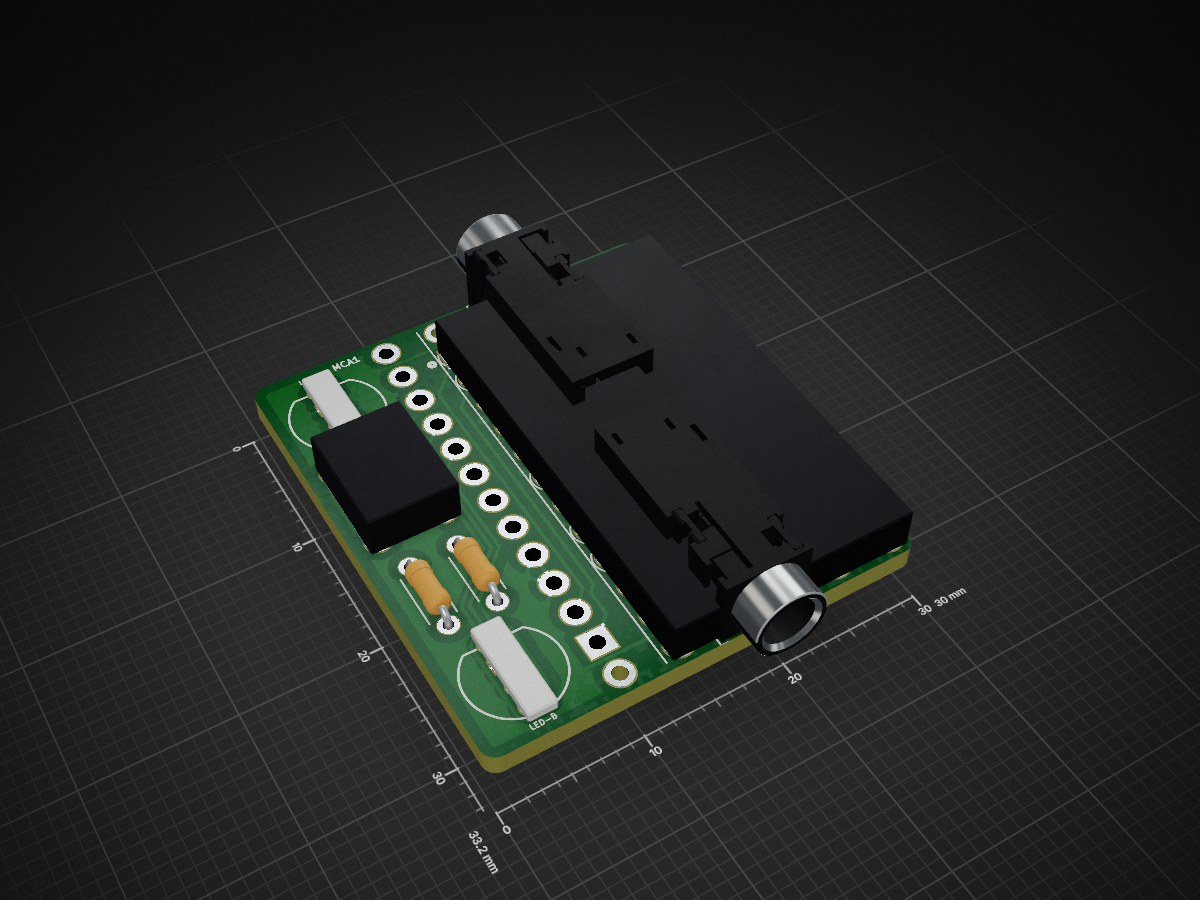
Prost pcb is an open-source printed circuit board by frederickk, from the frederickk/prost repository on GitHub, published under the MIT licence. It is a 2-layer board of 30 × 33.2 mm with 13 parts on 43 nets, routed with 166 tracks and 2 vias.
Its parts include 2 resistors, 2 diodes, 2 connectors and 1 switch. It belongs with the AVR (ATmega, ATtiny) boards of this library.
v.0.1.2
(Pros + Host) x 2 = Prost! SWDIT?
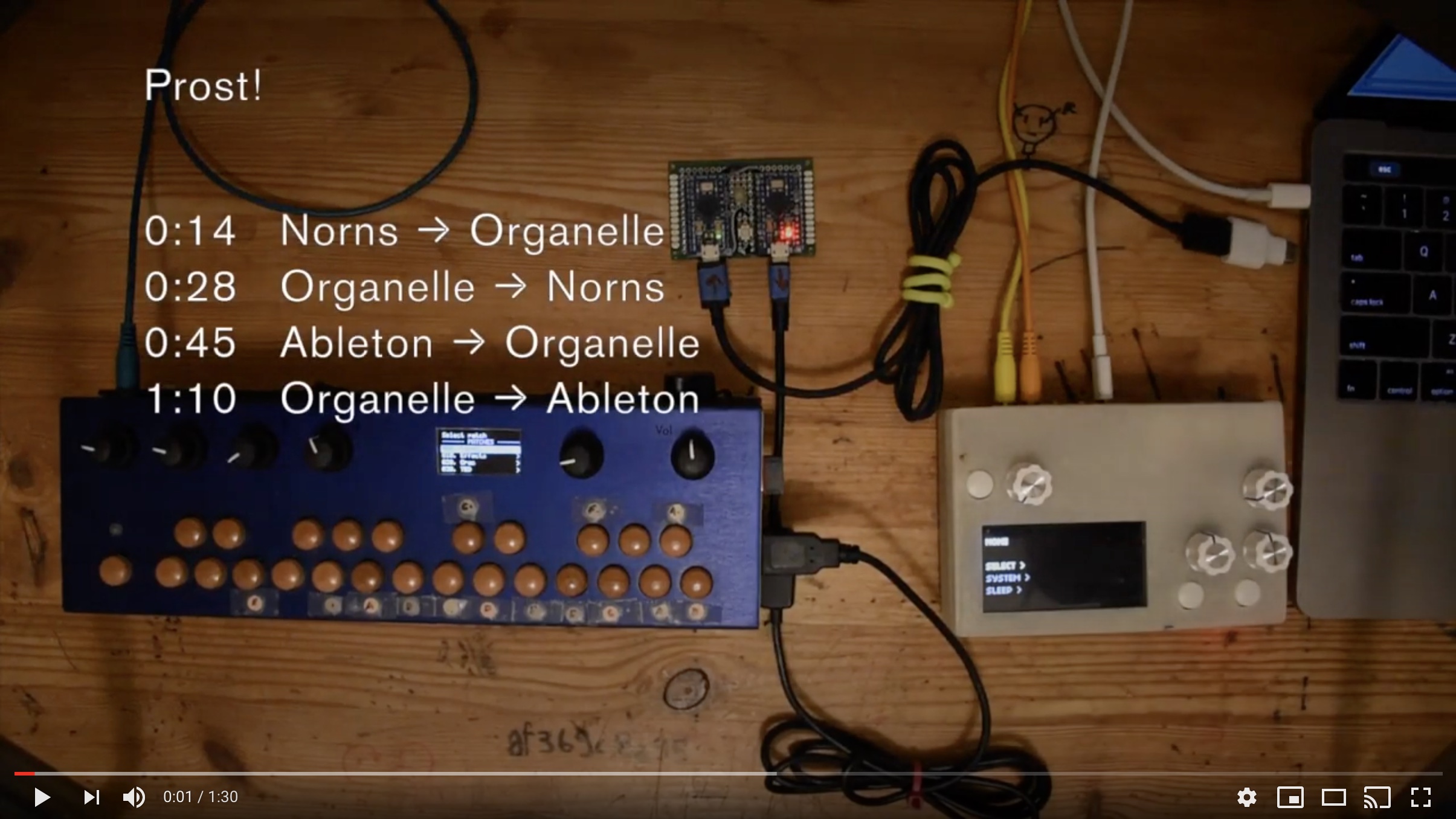
Here's a brief demo video with Ableton Live, an Organelle, and Norns/Fates.
Download
$ git clone https://github.com/frederickk/prost.gitDependencies
Prost! requires 2 dependencies to build and upload.
Before building and flashing be sure to install dependencies.
  # Install dependencies
  pio lib --storage-dir ./lib install 5841
Build and Flash
For 5V / 16MHz boards use:
  # Build and flash firmware
  pio run -e sparkfun_promicro16 -t upload
If using 3.3V / 8MHz boards use:
  # Build and flash firmware
  pio run -e sparkfun_promicro8 -t upload
Be sure to flash both boards 😃.
Prost! uses 2 Pro Micro boards (or any compatible board or clone with an Atmel 32u4 chip) connected serially (TX/RX) in order to pass USBMidi data. Other boards may work (e.g. Teensy), but I only tested with Pro Micros.
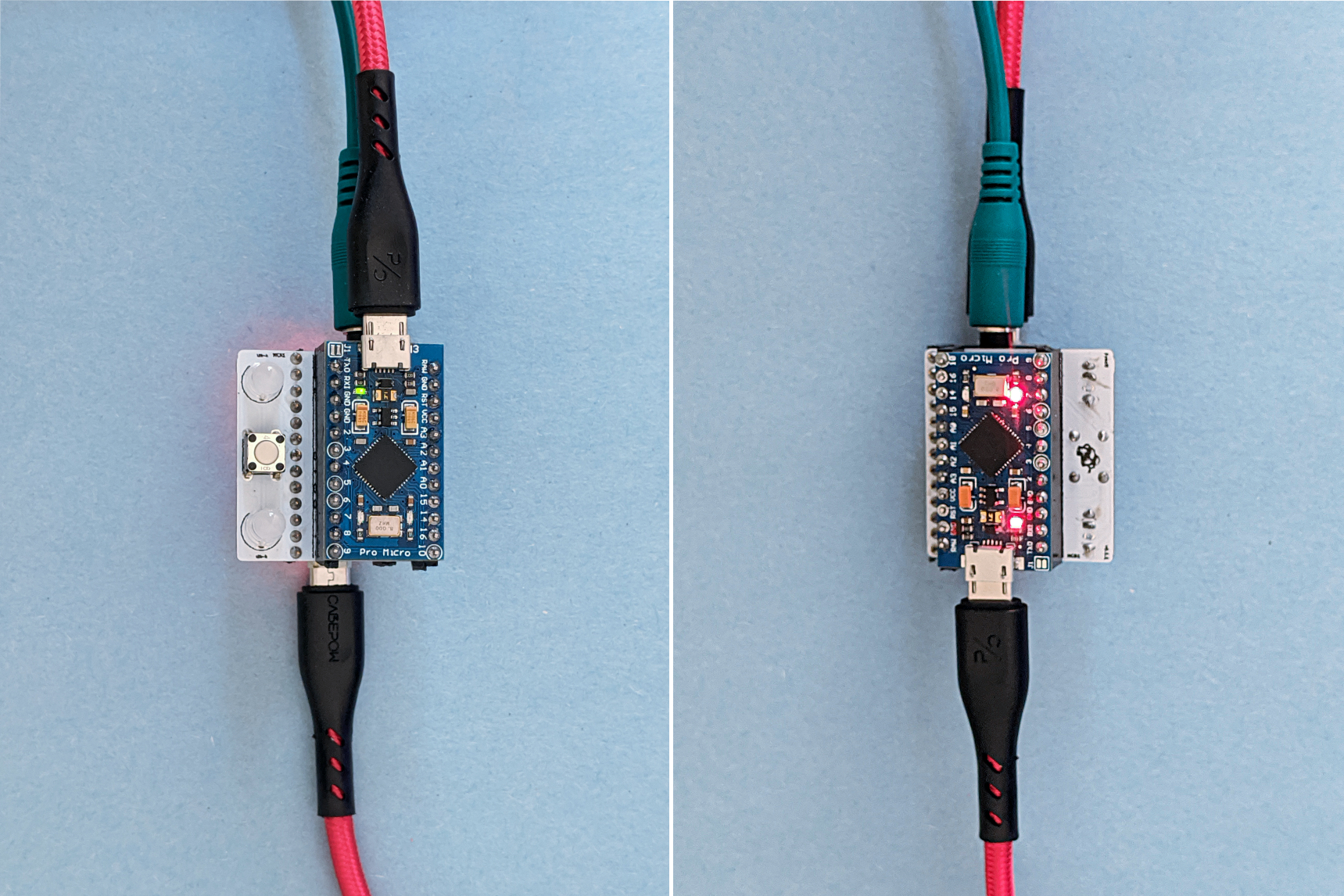
I've created a PCB which reduces the footprint of the device to be only slightly larger than a Pro Micro board itself (38mm x 35mm / 1.25" x 1.375"). Below I've soldered 2 header pins in order to test different boards, but you could solder the boards directly to further reduce the overall thickness (unless you opt to solder on the 3.5mm analog sync jack).
Board
A custom PCB is also available. if there's enough interest I would be willing to produce these in bulk and sell either bare PCB's or populated with components. For now you can order them yourself from JLCPCB.
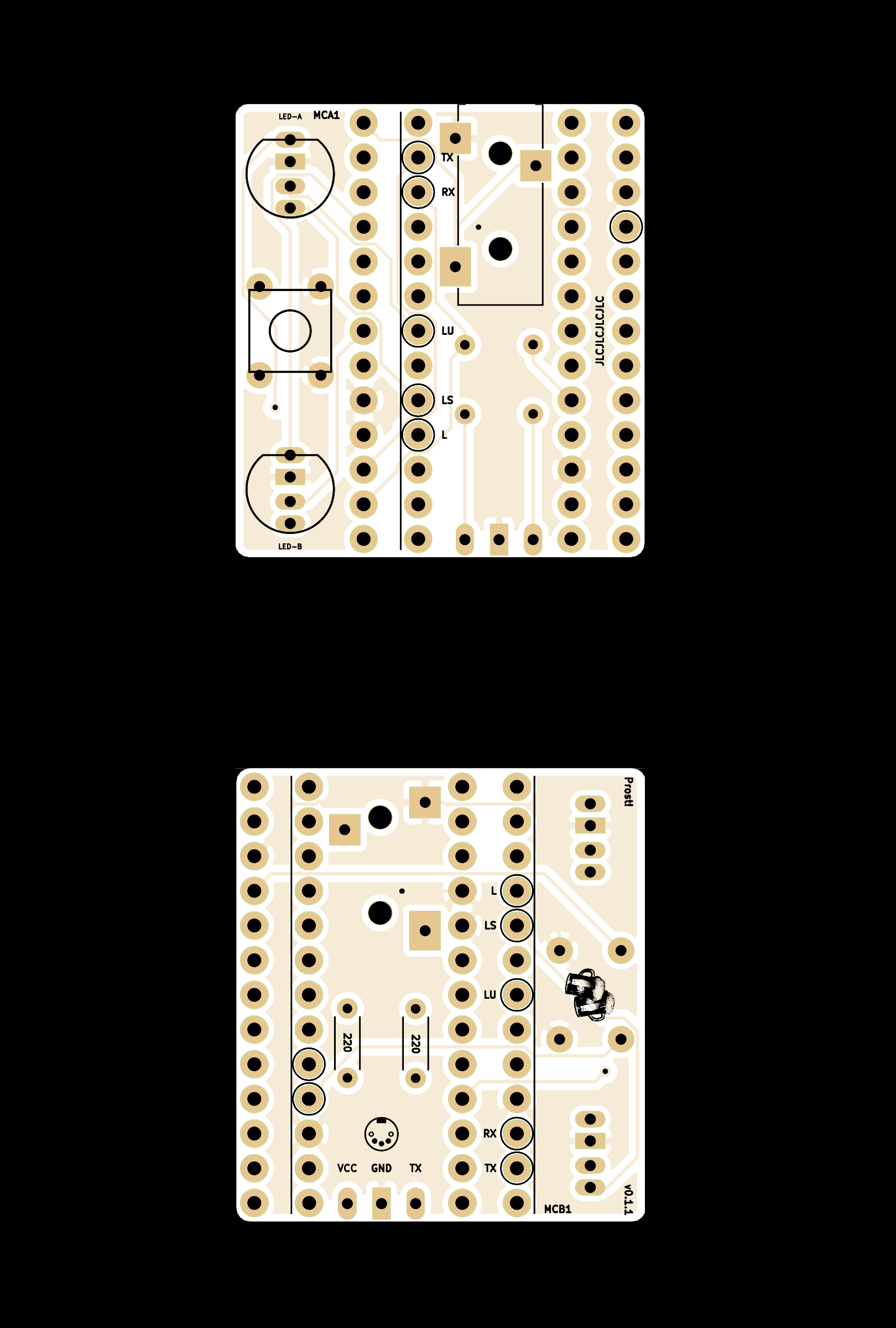
Although, the board is designed first and foremost for Pro Micros it can accomodate a number of other boards. Be mindful to align the marked TX and RX pins on the Prost! PCB with those on your board.
| Board | RX | TX | Voltage | Notes |
|---|---|---|---|---|
| Pro Micro | 0 | 1 | 3.3 or 5 | |
| Teensy 1.0, ++ | 2 | 3 | 3.3 or 5 | |
| Teensy LC, 3.0, 3.1, 3.2, 3.5, 3.6, 4.0 | 0 | 1 | 3.3 or 5 | |
| Arduino Micro | 20 | 21 | 3.3 or 5 | |
| Adafruit Feather 32u4, Bluefruit | 0 | 1 | 3.3 | Board must be mounted upside down |
| Adafruit ItsyBitsy 32u4 | 0 | 1 | 3 or 5 |
BOM
| Qty. | Part No. | Item |
|---|---|---|
| 2 | 5V/3.3V Pro Micro | |
| 1 | 1825910-6 | 6mm Momentary push button |
| 2 | WP154A4SUREQBFZGW | 5mm RGB LED (optional) |
| 4 | 1 x 10 female header (optional) |
Syncing with DIN Midi devices is also possible. Look for the 5-pin Midi graphic on the board and you'll find pin breakouts to connect a 5-pin Midi connector. Be sure to obtain 2 220 ohm resistors as well.
Prost! also supports analog sync, which takes the USB Midi clock signal and converts it to 3.3V or 5V (depending on voltage of Pro Micro) pulse; for Volcas, Pocket Operators, etc. There's room on the board for an SMD 3.5mm/.125" audio jack or pads to solder a jack type of your choice.
| Qty. | Part No. | Item |
|---|---|---|
| 1 | CUI SJ-3523-SMT | SMD 3.54mm/.125" audio jack (optional) |
Wiring
The diagram below shows how to connect the the 2 Pro Micros TX and RX pins. A push button is wired to reset the bootloader (for flashing if/as needed). The optional LEDs signal when Midi and Serial commands are being received and sent.
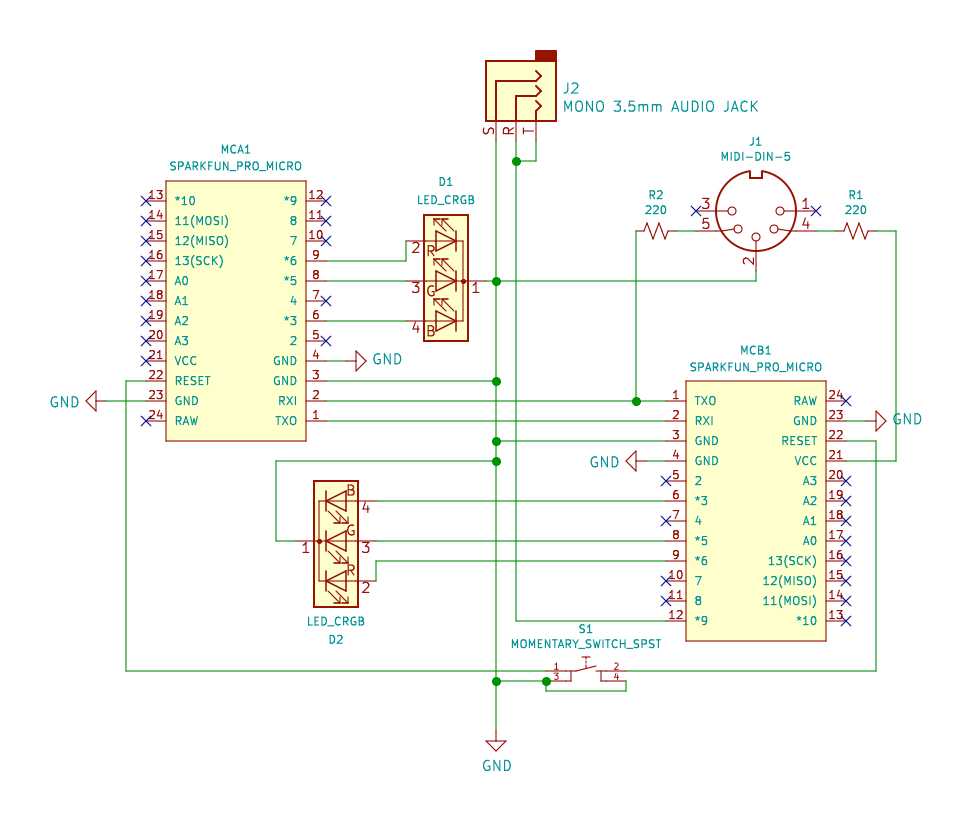
| Qty | Value | Footprint | References |
|---|---|---|---|
| 2 | 220 | Resistor_THT:R_Axial_DIN0204_L3.6mm_D1.6mm_P5.08mm_Horizontal | R1, R2 |
| 2 | LED_CRGB | LED:LED_5MM_RGB | D1, D2 |
| 2 | SPARKFUN_PRO_MICRO | Boards:SPARKFUN_PRO_MICRO | MCA1, MCB1 |
| 1 | DRILL1 | DRILL1 | |
| 1 | DRILL2 | DRILL2 | |
| 1 | DRILL3 | DRILL3 | |
| 1 | DRILL4 | DRILL4 | |
| 1 | MIDI-DIN-5 | prost:Jack_3.5mm_CUI_SJ-3523-SMT_Horizontal | J1 |
| 1 | MOMENTARY_SWITCH_SPST | Switches:MINI_PUSHBUTTON_SWITCH | S1 |
| 1 | MONO 3.5mm AUDIO JACK | prost:Jack_3.5mm_CUI_SJ-3523-SMT_Horizontal | J2 |
It measures 30 × 33.2 mm and has 2 copper layers, 1.6 mm thick.
13 parts. The full list of its parts is on this page, with links to each part's symbol and footprint where PCBKit's library has them.
From the frederickk/prost repository on GitHub, at the commit this page was made from: the board is board/prost-pcb.kicad_pcb. PCBKit opens the board in the browser, with nothing to install.
Its repository publishes it under the MIT licence: you may reuse it on that licence's terms (keep the author's notice, and for a copyleft licence share your changes alike).


samyk/magspoof
A portable device that can spoof/emulate any magnetic stripe, credit card or hotel card "wirelessly", even on standard magstripe (non-NFC/RFID) readers.

fossasia/pslab-scripts
Pocket Science Lab - Scripts for Sensor Experiments


willem-pennings/balancing-cube
A cube that balances itself in a corner or edge using reaction wheels

VoronDesign/Voron-Hardware
Cool Hardware designed by the Voron Design group

hoglet67/RGBtoHDMI
Bare-metal Raspberry Pi project that provides pixel-perfect sampling of Retro Computer RGB/YUV video and conversion to HDMI