2 layers65 × 56 mm
 FrancoPalau/Computer-Vision-Solar-Sensor2
Development of a solar tracker sensor based on computer vision using OpenCV
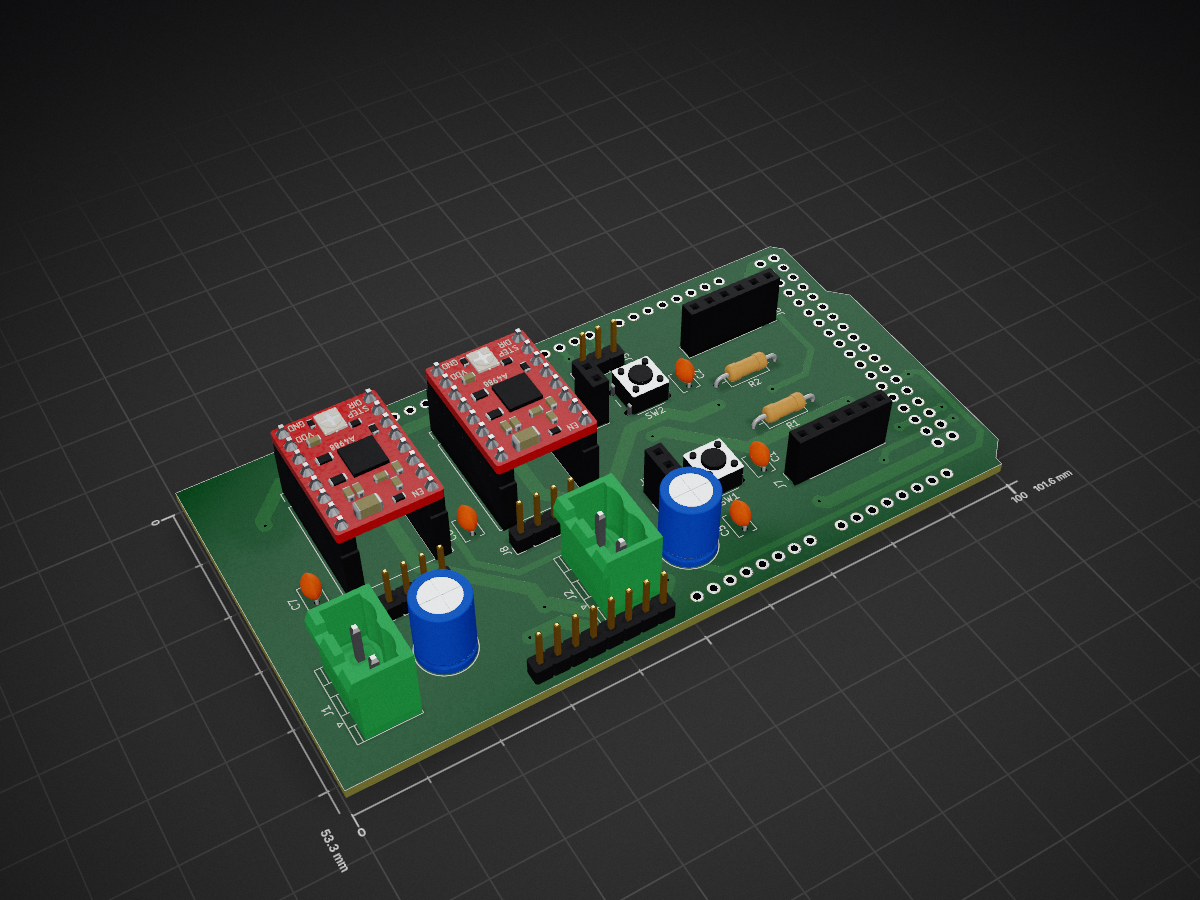
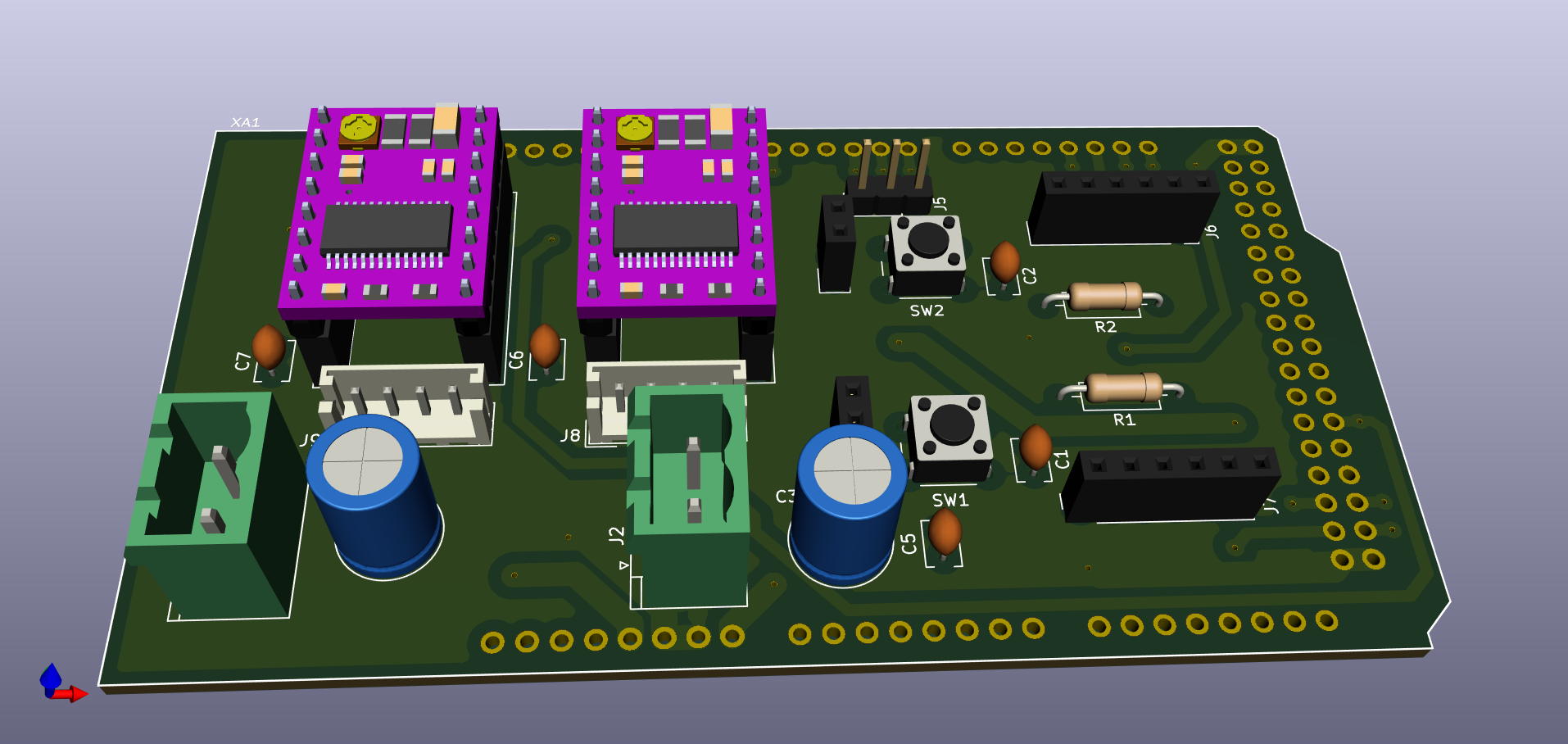
Solar tracker is an open-source printed circuit board by FrancoPalau, from the FrancoPalau/Computer-Vision-Solar-Sensor repository on GitHub. It is a 2-layer board of 101.6 × 53.3 mm with 23 parts on 27 nets, routed with 336 tracks and 25 vias.
Its parts include 9 connectors, 7 capacitors, 2 resistors and 2 switches. It belongs with the power boards of this library.
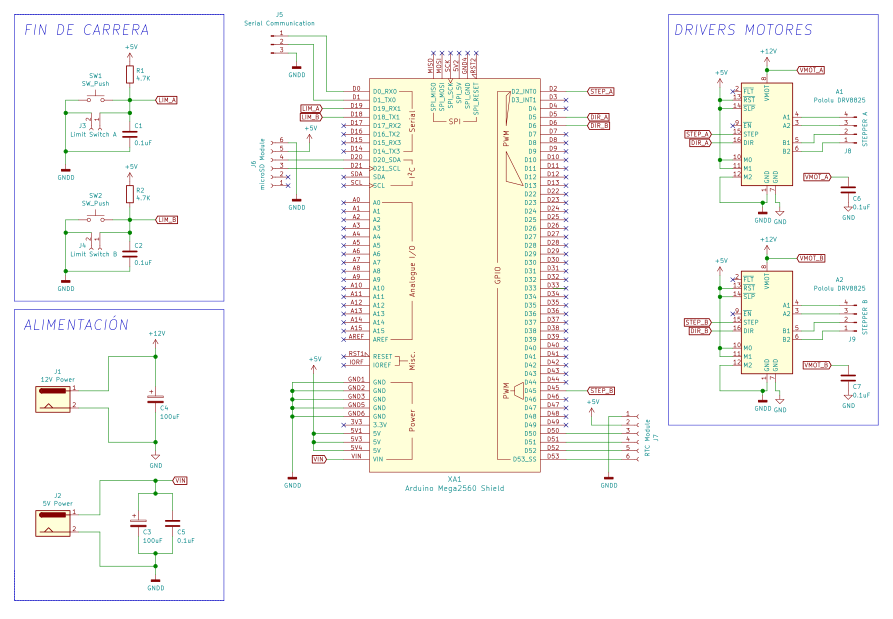
| Qty | Value | Footprint | References |
|---|---|---|---|
| 5 | 0.1uF | Capacitor_THT:C_Disc_D3.8mm_W2.6mm_P2.50mm | C1, C2, C5, C6, C7 |
| 2 | 100uF | Capacitor_THT:C_Radial_D8.0mm_H11.5mm_P3.50mm | C3, C4 |
| 2 | 4.7K | Resistor_THT:R_Axial_DIN0207_L6.3mm_D2.5mm_P10.16mm_Horizontal | R1, R2 |
| 2 | Pololu DRV8825 | Module:Pololu_Breakout-16_15.2x20.3mm | A1, A2 |
| 2 | SW_Push | Button_Switch_THT:SW_PUSH_6mm | SW1, SW2 |
| 1 | 12V Power | Connector_Phoenix_MSTB:PhoenixContact_MSTBVA_2,5_2-G-5,08_1x02_P5.08mm_Vertical | J1 |
| 1 | 5V Power | Connector_Phoenix_MSTB:PhoenixContact_MSTBVA_2,5_2-G-5,08_1x02_P5.08mm_Vertical | J2 |
| 1 | Arduino Mega2560 Shield | Arduino:Arduino_Mega2560_Shield | XA1 |
| 1 | Limit Switch A | Connector_PinSocket_2.54mm:PinSocket_1x02_P2.54mm_Vertical | J3 |
| 1 | Limit Switch B | Connector_PinSocket_2.54mm:PinSocket_1x02_P2.54mm_Vertical | J4 |
| 1 | RTC Module | Connector_PinSocket_2.54mm:PinSocket_1x06_P2.54mm_Vertical | J7 |
| 1 | STEPPER A | Connector_PinHeader_2.54mm:PinHeader_1x04_P2.54mm_Vertical | J8 |
| 1 | STEPPER B | Connector_PinHeader_2.54mm:PinHeader_1x04_P2.54mm_Vertical | J9 |
| 1 | Serial Communication | Connector_PinHeader_2.54mm:PinHeader_1x03_P2.54mm_Vertical | J5 |
| 1 | microSD Module | Connector_PinSocket_2.54mm:PinSocket_1x06_P2.54mm_Vertical | J6 |

google/mozc-devices
Circuit diagrams and firmware source code for Gboard DIY keyboards


Duet3D/Duet-2-Hardware
The KiCAD source for the Duet 3d printer controller see www.duet3d.com
It measures 101.6 × 53.3 mm and has 2 copper layers, 1.6 mm thick.
23 parts. The full list of its parts is on this page, with links to each part's symbol and footprint where PCBKit's library has them.
From the FrancoPalau/Computer-Vision-Solar-Sensor repository on GitHub, at the commit this page was made from: the board is hardware/solar-tracker.kicad_pcb. PCBKit opens the board in the browser, with nothing to install.
Its repository states no licence, so its author keeps all rights: ask FrancoPalau before reusing the design.