
2 layers15.2 × 12.7 mm
Location
fo-am/patternmatrix2
A tangible programming language for the Raspberry Pi, built for the Penelope project
9 parts5
 fo-am/patternmatrix25
A tangible programming language for the Raspberry Pi, built for the Penelope project
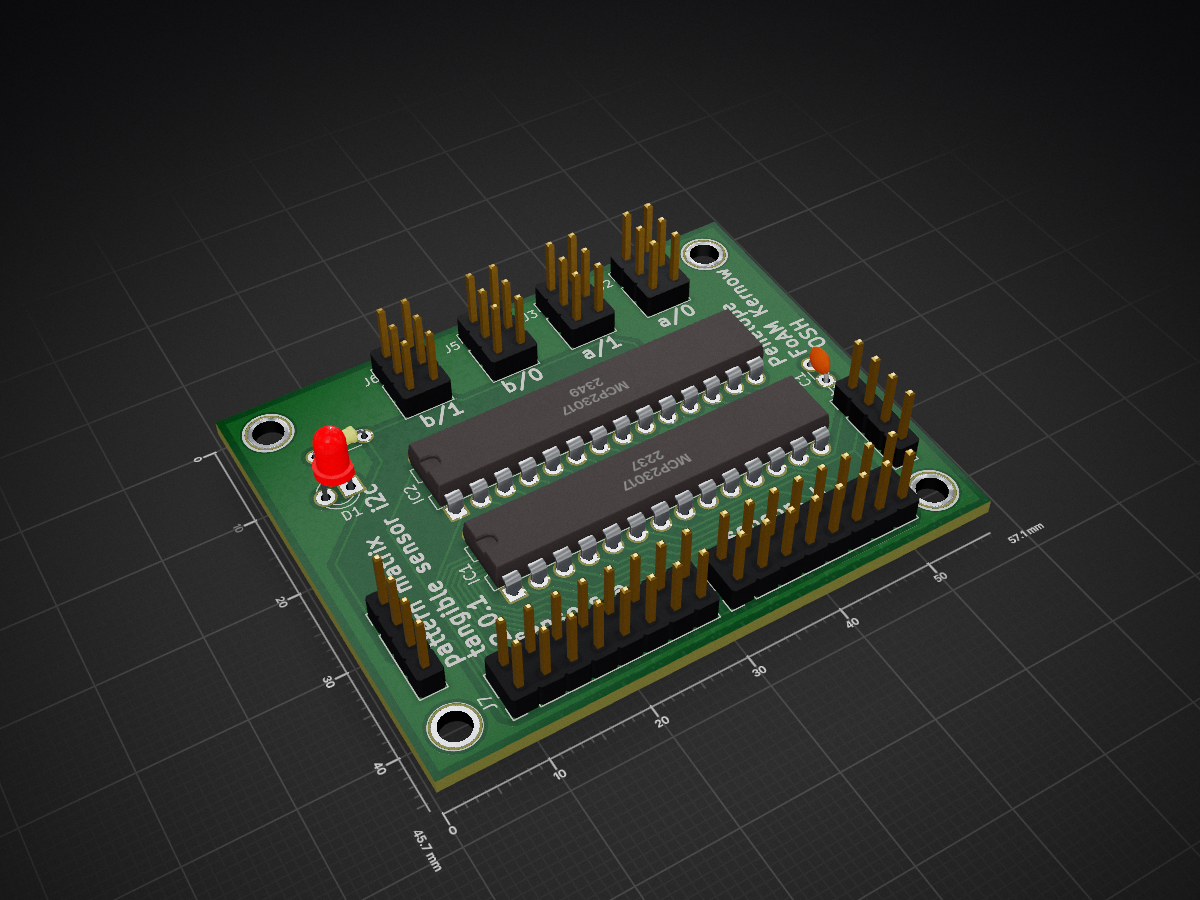
Expander is an open-source printed circuit board by fo-am, from the fo-am/patternmatrix2 repository on GitHub. It is a 2-layer board of 57.1 × 45.7 mm with 17 parts on 47 nets, routed with 419 tracks and 0 vias.
It is built around the MCP23017-E/SS. Its parts include 8 connectors, 2 ICs, 1 capacitor, 1 resistor and 1 diode.
| Qty | Value | Footprint | References |
|---|---|---|---|
| 4 | CONN_02X03 | Pin_Headers:Pin_Header_Straight_2x03_Pitch2.54mm | J2, J3, J5, J6 |
| 3 | 1pin | , , | |
| 2 | CONN_01X04 | Pin_Headers:Pin_Header_Straight_1x04_Pitch2.54mm | J1, J8 |
| 2 | CONN_02X08 | Pin_Headers:Pin_Header_Straight_2x08_Pitch2.54mm | J4, J7 |
| 2 | MCP23017 | Housings_DIP:DIP-28_W7.62mm | IC1, IC2 |
| 1 | Connectors:1pin | ||
| 1 | C | Capacitors_THT:C_Disc_D3.0mm_W1.6mm_P2.50mm | C1 |
| 1 | LED | LEDs:LED_D3.0mm | D1 |
| 1 | R | Resistors_THT:R_Axial_DIN0204_L3.6mm_D1.6mm_P5.08mm_Horizontal | R1 |
It measures 57.1 × 45.7 mm and has 2 copper layers, 1.6 mm thick.
17 parts, built around the MCP23017-E/SS. The full list of its parts is on this page, with links to each part's symbol and footprint where PCBKit's library has them.
From the fo-am/patternmatrix2 repository on GitHub, at the commit this page was made from: the board is hardware/kicad/i2c-expander/expander.kicad_pcb. PCBKit opens the board in the browser, with nothing to install.
Its repository states no licence, so its author keeps all rights: ask fo-am before reusing the design.

mattchesters/zmk-apple-desktop-bus-keyboard
ZMK shield for Apple Desktop Bus Keyboard

ZeroPhone/ZeroPhone-PCBs
PCB files for ZeroPhone - for gerbers and schematics, go to "Releases" tab!

ktec-hq/ErgoDone
ErgoDox using pro micro. Original work by Dox. Brainhole association present


djbristow/RAILS
RAILS is a software model and implementation of an automated system to assist the model railroader achieve realism in the operation of a model railroad. The model then drives the development of software.


