2 layers119 × 92 mm

 fluffy/blinky
Blinking lights to tell time
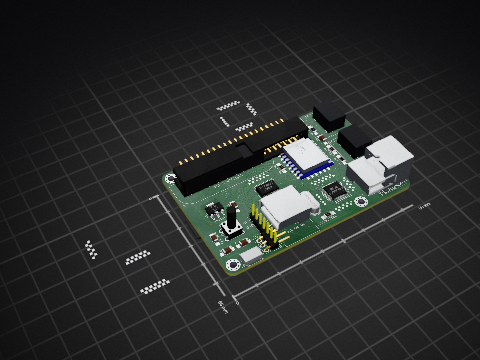
Disp A is an open-source printed circuit board by fluffy, from the fluffy/blinky repository on GitHub. It is a 2-layer board of 82 × 52 mm with 115 parts on 67 nets, routed with 1,184 tracks and 51 vias.
Its parts include 63 diodes, 33 resistors, 13 transistors, 3 capacitors and 3 connectors.
Blinking lights to tell time. And it beeps.
Build with:
mkdir build ; cd build ; cmake .. ; makeNote when programming the GPS board, the GPS must be unplugged while programming.
Program flash using stlink with:
st-flash --reset --format ihex write build/blinky.hexCan program using Stm32CubeProgrammer with RTS=1, DTR=0, baud at 115200, Parity Even, data bits 8, stop bits 1, flow control off.
Program flash using USB serial with:
stm32flash -w build/blinky.hex -v -b 115200 -m 8e1 -i "-dtr," /dev/cu.usbserial-31110If this fails, try the following reset then try to flash again. This will not work on a brand new uninitialized board, the board needs to be programmed for the first time with st-flash.
Can reset the board with:
stty -f /dev/cu.usbserial-31110 hupMonitor output connect with Serial program. Use 115200 baud with 8 bits, no parity, 1 stop bit. Set the RTS and DTR both low. Screen fails to do this. It sets RTS and DTR both high it will not work.
To use python miniterm (replace usbserial-31110 with number on your machine):
pyserial-miniterm -e --parity N --rts 0 --dtr 0 /dev/cu.usbserial-31110 115200Can exit the miniterm with CTRL+]. This will cause board reset when it starts.
Set up a mac to be able to build by installing:
On the Rev A hardware 1.0 software have:
Timing board with TXCO, LTC Sync in, LTC Sync out, LED grid, battery power, USB debug, audio in/out
Display 120 fps tick on 10x4 grid
3.3V LTC Sync Out
PPS out is hold sync button while booting
Jitter of less than 1 ms
Jam sync to 3.3V Sync input
Time drift of < 5 ms in 1 hour
USB port for serial data
read calibration from EEPROM
audio out of beep
headset monitor of audio out
usb upgrade of firmware
Status LEDs: error(red), external synced (green), not sync ( blue ), have sync (teal)
audio input to detect beep
battery with 2h life and USB charger
On the Rev A hardware 0.2 software have:
On the Rev A hardware 0.2 software have:
| Qty | Value | Footprint | References |
|---|---|---|---|
| 51 | LED-G | LED_SMD:LED_0603_1608Metric | D2, D12, D13, D14, D15, D16, D17, D18, D19, D20, D21, D22, D23, D24, D25, D26 +35 |
| 23 | 100R | Resistor_SMD:R_0603_1608Metric | R1, R2, R4, R29, R30, R31, R34, R36, R38, R40, R42, R44, R46, R48, R49, R50 +7 |
| 13 | 2N7002 | Package_TO_SOT_SMD:SOT-23 | Q1, Q2, Q3, Q4, Q5, Q6, Q7, Q8, Q9, Q10, Q11, Q12, Q13 |
| 11 | LED-R | LED_SMD:LED_0603_1608Metric | D1, D4, D5, D6, D7, D8, D9, D10, D11, D62, D63 |
| 10 | 4K7 | Resistor_SMD:R_0603_1608Metric | R3, R5, R33, R35, R37, R39, R41, R43, R45, R47 |
| 3 | 100n | Capacitor_SMD:C_0402_1005Metric | C32, C36, C38 |
| 2 | Conn_01x01_Pin | Connector_PinHeader_2.54mm:PinHeader_1x01_P2.54mm_Vertical | J2, J3 |
| 1 | Conn_02x16_Odd_Even_FLIP | Connector_PinHeader_2.54mm:PinHeader_2x16_P2.54mm_Vertical | J1 |
| 1 | LED-Y | LED_SMD:LED_0603_1608Metric | D3 |


NVlabs/Cypress
Cypress is a scalable, GPU-accelerated PCB placement method inspired by VLSI. It incorporates tailored cost functions, constraint handling, and optimized techniques adapted for PCB layouts.

uli/basicengine-pcb
Schematics and PCB layout for the BASIC Engine home computer


floookay/olice
The olice is 40% alice-like ortho keyboard. It features two board extension modules that can be magnetically attached on the sides.
It measures 82 × 52 mm and has 2 copper layers, 1.6 mm thick.
115 parts. The full list of its parts is on this page, with links to each part's symbol and footprint where PCBKit's library has them.
From the fluffy/blinky repository on GitHub, at the commit this page was made from: the board is hardware/disp_A/disp_A.kicad_pcb and its schematic hardware/blink_A/blink_A.kicad_sch. PCBKit opens the board in the browser, with nothing to install.
Its repository states no licence, so its author keeps all rights: ask fluffy before reusing the design.

