
4 layers40 × 40 mm
 floesche/LED-Display_G4_Hardware_Driver1
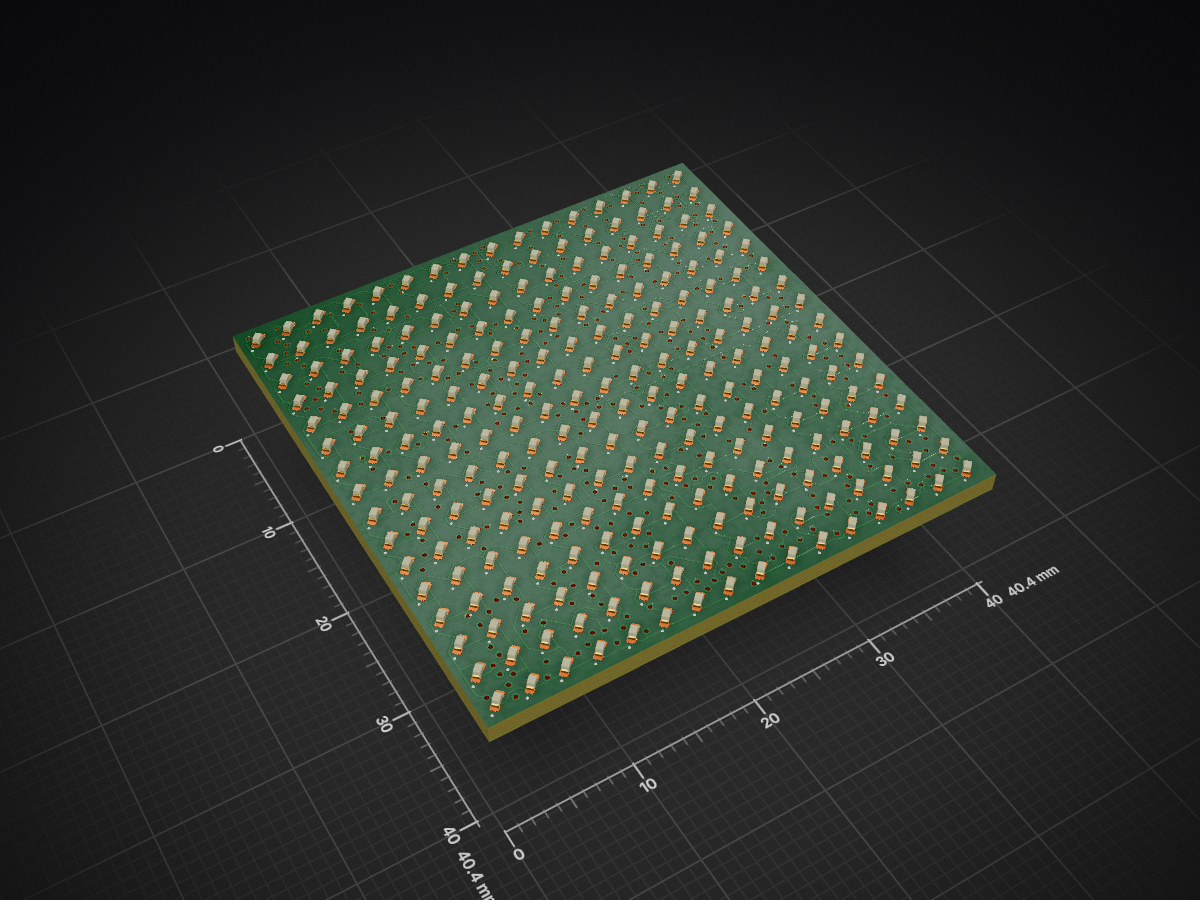
Driver 40mm atmega is an open-source printed circuit board by floesche, from the floesche/LED-Display_G4_Hardware_Driver repository on GitHub, published under the CC-BY-4.0 licence. It is a 6-layer board of 40.4 × 40.4 mm with 424 parts on 196 nets, routed with 3,390 tracks and 355 vias.
It is built around the ATMEGA328P-MU. Its parts include 256 diodes, 100 resistors, 40 capacitors, 16 transistors and 4 ICs. It belongs with the AVR (ATmega, ATtiny) boards of this library.
| Qty | Value | Footprint | References |
|---|---|---|---|
| 256 | LED | driver_custom:LED_0402_1005Metric | D1, D10, D11, D100, D101, D102, D103, D104, D105, D106, D107, D108, D109, D110, D111, D112 +240 |
| 32 | 100 | driver_custom:R_0201_0603Metric | R37, R39, R41, R43, R45, R47, R49, R51, R53, R54, R57, R58, R61, R62, R65, R66 +16 |
| 32 | 1k | driver_custom:R_0201_0603Metric | R38, R40, R42, R44, R46, R48, R50, R52, R55, R56, R59, R60, R63, R64, R67, R100 +16 |
| 32 | 220pF | driver_custom:C_0201_0603Metric | C10, C11, C12, C13, C14, C15, C16, C17, C18, C19, C20, C21, C22, C23, C24, C25 +16 |
| 32 | 240 | driver_custom:R_0201_0603Metric | R10, R11, R12, R13, R14, R15, R16, R17, R18, R19, R20, R21, R22, R23, R24, R25 +16 |
| 16 | NMOS | driver_custom:SC-89-6 | Q1, Q2, Q3, Q4, Q5, Q6, Q7, Q8, Q9, Q10, Q11, Q12, Q13, Q14, Q15, Q16 |
| 8 | 0.1uF | driver_custom:C_0201_0603Metric | C1, C2, C3, C4, C37, C38, C39, C40 |
| 4 | 20MHz | Crystal:Resonator_SMD_Murata_CSTxExxV-3Pin_3.0x1.1mm | X1, X2, X3, X4 |
| 4 | 4.7k | driver_custom:R_0201_0603Metric | R1, R2, R3, R4 |
| 4 | ATMEGA328P-M | Package_DFN_QFN:QFN-32-1EP_5x5mm_P0.5mm_EP3.1x3.1mm | IC1, IC2, IC3, IC4 |
| 4 | CONN_2X2 | driver_custom:PinHeader_2x02_P2.54mm_Vertical_SMD | P1, P2, P3, P4 |


Pakequis/Chaos_papagali
A annoying device that imitates the vibration of a phone


Arpit192005/Drone-ESC
A custom 3-phase Brushless DC (BLDC) Electronic Speed Controller (ESC) designed in KiCad, intended for drone and robotics applications.

R-Mutura/calve_heater
Hardware and software Implementation of a calf heater fabric
It measures 40.4 × 40.4 mm and has 6 copper layers, 1.6 mm thick.
424 parts, built around the ATMEGA328P-MU. The full list of its parts is on this page, with links to each part's symbol and footprint where PCBKit's library has them.
From the floesche/LED-Display_G4_Hardware_Driver repository on GitHub, at the commit this page was made from: the board is driver_40mm_atmega_v1p9/driver_40mm_atmega.kicad_pcb. PCBKit opens the board in the browser, with nothing to install.
Its repository publishes it under the CC-BY-4.0 licence: you may reuse it on that licence's terms (keep the author's notice, and for a copyleft licence share your changes alike).