2 layers98 × 27 mm

 felias-fogg/PyAvrOCD20
A cross-platform GDB server for AVR MCUs integrated into the Arduino IDE 2
Arduino jtag is an open-source printed circuit board by felias-fogg, from the felias-fogg/PyAvrOCD repository on GitHub. It is a 2-layer board of 50.2 × 30.9 mm with 5 parts on 23 nets, routed with 89 tracks and 0 vias.
It belongs with the interfaces and adapters and computers and single-board computers boards of this library.





PyAvrOCD is a GDB server for 8-bit AVR MCUs (see list of supported MCUs and supported boards), communicating with Microchip's EDBG-based debug probes, e.g., MPLAB Snap. So, is it simply another open-source GDB server for AVR MCUs? No! It is a cross-platform AVR GDB server. This means that it was easily possible to integrate it into Arduino IDE 2 and PlatformIO board packages, bringing AVR debugging to these IDEs. Additionally, PyAvrOCD excels in minimizing flash wear and protects single-stepping against interrupts.
Interested in giving PyAvrOCD a try? You are welcome to install it. Want to learn more about it? Read the docs. Any feedback, be it bug reports, crazy ideas, or praise, is welcome.
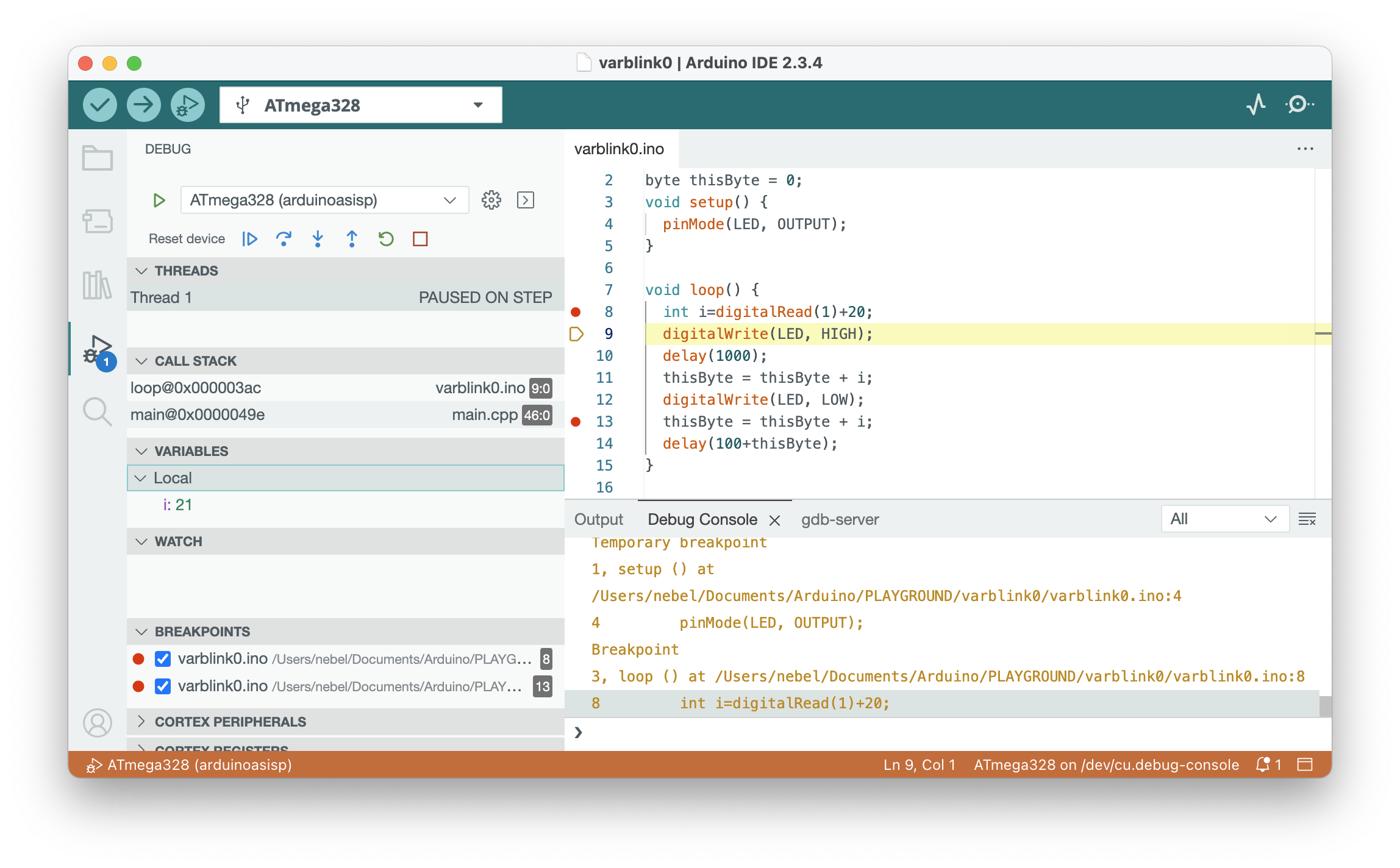
Meanwhile, PyAvrOCD covers all debugWIRE, JTAG (Megas), and UPDI MCUs. I am unsure whether it makes sense to extend its coverage to Xmegas.
I made some leeway into integrating PyAvrOCD more tightly with PlatformIO and with the Arduino Maker Workshop VSCode extension. There is the idea of basing everything on more recent versions of the GCC toolchain because it will probably solve a number of problems on the debugging front. My attempt at using the GCC 15.1 toolchain was abruptly stopped when I discovered that the compiler produces buggy debug information concerning local variables, whereas the old compiler works without a flaw at that point. I guess more research and/or debugging is necessary before GCC 15.1 is a viable solution.
Finally, I am committed to fixing some of the more obvious bugs in the AVR part of the GDB debugger.
| Qty | Value | Footprint | References |
|---|---|---|---|
| 3 | Conn_01x08_Pin | Connector_PinHeader_2.54mm:PinHeader_1x08_P2.54mm_Vertical | LV1, MA1, MV1 |
| 1 | AVR-JTAG-10 | Connector_IDC:IDC-Header_2x05_P2.54mm_Vertical | J1 |
| 1 | Conn_01x06_Pin | Connector_PinHeader_2.54mm:PinHeader_1x06_P2.54mm_Vertical | LA1 |

joypad-ai/joypad-os
Universal controller firmware for building adapters, dongles, and custom controllers.

OLIMEX/OLINUXINO
OLINUXINO is Open Source / Open Hardware, low cost from EUR 24 Linux Industrial grade Single Board Computer capable to operate -25+85C

jamro/tiny-engineer
A small desktop robot that brings an AI coding assistant to life, physically acting out when it reads files, thinks, writes code, and finishes work.

hackclub/OnBoard
💡 Join 1,000 teenagers and make your first PCB with a $100 grant!


Luos-io/luos_engine
Open-source and real-time orchestrator for cyber-physical-systems, to easily design, test and deploy embedded applications and digital twins.
It measures 50.2 × 30.9 mm and has 2 copper layers, 1.6 mm thick.
5 parts. The full list of its parts is on this page, with links to each part's symbol and footprint where PCBKit's library has them.
From the felias-fogg/PyAvrOCD repository on GitHub, at the commit this page was made from: the board is pcbs/arduino-jtag/arduino-jtag.kicad_pcb and its schematic pcbs/arduino-jtag/arduino-jtag.kicad_sch. PCBKit opens the board in the browser, with nothing to install.
Its repository states no licence, so its author keeps all rights: ask felias-fogg before reusing the design.