
2 layers68.8 × 53.6 mm
ZArduino
zmaker/arduino_cookbook
gli sketch del nuovo progetto Arduino Cookbook e dei video di YouTube
46 parts269
 FabLab-Merida/rFLOW
Estación de soldadura BGA para hacer PCBs caseras.
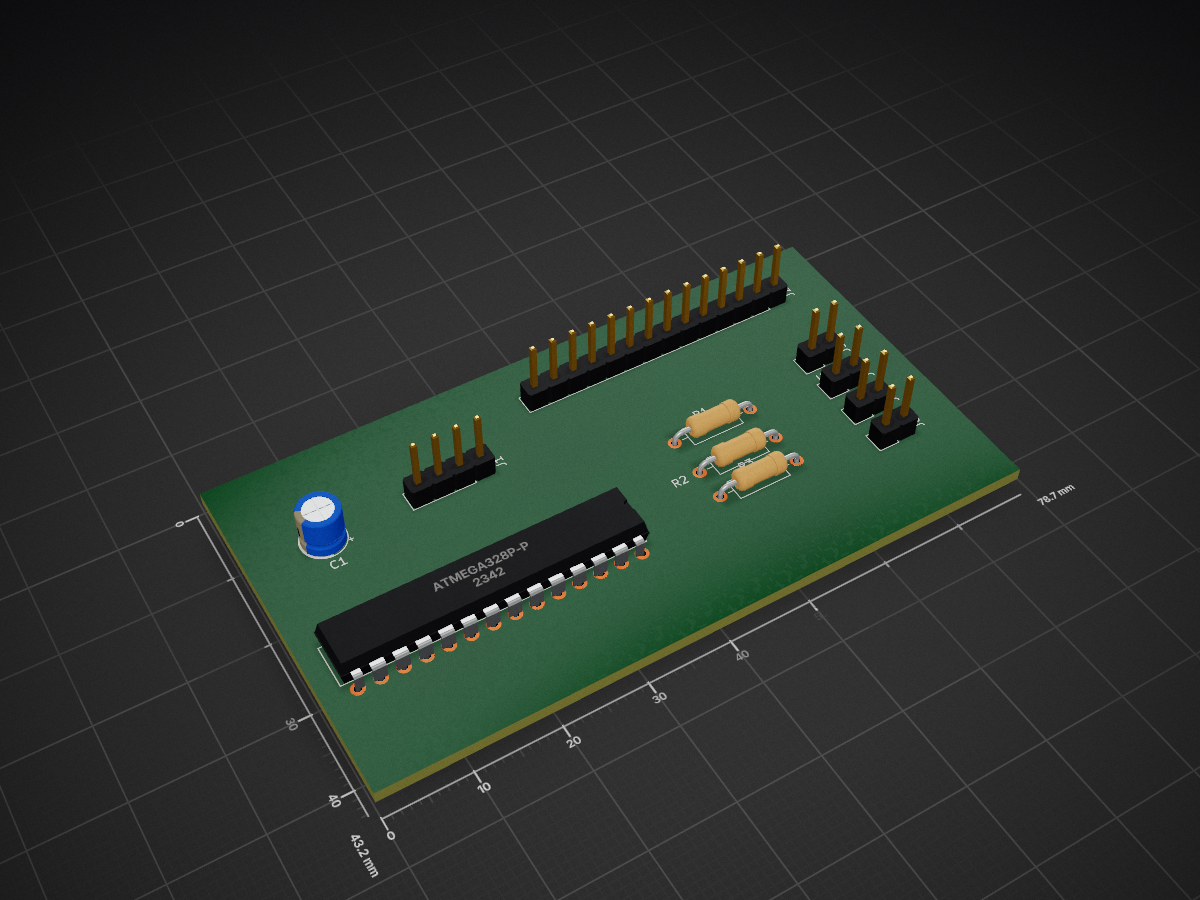
Floww is an open-source printed circuit board by FabLab-Merida, from the FabLab-Merida/rFLOW repository on GitHub, published under the GPL-3.0 licence. It is a 2-layer board of 78.7 × 43.2 mm with 11 parts on 30 nets, routed with 202 tracks and 0 vias.
It is built around the ATMEGA328P-PU. Its parts include 6 connectors, 3 resistors, 1 capacitor and 1 IC. It belongs with the AVR (ATmega, ATtiny) boards of this library.
Proyecto made in FabLab Mérida por el cual mediante el reciclaje de una antigua plancha de vapor y algunos componentes electronicos, se ha convertido en una estación de soldadura BGA monocapa. Capaz de llegar hasta 250º, ideal para multiples tipos de pasta de estaño.
La principal motivación tras este proyecto es buscar una solución económica a la creacion de PCBs y reparación de estas promoviendo la economia circular y el reciclaje de componentes y piezas.
1 * Relé de 5V que soporte como miínimo 250V y 13A.
1 * Termistor (vease el .ino para mas información).
1 * Resistencia de la plancha de vapor.
1 * Baquelita monocapa virgen.
1 * ATMEGA 328p.
3 * Botones Push.
3 * Resistencias de 1kO.
1 * Resistencia de 4.7kO.
1 * Condensador de 10uF.
1 * Potenciometro 10kO.
1 * LCD 16*4 segmentos.
La posibilidad de usar un amplio rango de temperatura estable ha dado lugar a múltiples aplicaciones extra, desde el anteriormente mencionada creación de PCBs pasando por facilitar soldaduras por aire manteniendo la zona caliente o secado de filamento de impresora 3D.
Se necesita que el Atmega use la frecuencia de relog interna de 8MHz, para ello se necesita grabar el bootloader por uno sin los parametros de Arduino, en la bibliografía encontrará información de como hacerlo.
LiquidCrystal.h ==> https://www.arduino.cc/reference/en/libraries/liquidcrystal/
thermistor.h ==> https://github.com/miguel5612/ThermistorLibrary
Grabar bootloader ==> https://docs.arduino.cc/built-in-examples/arduino-isp/ArduinoToBreadboard
| Qty | Value | Footprint | References |
|---|---|---|---|
| 4 | Conn_01x02_Pin | Connector_PinHeader_2.54mm:PinHeader_1x02_P2.54mm_Vertical | J3, J4, J5, J6 |
| 3 | R | Resistor_THT:R_Axial_DIN0207_L6.3mm_D2.5mm_P10.16mm_Horizontal | R1, R2, R3 |
| 1 | ATmega328P-P | Package_DIP:DIP-28_W7.62mm | U1 |
| 1 | C_Polarized_Small | Capacitor_THT:CP_Radial_D5.0mm_P2.50mm | C1 |
| 1 | Conn_01x04_Male | Connector_PinHeader_2.54mm:PinHeader_1x04_P2.54mm_Vertical | J1 |
| 1 | Conn_01x14_Male | Connector_PinHeader_2.54mm:PinHeader_1x14_P2.54mm_Vertical | J2 |
It measures 78.7 × 43.2 mm and has 2 copper layers, 1.6 mm thick.
11 parts, built around the ATMEGA328P-PU. The full list of its parts is on this page, with links to each part's symbol and footprint where PCBKit's library has them.
From the FabLab-Merida/rFLOW repository on GitHub, at the commit this page was made from: the board is PCB/floww.kicad_pcb and its schematic PCB/floww.kicad_sch. PCBKit opens the board in the browser, with nothing to install.
Its repository publishes it under the GPL-3.0 licence: you may reuse it on that licence's terms (keep the author's notice, and for a copyleft licence share your changes alike).
zmaker/arduino_cookbook
gli sketch del nuovo progetto Arduino Cookbook e dei video di YouTube

coseyfannitutti/discipad
17-key numpad assembled with only through hole components, including usb type-c

matthewcieplak/super-sixteen
Code and schematics for the Super Sixteen Eurorack sequencer

coseyfannitutti/romeo
Staggered 40% keyboard pcb that can be assembled with only through hole components, including USB Type-C

mattybrad/drumkid
Version 4 was the first successful working design, with full code, schematics, Gerbers, etc available on GitHub.


leomil72/LM80C
A Z80-based homebrew computer withTMS9918, AY-3-8910, Z80 CTC, Z80 PIO, and Z80 SIO
