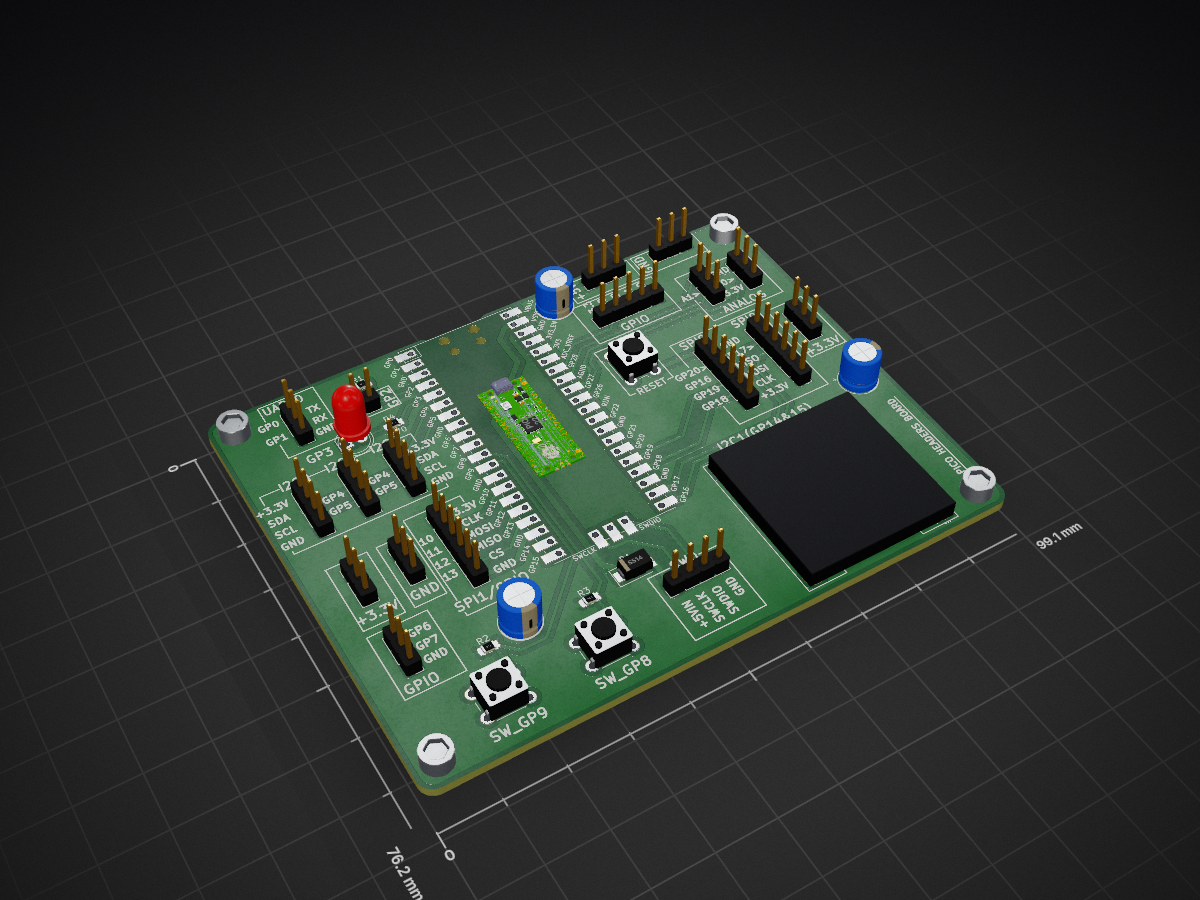
Pico dev is an open-source printed circuit board by execuc, from the execuc/u2if repository on GitHub. It is a 2-layer board of 99.1 × 76.2 mm with 36 parts on 38 nets, routed with 309 tracks and 0 vias.
It is built around the SS14. Its parts include 18 connectors, 4 resistors, 3 capacitors, 3 switches and 2 ICs. It belongs with the interfaces and adapters boards and the RP2040 boards of this library.
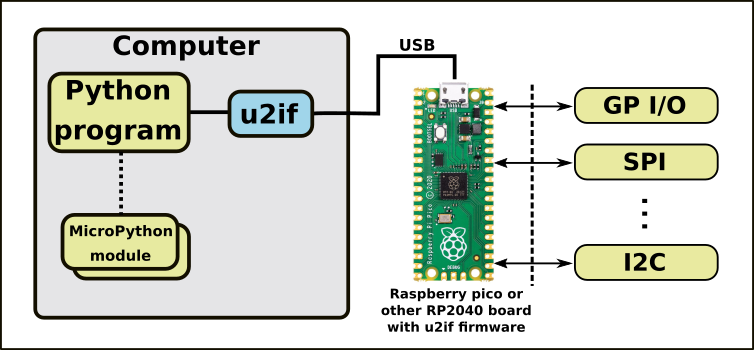
u2if(USB to interfaces) is an attempt to implement some of the MicroPython "machine" module functionalities on a computer.
The goal is to be able to communicate with breakout boards (sensors, lcd...) simply from a python program on x86 machine. It uses a Raspberry PICO (or other RP2040 based board) to make the interface between the computer (USB) and peripherals/protocols.
Python led swith on/off:
python
import time
from machine import u2if, Pin
# Initialize GPIO to output and set the value HIGH
led = Pin(u2if.GP3, Pin.OUT, value=Pin.HIGH)
time.sleep(1)# Switch off the led
led.value(Pin.LOW)
Caution
It is in experimental state and not everything has been tested. Use with caution. It is supposed to work on windows, linux and Mac.
To work in Linux in non-root, an udev rules has to be added (See Firmware readme).
Why this project ?
When I want to retrieve values from a sensor or even to play with a led or a button from the PC, I make an arduino program that communicate to the PC via the serial port. That umplies to define a serial "protocol" between the PC and the arduino and it is not necessarily reusable because it is specific. I find it interesting to implement a majority of the functionalities of the MicroPython machine module and add other protocols.
Solutions already exist, for example Adafruit Blinka from Adafruit via the FT2232H in CircuitPython or pyftdi in Python with the same IC.
Note: now, firmware part can be also used with Adafruit Blinka !
Implemented Interfaces
The following features are coded:
machine.Pin: input (+irq, +debounced), output (+pull down/up) and grouped pins.
Install python package from release file (u2if-..tar.gz) with python3 -m pip install dist/u2if-..tar.gz
Build u2if python package
To build package if wanted :
If needed, install build: python3 -m pip install --upgrade build
Build it: python3 -m build
Examples
There is no documentation but examples can help to use this library :
Led On/Off
Switch with or whithour irq and debouncing
PWM controlling servo-motor
Display testing: SSD1306 (I2C and SPI), GC9A01 (round lcd)
Some sensors simple test: MPU9250 (IMU), VL53L0X (range), BMP280(Temp)
UART read/Write
Analog read.
Rotrary encoder
I2C scan
Play 48khz 16bit .wav over I2S DAC (PAM5102)
...
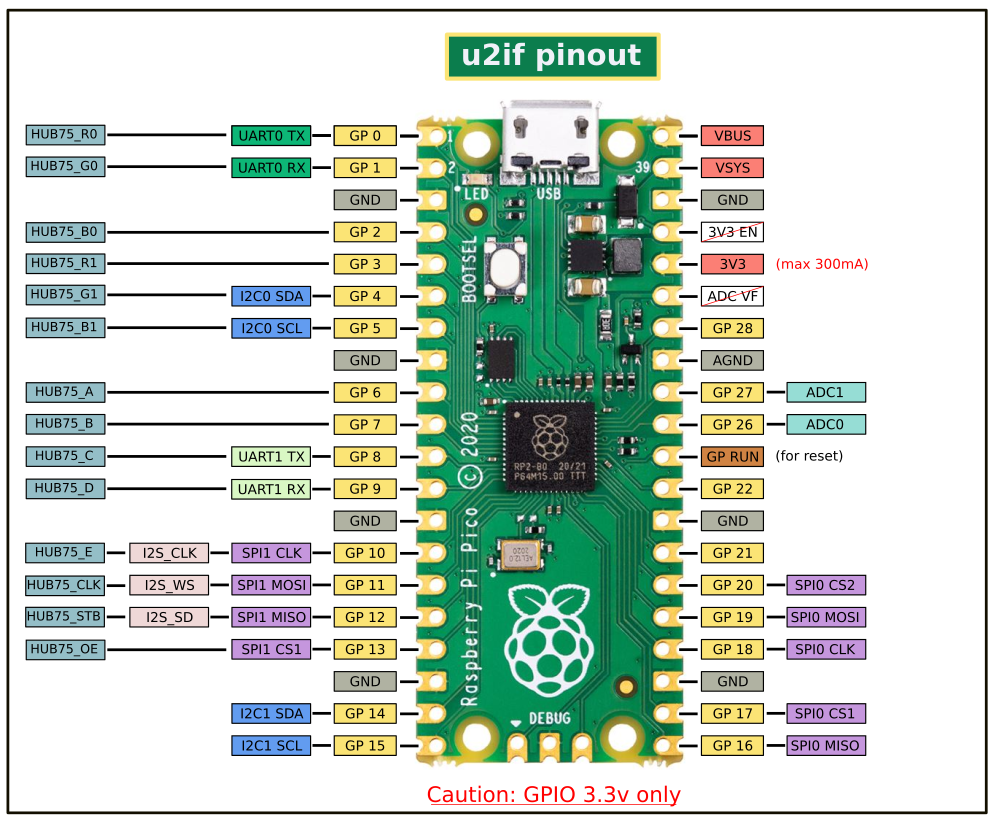
u2if boards/pinout
For simplicity, the pins of the SPI, I2C and UART devices have been fixed. If a peripheral is not used, its pins can be used as a classic I/O. Here are the compatibles boards.
PICO
Implemented interfaces:
GPIO
ADC
PWM
UART0 & UART1
I2C0 & I2C1
SPI0 & SPI1
WS2812B
I2S
Adafruit Feather RP2040
Implemented interfaces:
GPIO
ADC
PWM
UART0
I2C0 & I2C1
SPI0 & SPI1
WS2812B
Adafruit Qt Py RP2040
Implemented interfaces:
GPIO
ADC
PWM
UART1
I2C0 & I2C1
SPI0
WS2812B
Adafruit ItsyBitsy RP2040
Implemented interfaces:
GPIO
ADC
PWM
UART0
I2C1
SPI0 & SPI1
WS2812B
Adafruit Trinkey QT2040
Implemented interfaces:
GPIO
ADC
PWM
UART0
I2C0 & I2C1
SPI0 & SPI1
WS2812B
Troubleshooting
Import error using MicroPython module
import ustruct
The ustruct module is belongs by micropython. There is a micropython-cpython-ustruct compatibility module, but it doesn't seem to work for me. If necessary modify:
python
import ustruct
to:
python
importstructas ustruct
import utime & const
Install micropython-cpython-utime and micropython-cpython-micropython.
It measures 99.1 × 76.2 mm and has 2 copper layers, 1.6 mm thick.
What parts does the Pico dev use?
36 parts, built around the SS14. The full list of its parts is on this page, with links to each part's symbol and footprint where PCBKit's library has them.
Where can I download the Pico dev KiCad files?
From the execuc/u2if repository on GitHub, at the commit this page was made from: the board is board/pico-dev/pico-dev.kicad_pcb. PCBKit opens the board in the browser, with nothing to install.
Can I use the Pico dev design in my own project?
Its repository states no licence, so its author keeps all rights: ask execuc before reusing the design.
The Smart Plant is a board that can be plugged directly on the soil, close to the plant, that allows the measurement of the environment (soil moisture, environment temperature & illuminance), and presents the…
Drone Show Software is software designed for drone shows, allowing flight path planning as well as control of dozens of drones simultaneously in a synchronized manner.