2 layers30 × 61.3 mm

 egradman/ynot-keyboard21
This is the repo for my "ynot" keyboard.
Cho corne ice is an open-source printed circuit board by egradman, from the egradman/ynot-keyboard repository on GitHub. It is a 2-layer board of 143.5 × 78.6 mm with 47 parts on 45 nets, routed with 316 tracks and 6 vias.
Its parts include 19 diodes, 18 switches, 3 resistors, 3 ICs and 1 capacitor. It belongs with the keyboards and input boards and the nRF52 and nRF5x boards of this library.
This is the repo for my "ynot" keyboard.
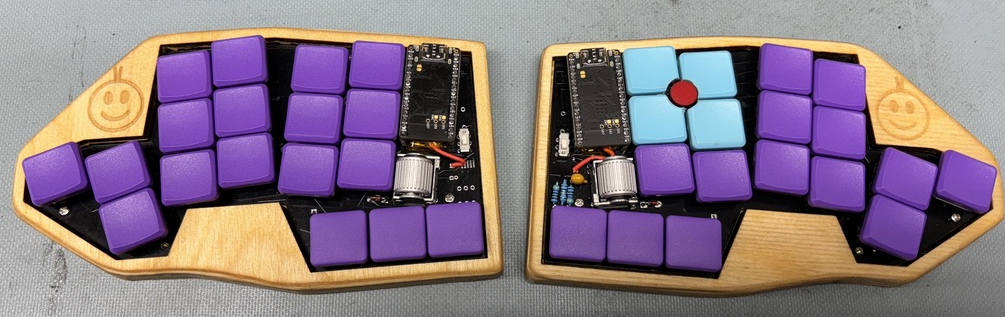
it uses:
trackpoint reset circuit as described here https://github.com/alonswartz/trackpoint
and the firmware provided by infusedkim https://github.com/infused-kim/kb_zmk_ps2_mouse_trackpoint_driver
| Qty | Value | Footprint | References |
|---|---|---|---|
| 19 | D | promicro_reversible:ComboDiode | D1, D23, D24, D25, D26, D27, D29, D30, D31, D32, D33, D35, D36, D37, D38, D39 +3 |
| 18 | SW_PUSH | keyswitches_pretty:SW_PG1350_reversible | SW23, SW24, SW25, SW26, SW27, SW29, SW30, SW31, SW32, SW33, SW35, SW36, SW37, SW38, SW39, SW40 +2 |
| 2 | 4.7k | Resistor_THT:R_Axial_DIN0204_L3.6mm_D1.6mm_P5.08mm_Horizontal | R1, R2 |
| 1 | 100k | Resistor_THT:R_Axial_DIN0204_L3.6mm_D1.6mm_P5.08mm_Horizontal | R3 |
| 1 | 2.2uF | Capacitor_THT:CP_Radial_D4.0mm_P1.50mm | C1 |
| 1 | BAT | Connector_Wire:SolderWire-0.1sqmm_1x02_P3.6mm_D0.4mm_OD1mm | J3 |
| 1 | SW_PUSH | promicro_reversible:reset_switch | RSW2 |
| 1 | SW_SPDT | promicro_reversible:power_switch | PSW2 |
| 1 | nice_nano | promicro_reversible:ProMicro_jumpable_eric | U2 |
| 1 | ~ | keyswitches_pretty:trackpoint | U3 |
| 1 | ~ | EVQWGD001:RollerEncoder_Panasonic_EVQWGD001 | U1 |


VoronDesign/Voron-Hardware
Cool Hardware designed by the Voron Design group

hackclub/OnBoard
💡 Join 1,000 teenagers and make your first PCB with a $100 grant!


FrameworkComputer/InputModules
Reference designs and documentation for the Input Module system in the Framework Laptop 16
It measures 143.5 × 78.6 mm and has 2 copper layers, 1.6 mm thick.
47 parts. The full list of its parts is on this page, with links to each part's symbol and footprint where PCBKit's library has them.
From the egradman/ynot-keyboard repository on GitHub, at the commit this page was made from: the board is kicad_project/pcb/cho-corne-ice.kicad_pcb and its schematic kicad_project/pcb/cho-corne-ice.kicad_sch. PCBKit opens the board in the browser, with nothing to install.
Its repository states no licence, so its author keeps all rights: ask egradman before reusing the design.