2 layers141.1 × 127.1 mm

 eggsworks/egg5889
a 58-key, low profile, split keyboard with RGB
Egg58v2 is an open-source printed circuit board by eggsworks, from the eggsworks/egg58 repository on GitHub, published under the GPL-3.0 licence. It is a 2-layer board of 141.1 × 127.1 mm with 37 parts on 52 nets, routed with 915 tracks and 51 vias.
Its parts include 29 switches and 1 IC. It belongs with the keyboards and input and lEDs and displays boards and the nRF52 and nRF5x boards of this library.
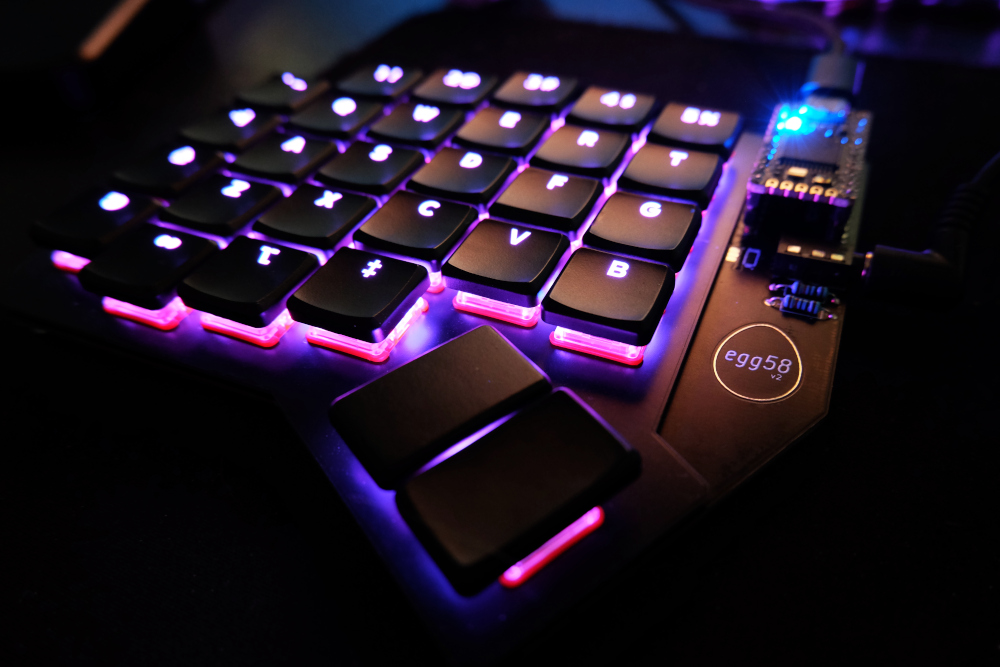
The egg58 is a staggered-column, split, low-profile keyboard with 58 keys and per-key RGB. The PCB is reversible (i.e. the same part is used for both hands). This repository contains its design files.
The egg58 was designed to remain fairly close in layout to an ANSI 60% keyboard, but with a reduced number of keys and minimal thumb clusters.
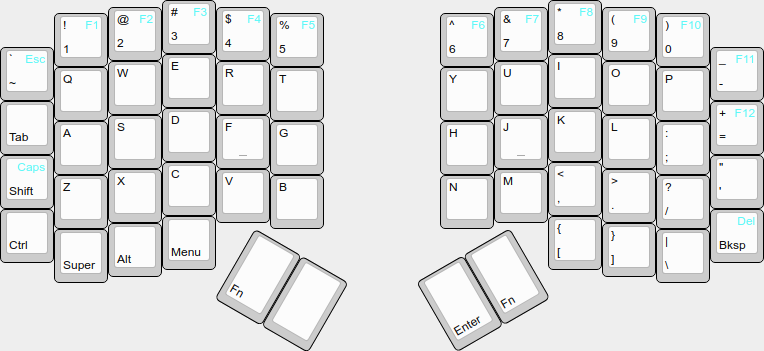
This is a suggested layout, but obviously it is customizable.
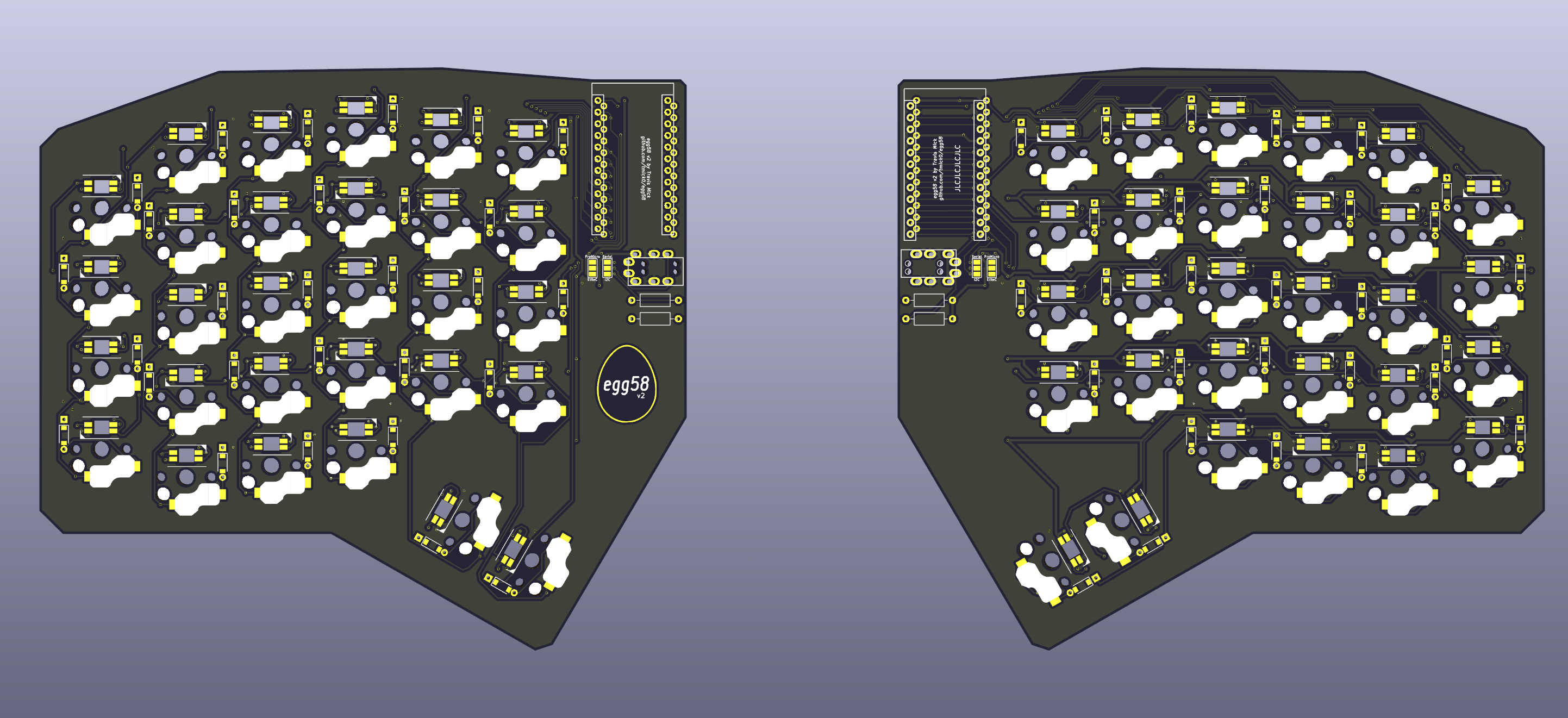
The original (wired) keyboard design files can be found in directory egg58v2.
On the back of each board:
On the front:
Mount the switchplate to the PCB with 5x M2 screws. Nylon screws are recommended. A spacer is recommended between the two layers. Finally, install switches in the sockets.
My fork of QMK contains default configuration and a keymap for the board.
The configuration will need to be changed if using soft serial instead of I2C, or if your microcontrollers do not use the DFU bootloader.
A simplified version designed to be used with ZMK is available in the egg58bt directory. This version has no RGB and uses BLE for both connectivity to the host and the split transport.
Construction is the same as the original variant above, just skip the steps related to the split transport and LEDs.
ZMK support is available from my zmk-config repo.
A 3D-printable case compatible with both the original and wireless boards can be found in egg58v2 case. The case uses M2 threaded heat-set inserts to mount the board.
Minimal tenting stands in 15, 10, and 5 degree variants can be printed from the models in egg58v2 tenting stands. They also use M2 threaded inserts. The tenting stands are mutually exclusive with the full-bottom case. Rubber bumpons should be applied to the bottom of the stands, and on the "outside" edge of the PCB where the stands do not attach.
A model for a wrist rest is also available in egg58v2 wrist rest.
This repository is available under the terms of the GPL, verison 3.
Some portions are derived from:
| Qty | Value | Footprint | References |
|---|---|---|---|
| 29 | SW_PUSH | egg58v2:Choc_Hotswap | SW11, SW12, SW13, SW14, SW15, SW16, SW21, SW22, SW23, SW24, SW25, SW26, SW31, SW32, SW33, SW34 +13 |
| 1 | LOGO | egg58v2:egg58logo | G*** |
| 1 | nice!nano v2 | egg58v2:ProMicro | U1 |
The 31 most common of 37 parts.
It measures 141.1 × 127.1 mm and has 2 copper layers, 1.6 mm thick.
37 parts. The full list of its parts is on this page, with links to each part's symbol and footprint where PCBKit's library has them.
From the eggsworks/egg58 repository on GitHub, at the commit this page was made from: the board is egg58bt/egg58v2.kicad_pcb. PCBKit opens the board in the browser, with nothing to install.
Its repository publishes it under the GPL-3.0 licence: you may reuse it on that licence's terms (keep the author's notice, and for a copyleft licence share your changes alike).


hoglet67/RGBtoHDMI
Bare-metal Raspberry Pi project that provides pixel-perfect sampling of Retro Computer RGB/YUV video and conversion to HDMI

hackclub/OnBoard
💡 Join 1,000 teenagers and make your first PCB with a $100 grant!

FreeYourStream/freedeck-hardware
all the stuff you need to build your own FreeDeck

stuartpittaway/diyBMS
Do it yourself battery management system for Lithium ion battery packs/cells

Pwnsat/FlatSat
Flatsat v1.0 is a hardware based platform for aerospace cybersecurity research


vsfteam/vsf
Versaloon Software Framework -- a tiny preemptive-capable event-driven incremental software framework for embedded systems