2 layers
 dvd604/OpenClock
Raspberry Pi Pico / ESPHome based central heating controller
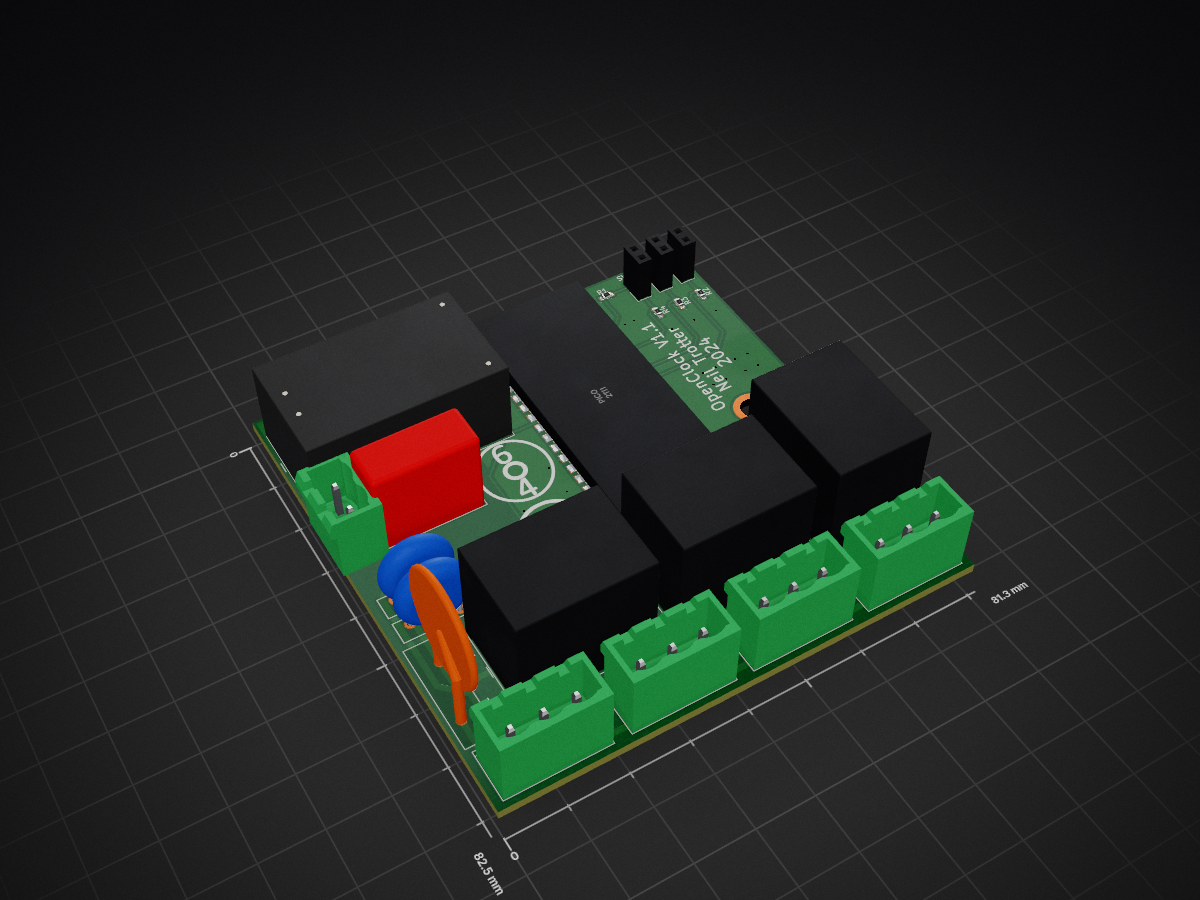
HeatingController is an open-source printed circuit board by dvd604, from the dvd604/OpenClock repository on GitHub, published under the GPL-3.0 licence. It is a 2-layer board of 81.3 × 82.6 mm with 44 parts on 66 nets, routed with 219 tracks and 63 vias.
It is built around the HLK-PM12, L7805 and LTV-847S, with the AOSS21319C and BAS521,115-JSM among its other parts. Its parts include 13 resistors, 6 switches, 4 connectors, 3 capacitors and 3 ICs. It belongs with the home automation and IoT boards and the RP2040 boards of this library.


Raspberry Pi Pico / ESPHome based central heating controller
I bought a house that had a "dumb" heating controller - a heating clock that switched zones on and off on a schedule. It had three zones, as my house has a hot water, upstairs and downstairs loop. I replaced it for a Nest Learning Thermostat 3, and was very unimpressed with it - It only had water and one zone, and the app design was terrible. For me (having an oil fired boilder), I wanted to turn the heating on for an hour in the morning to get the house warm, and give me hot water for a shower, and that's about it. Obviously as the name suggests, the Nest Thermostat wanted to get the house to a temperature and hold it there, which didn't work for me.
To fix this, I designed OpenClock - an ESPHome based heating clock built around readily available parts that would integrate into my already mature smart home system, giving me the ability to make the control of this clock as simple or as complex as I wanted. It was also a learning tool for me, being the second time I've designed circuitry for UK mains (240V) applications.
While I wouldn't recommend anyone build this (as I have limited experience with designing mains application devices), and this repo is more for demonstration purposes, I have been using OpenClock for over a year without issue.
Only tested in my house - has an oil fired boiler, which is controlled in two ways:
While OpenClock has worked well for over a year, having spent some time with it, I now know how I would do it different - and probably will. If I was doing this centralised control method again, I would buy a Shelly relay - these guys have far more experience than me with designing safe electronics, and their hardware is small enough to fit in a UK backbox. One of their relays probably costs less than the price of the PCBs alone.
However, I've come to strongly dislike my room thermostats - they're loud when switching, difficult to use, and are very feature-light. By this I mean, they turn on and off with temperature in a room. To fix this, I would hardwire the mains wires where OpenClock is at the moment, so the room thermostats are receiving power all the time, and install something like the Sonoff NSPanel. This would add so many more options into the rooms where the thermostats are mounted.
| Qty | Value | Footprint | References |
|---|---|---|---|
| 6 | 10K | Resistor_SMD:R_0603_1608Metric_Pad0.98x0.95mm_HandSolder | R2, R3, R4, R14, R15, R16 |
| 3 | 10R | Resistor_SMD:R_0805_2012Metric_Pad1.20x1.40mm_HandSolder | R8, R9, R10 |
| 3 | 75R | Resistor_SMD:R_0805_2012Metric_Pad1.20x1.40mm_HandSolder | R5, R6, R7 |
| 3 | AOSS21319C | Package_TO_SOT_SMD:SOT-23 | Q1, Q2, Q3 |
| 3 | BAS521,115 | Diode_SMD:D_SOD-523 | D1, D2, D3 |
| 3 | G5LE-1 | Relay_THT:Relay_SPDT_Omron-G5LE-1 | K1, K2, K3 |
| 2 | 1 | MountingHole:MountingHole_3.2mm_M3_Pad | H1, H2 |
| 2 | 220uF | Resistor_SMD:R_0603_1608Metric_Pad0.98x0.95mm_HandSolder | C2, C3 |
| 2 | 250V | Varistor:RV_Disc_D12mm_W3.9mm_P7.5mm | RV1, RV2 |
| 1 | 0.1uF Class X | Capacitor_THT:C_Rect_L18.0mm_W8.0mm_P15.00mm_FKS3_FKP3 | C1 |
| 1 | 100R | Resistor_SMD:R_0603_1608Metric_Pad0.98x0.95mm_HandSolder | R1 |
| 1 | Ch 1 Override | Connector_PinSocket_2.54mm:PinSocket_1x02_P2.54mm_Vertical | SW1 |
| 1 | Ch 2 Override | Connector_PinSocket_2.54mm:PinSocket_1x02_P2.54mm_Vertical | SW2 |
| 1 | Ch 3 Override | Connector_PinSocket_2.54mm:PinSocket_1x02_P2.54mm_Vertical | SW3 |
| 1 | Channel 1 | Connector_Phoenix_MSTB:PhoenixContact_MSTBVA_2,5_3-G-5,08_1x03_P5.08mm_Vertical | J3 |
| 1 | Channel 2 | Connector_Phoenix_MSTB:PhoenixContact_MSTBVA_2,5_3-G-5,08_1x03_P5.08mm_Vertical | J4 |
| 1 | Channel 3 | Connector_Phoenix_MSTB:PhoenixContact_MSTBVA_2,5_3-G-5,08_1x03_P5.08mm_Vertical | J2 |
| 1 | Fuse | Fuse:Fuse_BelFuse_0ZRE0100FF_L18.7mm_W5.1mm | F1 |
| 1 | HLK-PM12 | Converter_ACDC:Converter_ACDC_HiLink_HLK-PMxx | PS1 |
| 1 | L7805 | Package_TO_SOT_SMD:TO-252-3_TabPin2 | U2 |
| 1 | LOGO | Dvd:dvd | G*** |
| 1 | LOGO | Dvd:ocelot | G*** |
| 1 | LTV-847S | Package_DIP:SMDIP-16_W9.53mm | U3 |
| 1 | Mains | Connector_Phoenix_MSTB:PhoenixContact_MSTBVA_2,5_3-G-5,08_1x03_P5.08mm_Vertical | J1 |
| 1 | Pico | MCU_RaspberryPi_and_Boards:RPi_Pico_SMD_TH | U1 |
| 1 | Thermal Fuse | Connector_Phoenix_MSTB:PhoenixContact_MSTBVA_2,5_2-G-5,08_1x02_P5.08mm_Vertical | F2 |
It measures 81.3 × 82.6 mm and has 2 copper layers, 1.6 mm thick.
44 parts, built around the HLK-PM12, L7805, LTV-847S and AOSS21319C. The full list of its parts is on this page, with links to each part's symbol and footprint where PCBKit's library has them.
From the dvd604/OpenClock repository on GitHub, at the commit this page was made from: the board is KiCad Project/heatingController.kicad_pcb and its schematic KiCad Project/heatingController.kicad_sch. PCBKit opens the board in the browser, with nothing to install.
Its repository publishes it under the GPL-3.0 licence: you may reuse it on that licence's terms (keep the author's notice, and for a copyleft licence share your changes alike).

Jochen0x90h/RoomControl
Smart home room controller based on nRF52840 with MQTT and and IEEE 802.15.4 radio support. Buttons and relays for lights and roller shutters can also be connected with a local bus using LIN physical layer


AlanCarvalhoEE/hap
Home Automation Platform with custom hardware and firmware (ESP8266), a Raspberry Pi–based server, and an Android client. Features modular IoT devices, TCP/IP and MQTT messaging, and a scalable system architecture.

aditya02095/PCB-Design
Here are the gerber files for the digital frequency meter created using KiCAD


enriquewph/potenciatp4
Fuente Conmutada 50W 24V 2.4A de la cátedra Electrónica de Potencia - Grupo 3 - 5R2

Escondol/Electiva-Meca
Este repositorio es para colocar tareas asignadas por el profesor Carlos Pichardos.