2 layers70 × 66 mm

 dhuntoon/kool_keg
This repository holds relevant files for Team 51 (Kool Keg) in ECE Senior Design. It includes hardware schematics, PCB layouts, mobile application software, and software diagrams.
Kool keg is an open-source printed circuit board by dhuntoon, from the dhuntoon/kool_keg repository on GitHub. It is a 2-layer board of 121.6 × 72.7 mm with 75 parts on 64 nets, routed with 429 tracks and 54 vias.
It is built around the ESP32-WROOM-32D, HX711 and TPS562207DRL, with the 24LC256-I/MS, 74LVC3G14DC and LM1117-ADJ among its other parts. Its parts include 23 capacitors, 21 resistors, 7 ICs, 7 connectors and 4 diodes. It belongs with the ESP32 boards of this library.


Purdue University > ECE Senior Design (ECE 49022) > Lab Section 5 > Team 51
This repository holds relevant files for Team 51 (Kool Keg) in ECE Senior Design. It includes hardware schematics, PCB layouts, mobile application software, and software diagrams.
kool_keg (repository home directory)
/Circuit Design/...
/main/...
/Kool Keg Circuit/...
/Software/...
/aws_backend/...
/figures/...
/keg_app/...
/lib/...
/testing_scripts/...
/README.md
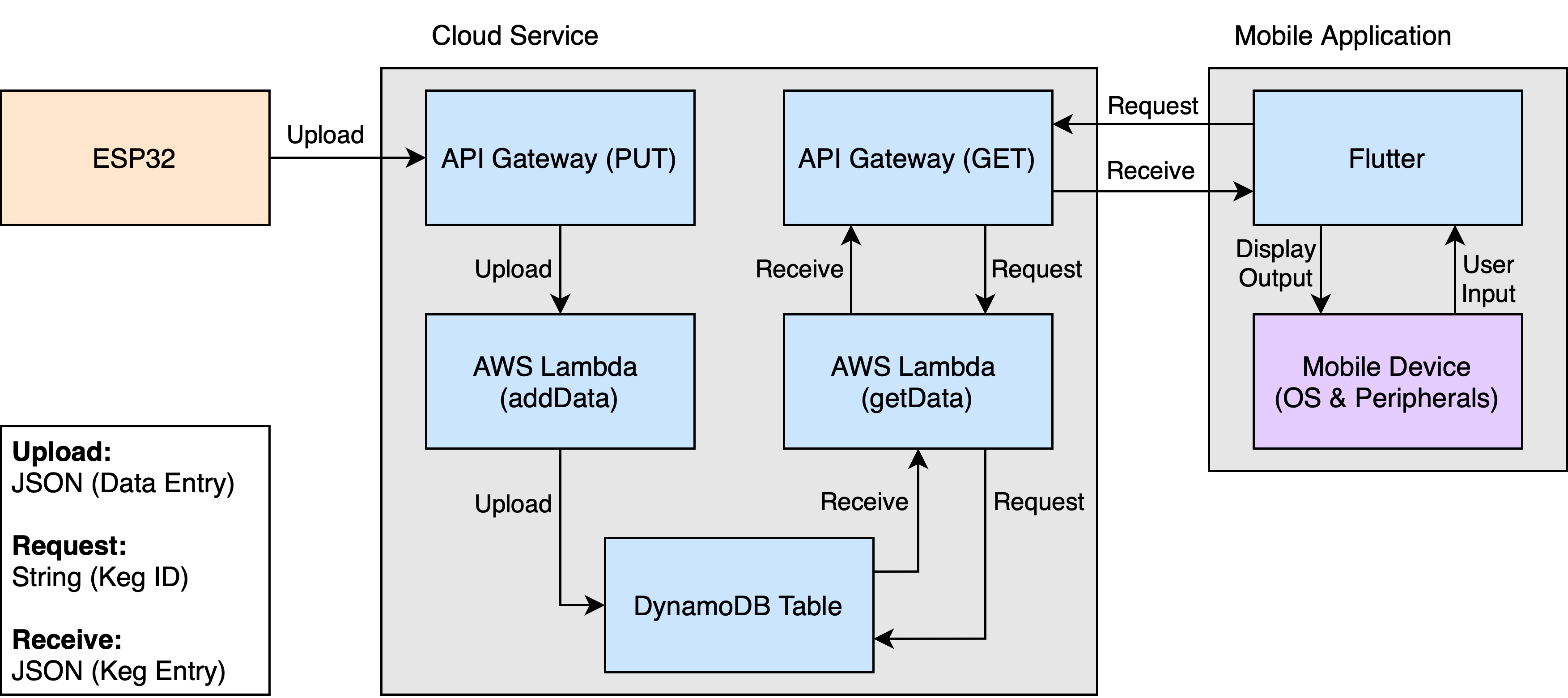
The following diagram illustrates the components of the software subsystem and related interactions with other subsystems. The color-coding corresponds to the overall system diagram, found in the design documentation.
The following diagram illustrates the software architecture for the system's mobile application. The program is written in Flutter (Dart) and is deployable on iOS and Android platforms. The black circle identifies the program entry point and is triggered when the application launches.
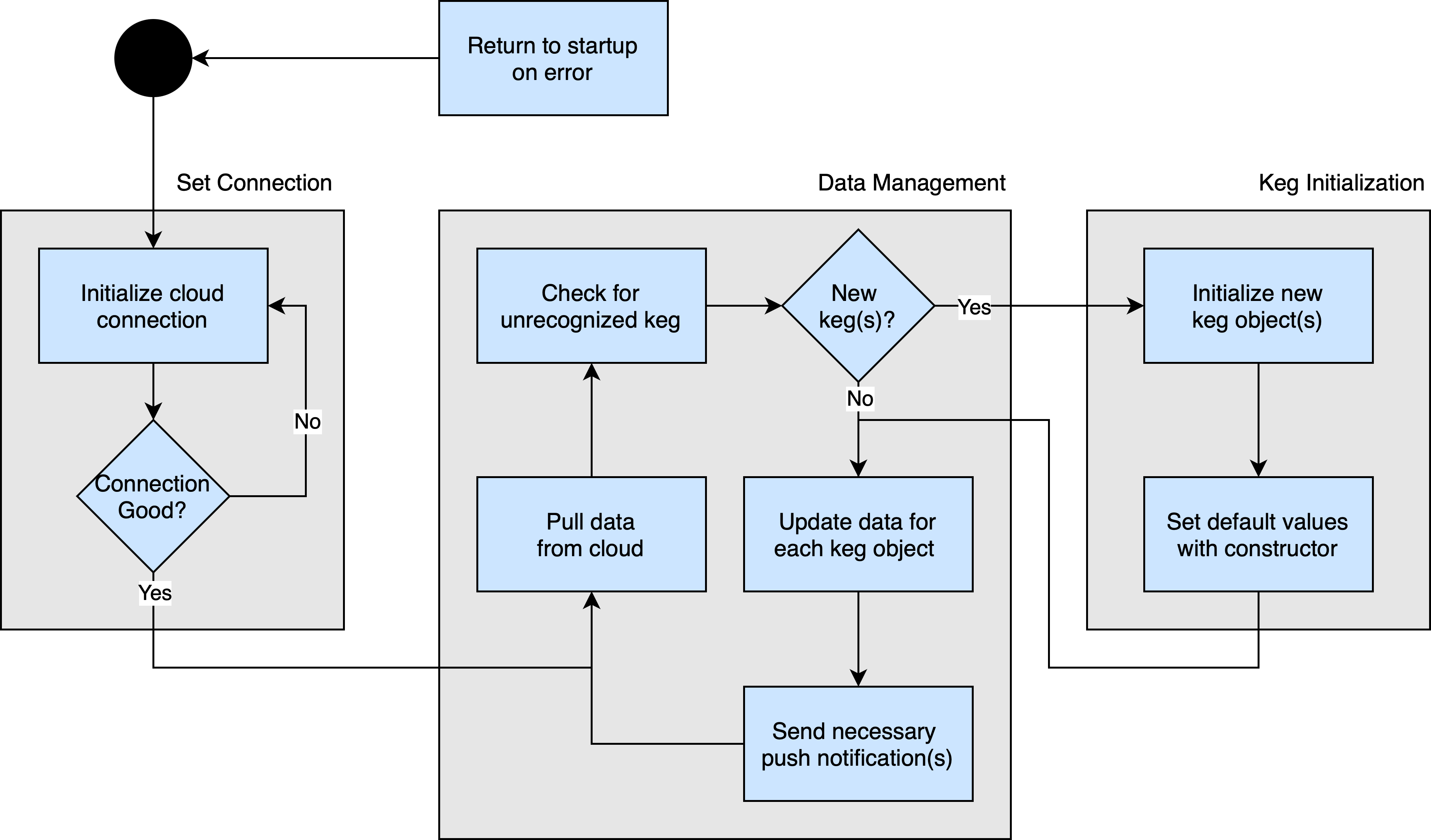
For further detail, see the related figures in the Software/figures/ subdirectory.
Updated Nov 1, 2022.
The mobile application will be deployed onto devices supporting the iOS and Android platforms. Execution will automatically begin when the application is launched on the aforementioned devices.
To build or prototype with the program on a local machine, you must install the following dependencies. To ensure dependencies are installed correctly, reference the flutter documentation (https://docs.flutter.dev/get-started/install).
Dependencies:
For rapid prototyping and testing, an IDE (such as VSCode or XCode) is recommended. Alternative command line operations are listed below for Unix terminals.
See the following documentation for Flutter Command Line Tools: https://docs.flutter.dev/reference/flutter-cli.
$ flutter --version returns the version of flutter installed on your machine.
$ flutter doctor returns the dependency checks for the aforementioned libraries. Helpful installation directions are provided for missing dependencies.
To build the program:
$ cd kool_keg/Software/keg_app
$ flutter build target
where target is the targeted platform (ios, android, etc.)
To run the program:
$ cd kool_keg/Software/keg_app
$ flutter run lib/main.dartContributors to this repository:
| Qty | Value | Footprint | References |
|---|---|---|---|
| 7 | 10k | Resistor_SMD:R_0805_2012Metric_Pad1.20x1.40mm_HandSolder | R4, R16, R17, R18, R19, R20, R21 |
| 6 | 0.1uF | Capacitor_SMD:C_0805_2012Metric_Pad1.18x1.45mm_HandSolder | C11, C12, C13, C14, C16, C23 |
| 6 | 22000 | Resistor_SMD:R_0805_2012Metric_Pad1.20x1.40mm_HandSolder | R5, R6, R7, R8, R9, R10 |
| 4 | 10uF | Capacitor_SMD:C_0805_2012Metric_Pad1.18x1.45mm_HandSolder | C4, C5, C15, C17 |
| 3 | .1uF | Capacitor_SMD:C_0805_2012Metric_Pad1.18x1.45mm_HandSolder | C6, C19, C21 |
| 3 | 22uF | Capacitor_SMD:C_0805_2012Metric_Pad1.18x1.45mm_HandSolder | C9, C10, C22 |
| 3 | D | Diode_SMD:D_SOD-323_HandSoldering | D1, D2, D3 |
| 3 | SW_MEC_5G | Button_Switch_THT:SW_PUSH-12mm | SW1, SW2, SW3 |
| 3 | TestPoint_Pad_1.5x1.5mm | TestPoint:TestPoint_Pad_1.5x1.5mm | +3.3, +5V, GND |
| 2 | 100 | Resistor_SMD:R_0805_2012Metric_Pad1.20x1.40mm_HandSolder | R11, R12 |
| 1 | 100 nF | Capacitor_SMD:C_0805_2012Metric_Pad1.18x1.45mm_HandSolder | C20 |
| 1 | 100k | Resistor_SMD:R_0805_2012Metric_Pad1.20x1.40mm_HandSolder | R15 |
| 1 | 100nF | Capacitor_SMD:C_0805_2012Metric_Pad1.18x1.45mm_HandSolder | C1 |
| 1 | 100uF | Capacitor_SMD:CP_Elec_6.3x5.8 | C7 |
| 1 | 10uF | Capacitor_SMD:CP_Elec_4x5.8 | C2 |
| 1 | 1N4148 | Diode_THT:D_DO-35_SOD27_P7.62mm_Horizontal | D4 |
| 1 | 1k | Resistor_SMD:R_0805_2012Metric_Pad1.20x1.40mm_HandSolder | R2 |
| 1 | 2.2uF | Capacitor_SMD:C_0805_2012Metric_Pad1.18x1.45mm_HandSolder | C18 |
| 1 | 22k | Resistor_SMD:R_0805_2012Metric_Pad1.20x1.40mm_HandSolder | R14 |
| 1 | 24LC256-I/MS | Package_SO:MSOP-8_3x3mm_P0.65mm | U6 |
| 1 | 2N3905 | Package_TO_SOT_THT:TO-92_Inline | Q1 |
| 1 | 2N3906 | Package_TO_SOT_THT:TO-92_Inline | Q2 |
| 1 | 3.3uH | Inductor_SMD:L_Bourns_SRN6045TA | L1 |
| 1 | 30.9k | Resistor_SMD:R_0805_2012Metric_Pad1.20x1.40mm_HandSolder | R3 |
| 1 | 330 | Resistor_SMD:R_0805_2012Metric_Pad1.20x1.40mm_HandSolder | R1 |
| 1 | 56pF | Capacitor_SMD:C_0603_1608Metric_Pad1.08x0.95mm_HandSolder | C8 |
| 1 | 68nF | Capacitor_SMD:C_0805_2012Metric_Pad1.18x1.45mm_HandSolder | C3 |
| 1 | 74LVC3G14 | Package_SO:MSOP-8_3x3mm_P0.65mm | U3 |
| 1 | 8.2k | Resistor_SMD:R_0805_2012Metric_Pad1.20x1.40mm_HandSolder | R13 |
| 1 | 946-MPQ6610GS-AEC1-P | Package_SO:SOIC-8_3.9x4.9mm_P1.27mm | U5 |
| 1 | Conn_01x02_Female | Connector_PinHeader_2.00mm:PinHeader_1x04_P2.00mm_Vertical | J7 |
| 1 | Conn_01x02_Male | Connector_Molex:Molex_KK-396_A-41791-0002_1x02_P3.96mm_Vertical | J1 |
| 1 | ESP32-WROOM-32D | RF_Module:ESP32-WROOM-32 | U7 |
| 1 | Flowmeter Header | Connector_PinHeader_2.00mm:PinHeader_1x03_P2.00mm_Vertical | J4 |
| 1 | HX711 | Package_SO:SOP-16_3.9x9.9mm_P1.27mm | U4 |
| 1 | IR Header | Connector_PinHeader_2.00mm:PinHeader_1x04_P2.00mm_Vertical | J3 |
| 1 | LM1117-ADJ | Package_TO_SOT_SMD:SOT-223-3_TabPin2 | U1 |
| 1 | Prog | Connector_PinHeader_2.00mm:PinHeader_1x06_P2.00mm_Vertical | J5 |
| 1 | Scale Header | Connector_PinHeader_2.00mm:PinHeader_1x04_P2.00mm_Vertical | J2 |
| 1 | Solenoid Conn, 01x02_Male | Connector_Molex:Molex_KK-396_A-41791-0002_1x02_P3.96mm_Vertical | J6 |
| 1 | TPS562207 | Package_TO_SOT_SMD:SOT-563 | U2 |
The 71 most common of 75 parts.


linlun/HW-ESP8266_Roomba
Kicad schematics of a generic ESP8266 board with interfaces for OLED-display, rotary encoder, Roomba and DC/DC


graham-r/kiCad_Schmitt_Trigger
Schmitt Trigger switch-bounce removal based kiCad projects


dennisperry/RC2014_PCBs
A group of RC2014 PCBs I've designed to expand my system

It measures 121.6 × 72.7 mm and has 2 copper layers, 1.6 mm thick.
75 parts, built around the ESP32-WROOM-32D, HX711, TPS562207DRL and 24LC256-I/MS. The full list of its parts is on this page, with links to each part's symbol and footprint where PCBKit's library has them.
From the dhuntoon/kool_keg repository on GitHub, at the commit this page was made from: the board is Kool Keg Circuit/Kool Keg.kicad_pcb and its schematic Kool Keg Circuit/Kool Keg.kicad_sch. PCBKit opens the board in the browser, with nothing to install.
Its repository states no licence, so its author keeps all rights: ask dhuntoon before reusing the design.