2 layers35 × 100 mm
WalkieTalkie
GuzziFlipFlops/ESP32-Walkie-Talkie
An open source ESPNOW based walkie talkie with a 600 meter tested distance, with an OLED and multiple buttons to interact with
66 parts7MIT
 devvazquez/bonsai1
Bonsai is a small, snap-on device that can be attached to almost any pair of glasses. Powered by a Seeed Studio XIAO ESP32S3 Sense, it captures images and video from the user's perspective and uses AI to analyze the surrounding environment.
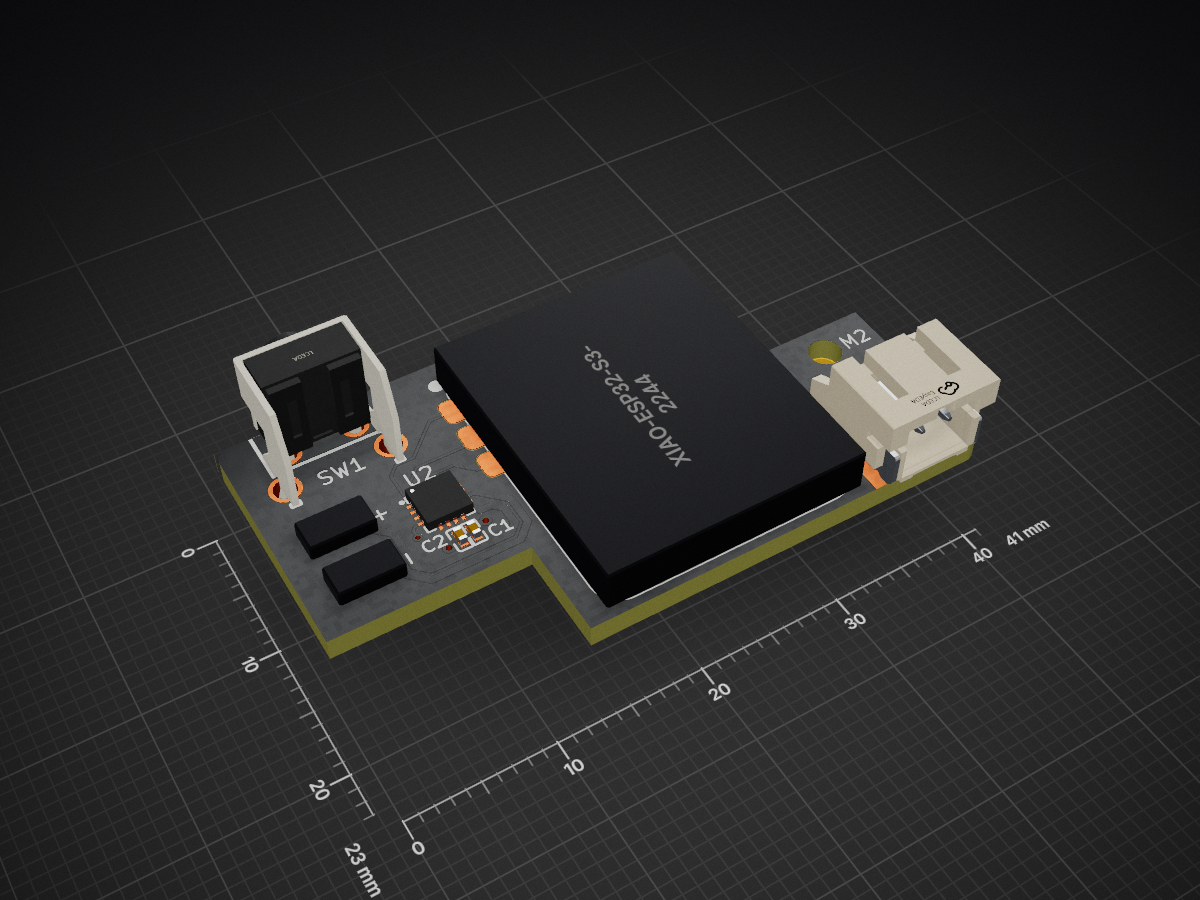
Bonsai pcb is an open-source printed circuit board by devvazquez, from the devvazquez/bonsai repository on GitHub, published under the MIT licence. It is a 2-layer board of 41 × 23 mm with 11 parts on 19 nets, routed with 93 tracks and 29 vias.
It is built around the MAX98357AETE+T, S2B-PH-SM4-TB(LF)(SN) and TS-1102N-5516. Its parts include 2 capacitors, 2 ICs, 2 connectors and 1 switch. It belongs with the ESP32 boards of this library.


The main repository containing all the files involved in the creation of this smart device, such as cad files, code, designs...
I've always wanted to do a hardware project like this, involving a camera. And I love the idea of being able to connect AI with real-world data, so this project is perfect!
Bonsai-Glasses/
├── bom.csv             # The bill of materials with links.
├── src/
│   ├── firmware/       # Embedded / microcontroller source code
├── hardware/
│   ├── cad/            # 3D CAD models and mechanical designs
│   └── bonsai_pcb/     # PCB schematics and board layouts
└── assets/ # Images, logos, and other design assetsThanks to the backend, Bonsai is able to interact easily with free and fast AI providers, such as Groq (for the STT and vision LLM). For TTS, it uses Piper (locally), which is esential for Catalan support. Thanks to the board, a XIAO ESP32 Sense, we can use the provided camera to give the model visual context, which is then used to describe the current enviroment. Using the built-in web server in the firmware, you can configre all the Wifi networks, and default user button actions. You can also change parameters such as default language. Some of these parameters can also be configured using the wake word (ex. "Hey Bonsai, change the language to Spanish").
The web flasher writes a firmware release to a board over USB from the browser, with no toolchain to install. Plug the board in, pick a version and press write. It needs Chrome, Edge or Opera on a computer, since it runs on the Web Serial API.
Releases are cut by hand: run the Build and publish firmware workflow from the Actions tab, give it a version like v1.0.0, and it builds the firmware, tags the commit and publishes the release the page reads (.github/workflows/release.yml). The page itself lives in docs/ and is described in docs/README.md.
Your settings are safe across a flash: /config.json, the saved networks and the voice clips are on the SD card, and only the firmware images get replaced.
| Name | Purpose | Quantity | Total Cost (USD) | Link | Distributor |
|---|---|---|---|---|---|
| 3.7V Lipo Battery | Powering the device. | $10.50 | Buy | Aliexpress | |
| JST PH 2.0 Connector | Connect battery to PCB (Bent pin socket, 2P) | $1.95 | Buy | Aliexpress | |
| Seeed Studio XIAO ESP32S3 Sense | Tiny devboard with camera support (ESP32S3 Sense Module) | $20.00 | Buy | Aliexpress | |
| MAX98357A I2S Audio Amplifier | Drives the speakers since ESP32 lacks enough power directly | $1.68 | Buy | Aliexpress | |
| 75MM OV3660 120° Camera | Captures image for ESP32 to process (120 Degrees GOOD) | $6.89 | Buy | Aliexpress | |
| Push Button | Taking the photo | 2.95$ | Buy | Aliexpress | |
| Small Speaker | Playing the TTS sound | 4.53$ | Buy | Aliexpress | |
| PCB | Holding all the components together | 23$ | Buy | JLPCB |
| Qty | Value | Footprint | References |
|---|---|---|---|
| 2 | Conn_01x01_Socket | Connector_Wire:SolderWirePad_1x01_SMD_2x4mm | -, + |
| 1 | 100nF | JLCPCB_Capacitors:C0402 | C2 |
| 1 | 10uF | JLCPCB_Capacitors:C0402 | C1 |
| 1 | B+ Solder Pad | Connector_Wire:SolderWirePad_1x01_SMD_2x4mm | J1 |
| 1 | LOGO | LOGO | G*** |
| 1 | MAX98357AETE+T | JLCPCB_Amplifiers:TQFN-16_L3.0-W3.0-P0.50-BL-EP1.5 | U2 |
| 1 | MountingHole_2.2mm_M2 | MountingHole:MountingHole_2.2mm_M2 | M2 |
| 1 | S2B-PH-SM4-TB | JLCPCB_Connectors:CONN-SMD_P2.00_S2B-PH-SM4-TB-LF-SN | CN1 |
| 1 | TS-1102N-5516 | JLCPCB_Switches:SW-TH_TS-1102N-5516 | SW1 |
| 1 | XIAO-ESP32-S3-SMD | New_XIAO_Series_Footprints:XIAO-ESP32-S3-SMD | U1 |
It measures 41 × 23 mm and has 2 copper layers, 1.6 mm thick.
11 parts, built around the MAX98357AETE+T, S2B-PH-SM4-TB(LF)(SN) and TS-1102N-5516. The full list of its parts is on this page, with links to each part's symbol and footprint where PCBKit's library has them.
From the devvazquez/bonsai repository on GitHub, at the commit this page was made from: the board is hardware/bonsai_pcb/bonsai_pcb.kicad_pcb and its schematic hardware/bonsai_pcb/bonsai_pcb.kicad_sch. PCBKit opens the board in the browser, with nothing to install.
Its repository publishes it under the MIT licence: you may reuse it on that licence's terms (keep the author's notice, and for a copyleft licence share your changes alike).
GuzziFlipFlops/ESP32-Walkie-Talkie
An open source ESPNOW based walkie talkie with a 600 meter tested distance, with an OLED and multiple buttons to interact with

JMET04/aicad-agent
Deterministic CAD/EDA agent plugin for 2D drawings, AutoCAD, SolidWorks, KiCad, review gates and auditable delivery.

Vishvak365/OpenCycle
Everything is generated from design.py — do not hand-edit the board and then regenerate, you will lose the edit. If you do route by hand in KiCad, stop using the pipeline for that board and say so in docs/DECISIONS.md.


Open-Authenticator/hardware-design
Hardware design files for open authenticator

alvarop/chaac
This is a work in progress for a wireless weather station project.