4 layers40 × 40 mm
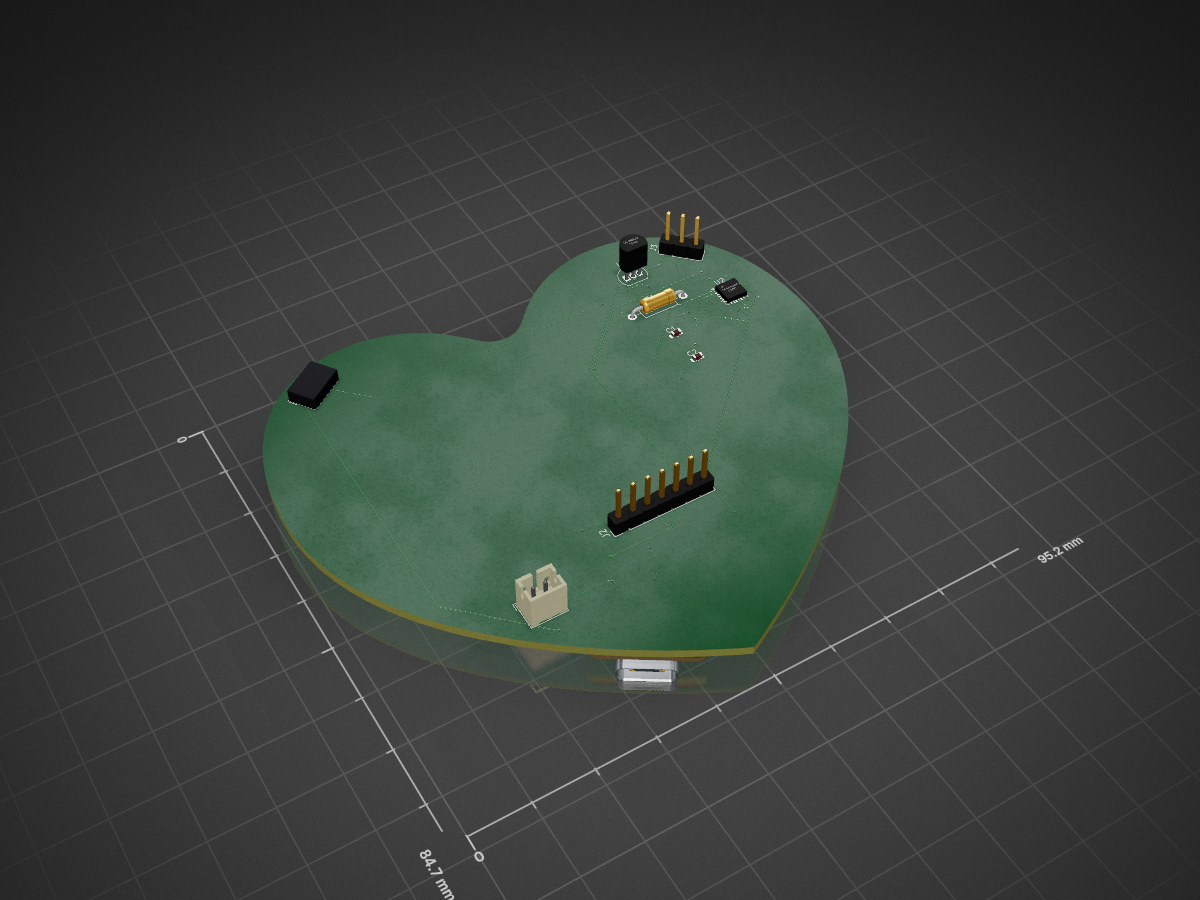
 devoymac/clicky
A portable, battery-powered heart-shaped "pet" in the style of STΛRBOY / Lil Guy: a round animated eye, a personality driven by sensors, and a touch button to pet it — it blushes when you give it affection.
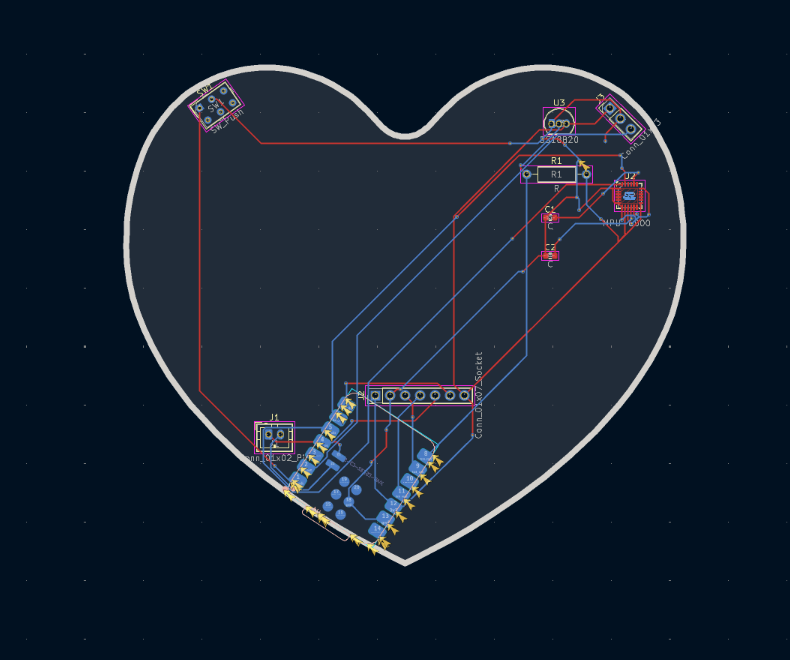
Clicky is an open-source printed circuit board by devoymac, from the devoymac/clicky repository on GitHub. It is a 2-layer board of 95.2 × 84.7 mm with 10 parts on 24 nets, routed with 179 tracks and 31 vias.
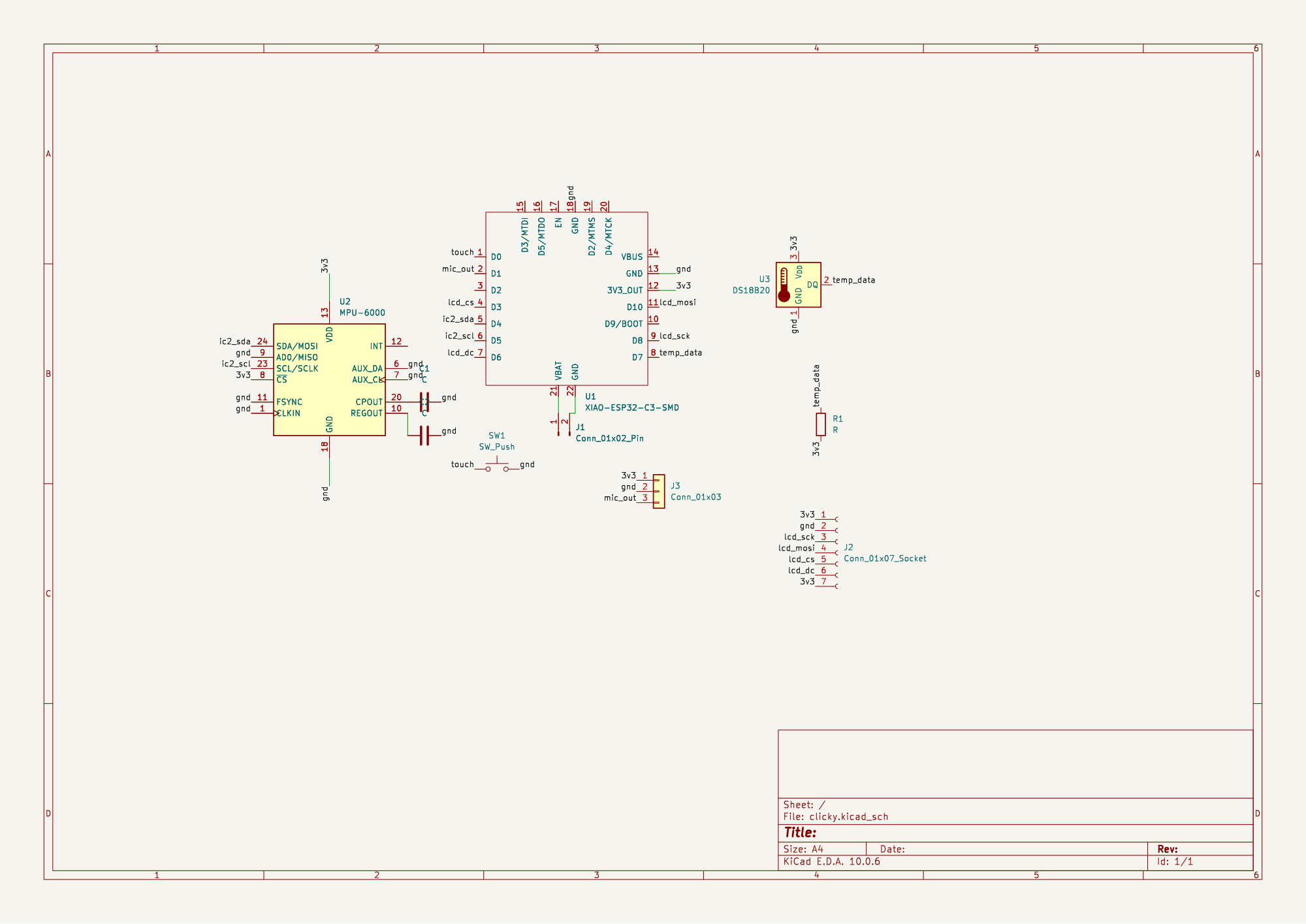
It is built around the DS18B20 and MPU-6000. Its parts include 3 ICs, 3 connectors, 2 capacitors, 1 resistor and 1 switch. It belongs with the ESP32 and RISC-V boards of this library.


A portable, battery-powered heart-shaped "pet" in the style of STΛRBOY / Lil Guy: a round animated eye, a personality driven by sensors, and a touch button to pet it — it blushes when you give it affection. It runs on a single LiPo battery and charges through the same USB-C port it uses to program.
Clicky is a small companion you wear on your clothes or bag. Inside a 3D-printed heart lives a round screen that acts as its eye, and a set of sensors give it a personality: it gets dizzy when you shake it, shivers when it's cold, startles at loud noises, and falls asleep if you ignore it. Touch it and it wakes up happy. It remembers its state across power-off.
A thumb-sized module with a built-in LiPo charger, WiFi/BLE, and plenty of GPIOs, chosen over the nRF52840 for its lower cost and simplicity:
A 240x240 round SPI display that shows Clicky's expressions. Note: the chosen module has no separate backlight pin — the backlight is tied to 3V3 internally, so the firmware should put the display to sleep instead of just dimming it, to save battery when it dozes.
The KiCad schematic is complete and validated by ERC. All nets are connected: power (3V3/GND), I2C (MPU), 1-Wire (DS18B20 with 4.7k pull-up), SPI (display), the microphone, the pet button, and the battery (VBAT). The remaining ERC notices are intentional free pins and CLI false positives.
Scaffolded for Arduino IDE in firmware/clicky/ — a
working skeleton that boots the GC9A01 eye and drives a mood state machine
(idle / dizzy / cold / startled / blush / sleep) from the MPU-6000, DS18B20,
mic and pet button. Compiles clean for the XIAO ESP32-C3 (27% flash).
Setup steps, board/library install and the TFT_eSPI GC9A01 config are in
firmware/SETUP-arduino-ide.md.
See BOM.md for the full parts list with prices (~$60 parts).
| Qty | Value | Footprint | References |
|---|---|---|---|
| 2 | C | Capacitor_SMD:C_0603_1608Metric | C1, C2 |
| 1 | Conn_01x02_Pin | Connector_JST:JST_PH_B2B-PH-K_1x02_P2.00mm_Vertical | J1 |
| 1 | Conn_01x03 | Connector_PinHeader_2.54mm:PinHeader_1x03_P2.54mm_Vertical | J3 |
| 1 | Conn_01x07_Socket | Connector_PinHeader_2.54mm:PinHeader_1x07_P2.54mm_Vertical | J2 |
| 1 | DS18B20 | Package_TO_SOT_THT:TO-92_Inline | U3 |
| 1 | MPU-6000 | Sensor_Motion:InvenSense_QFN-24_4x4mm_P0.5mm | U2 |
| 1 | R | Resistor_THT:R_Axial_DIN0207_L6.3mm_D2.5mm_P10.16mm_Horizontal | R1 |
| 1 | SW_Push | Button_Switch_THT:SW_NKK_GW12LJP | SW1 |
| 1 | XIAO-ESP32-C3-SMD | Seeed_Studio_XIAO_Series:XIAO-ESP32-C3-SMD | U1 |
It measures 95.2 × 84.7 mm and has 2 copper layers, 1.6 mm thick.
10 parts, built around the DS18B20 and MPU-6000. The full list of its parts is on this page, with links to each part's symbol and footprint where PCBKit's library has them.
From the devoymac/clicky repository on GitHub, at the commit this page was made from: the board is clicky.kicad_pcb and its schematic clicky.kicad_sch. PCBKit opens the board in the browser, with nothing to install.
Its repository states no licence, so its author keeps all rights: ask devoymac before reusing the design.


