2 layers37 × 19 mm
Passive rpi hub75-adapter
hzeller/rpi-rgb-led-matrix
Controlling up to three chains of 64x64, 32x32, 16x32 or similar RGB LED displays using Raspberry Pi GPIO
2 parts4.4kGPL-2.0
 devinacker/satecard17
CompactFlash adapter for Satellaview EXT port with example SNES code
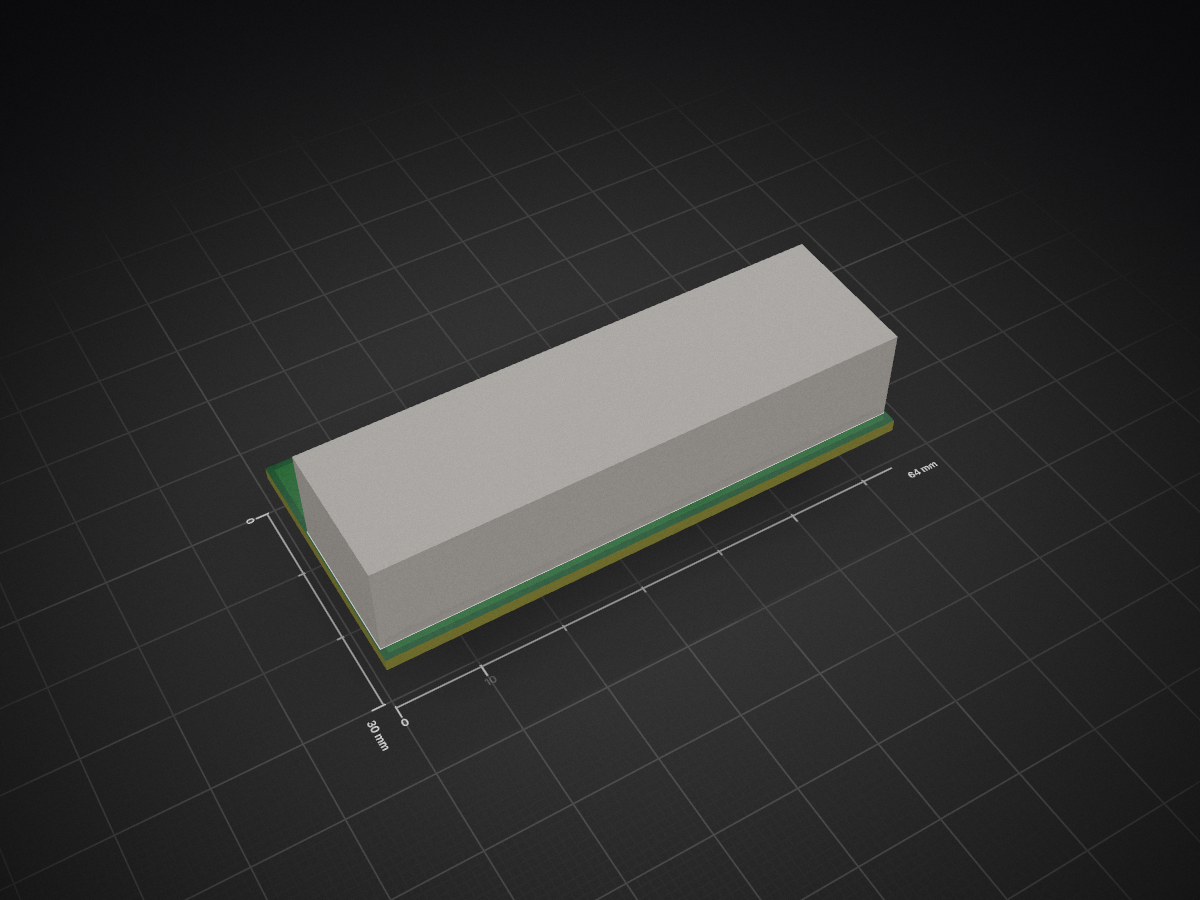
Satecard is an open-source printed circuit board by devinacker, from the devinacker/satecard repository on GitHub. It is a 2-layer board of 64 × 30 mm with 2 parts on 38 nets, routed with 141 tracks and 19 vias.
It belongs with the interfaces and adapters boards of this library.
This is a proof-of-concept prototype of a small (~3in²) adapter for the Satellaview which solders onto a CompactFlash breakout board to add memory-mapped CF card storage to the Satellaview base unit.
In addition, a small example SNES ROM and source code is included which will display some info about a CF card (vendor info, total size, MBR partition table) if one is detected.
Aside from the Super Famicom's underside expansion port used to connect the Satellaview unit, the Satellaview itself has an internal 38-pin expansion connector which resembles the 2.5-inch IDE/ATA hard drive connector. This similarity isn't a coincidence; available patent documents show that the connector was intended for some sort of never-released hard drive add-on, and recent reverse-engineering efforts revealed that the connector is essentially an IDE connector with fewer pins, no DMA signals, and an 8-bit (rather than 16-bit) data bus.
In addition, the CompactFlash standard has a "True IDE" compatibility mode which is (theoretically) guaranteed to support 8-bit data buses. CF cards are also capable of operating at 5V, making it easy to interface with "retro" hardware that doesn't use 3.3V components. As a result, this project shows that it is possible to successfully interface CF cards with the Satellaview using a simple physical adapter.
Since the Satellaview's internal expansion port was never officially used, no contemporary support for any such expansion hardware is known to exist. This proof of concept is essentially a "what could have been" experiment, rather than an actual enhancement for any existing games. Maybe it'll find a purpose in some sort of homebrew project later on?
The board was designed around a pre-made CF breakout/adapter board mainly for ease of assembly and testing, since I still consider it a "prototype". If this actually manages to turn into a serious product somehow, it may eventually be redesigned to feature a CF slot directly on the board instead.
You can order the board itself from OSHPark; a minimum order of 3 boards costs exactly $15.00 USD.
| Qty | Value | Footprint | References |
|---|---|---|---|
| 1 | CF-CARD | SateCard footprints:CF_proto | J2 |
| 1 | SatellaviewEXT | SateCard footprints:SV_Ext | J1 |
It measures 64 × 30 mm and has 2 copper layers, 1.6 mm thick.
2 parts. The full list of its parts is on this page, with links to each part's symbol and footprint where PCBKit's library has them.
From the devinacker/satecard repository on GitHub, at the commit this page was made from: the board is pcb/satecard/satecard.kicad_pcb. PCBKit opens the board in the browser, with nothing to install.
Its repository states no licence, so its author keeps all rights: ask devinacker before reusing the design.
hzeller/rpi-rgb-led-matrix
Controlling up to three chains of 64x64, 32x32, 16x32 or similar RGB LED displays using Raspberry Pi GPIO


adamws/kicad-kbplacer
KiCad plugin for automatic keyboard's key placement and routing

Luos-io/luos_engine
Open-source and real-time orchestrator for cyber-physical-systems, to easily design, test and deploy embedded applications and digital twins.

NVNTLabs/switch2-SDEX2M2
Micro SD Express to M.2 NVME Adapter for Nintendo Switch 2

BlueSCSI/BlueSCSI-v2
BlueSCSI v2/Ultra - an open source, open hardware, SCSI emulator using the Pi Pico PR2040 and Pico 2 RP2350

ohmtech-rdi/eurorack-blocks
Software to Hardware Prototyping for Eurorack using C++, Max/Gen~ or Faust
