
6 layers133.4 × 22.5 mm
Rdimm interposer
ddropattack/ddrop
This repository contains the hardware designs, firmware, host evaluation tools, and attack proof-of-concepts for DDRop.
68 parts33MIT
 ddropattack/ddrop33
This repository contains the hardware designs, firmware, host evaluation tools, and attack proof-of-concepts for DDRop.
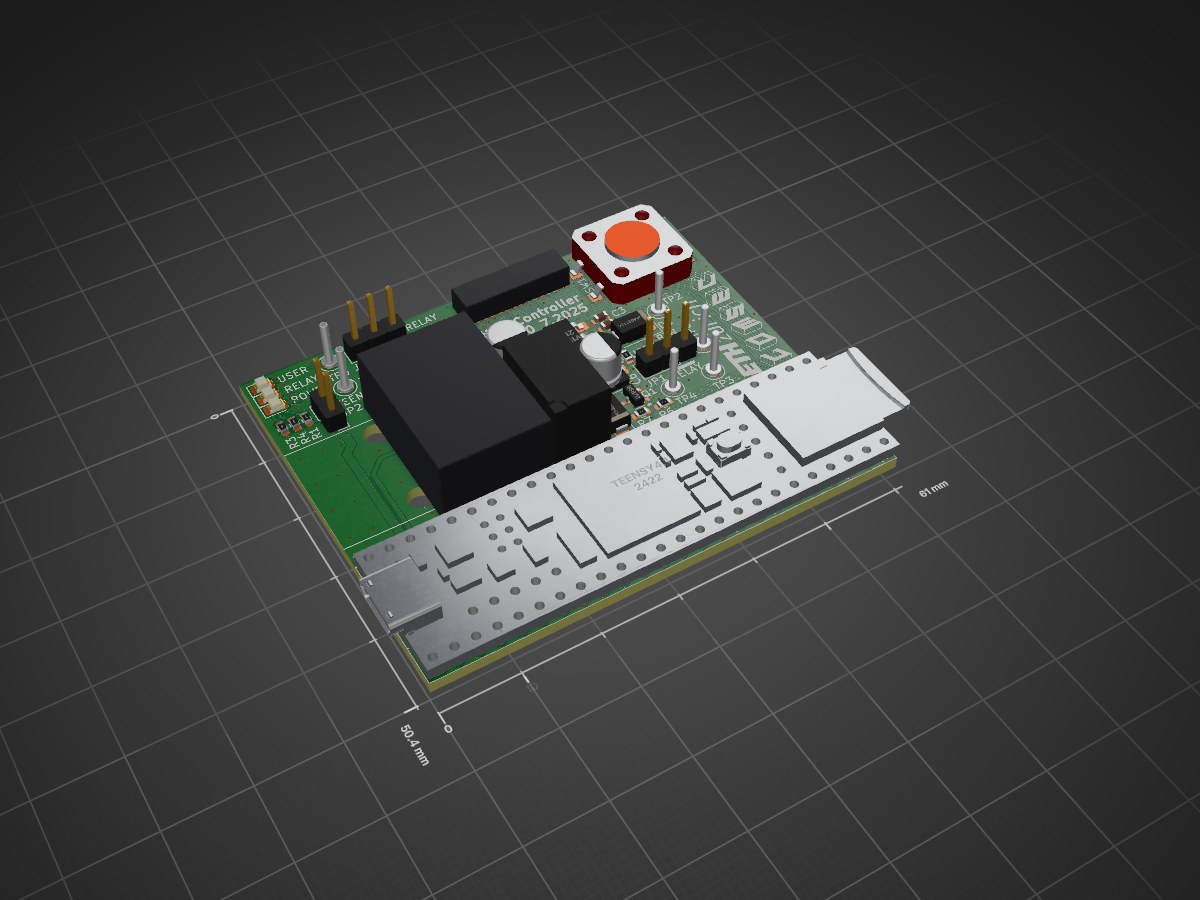
Injection controller is an open-source printed circuit board by ddropattack, from the ddropattack/ddrop repository on GitHub, published under the MIT licence. It is a 2-layer board of 61 × 50.3 mm with 37 parts on 74 nets, routed with 838 tracks and 195 vias.
It is built around the TEENSY 4.1, TLV1117-33DCY and MRA4007T3G-FS, with the BS870 among its other parts. Its parts include 7 capacitors, 7 resistors, 5 diodes, 3 connectors and 2 ICs. It belongs with the NXP (LPC, Kinetis, i.MX RT) boards of this library.


This repository contains the hardware designs, firmware, host evaluation tools, and attack proof-of-concepts for DDRop.
Modern Trusted Execution Environments (TEEs) such as Intel TDX, Intel Scalable SGX, and AMD SEV-SNP rely on memory encryption to protect enclaves and confidential VMs from an untrusted hypervisor or cloud operator. However, to maintain memory performance, scalable cloud TEEs omit cryptographic freshness guarantees.
DDRop demonstrates active physical interposition attacks on DDR5 at native bus speeds using a custom low-cost DDR5 RDIMM interposer. By injecting parity errors on DDR5 command/address lines, the interposer silently discards cache line writebacks (dropping writes) or swaps chip selects. This repository contains the full materials to inspect, build, and evaluate the interposer hardware, controller firmware, host primitives, and confidential VM attacks.
The contents of this repository correspond directly to the sections of the paper:
| Directory | Paper Section | Description |
|---|---|---|
rdimm-interposer/ | §4.1 | DDR5 RDIMM interposer PCB designs |
rdimm-injection-controller/ | §4.1 | Microcontroller injection board designs |
rdimm-injection-controller-firmware/ | §4.1 | Teensy 4.1 firmware & Python control scripts |
host-evaluation/ | §4.2 | Bare-metal host evaluation of DDRop primitives |
sev-attacks/ | §5.1, §5.2.1 | Attacks on AMD SEV-SNP |
sgx-attacks/ | §5.1 | Attacks on Intel Scalable SGX |
tdx-attacks/ | §5.1, §5.2.1, §5.2.2, §6 | Attacks on Intel TDX |
Demonstration videos recorded during physical attack execution are available in the respective directories:
sev-attacks/drop-write/sev-drop-write.pngSNP_PAGE_MOVE exploit: sev-attacks/page-move/sev-page-move.webmsgx-attacks/drop-write/sgx-drop-write.mp4tdx-attacks/page-relocate/tdx-page-relocate.webmtdx-attacks/sept-injection/tdcs-poc.mp4requirements.txt packages installedteensy_loader_cli with Teensyduino support (for compiling and flashing the controller firmware)End-to-end physical replication of the attacks requires:
rdimm-interposer/ and rdimm-injection-controller/).When physical interposer hardware is not available, the software components and attack binaries can still be compiled locally, and their execution flow can be cross-referenced with the provided screencasts.
You can verify and build all host evaluation tools and attack PoCs from the repository root:
make allThis command automatically builds the dependencies and produces:
host-evaluation/drop-write, swap-ranks, drop-read)sev-attacks/drop-write, page-move, movepage)tdx-attacks/drop-write, page-relocate, attacker-td, victim-td)To remove all built binaries and object files:
make clean[!NOTE] Building Intel Scalable SGX enclaves (
sgx-attacks/) requires the Intel SGX SDK and SGX-Step withLIBSGXSTEP_DIRset (seesgx-attacks/README.md). The microcontroller firmware can be compiled withmake firmware(seerdimm-injection-controller-firmware/README.md).
Refer to the individual README files in each folder for specific execution steps, kernel patch instructions, and command-line parameters:
rdimm-interposer/README.md: Interposer specifications, stackup, and modification instructions.rdimm-injection-controller/README.md: Controller board hardware and assembly.rdimm-injection-controller-firmware/README.md: Firmware flashing and control API.host-evaluation/README.md: Running host-level write drop, read drop, and rank swapping primitives.sev-attacks/README.md: AMD SEV-SNP setup and attack steps.sgx-attacks/README.md: Intel Scalable SGX driver patches and enclave evaluation.tdx-attacks/README.md: Intel TDX kernel/TDXplore patches, page relocation, and SEPT injection attacks.If you reference or build upon this work, please cite the paper:
@inproceedings{ddrop26,
  title     = {{DDRop}: Active Memory Interposer Attacks on Confidential {VMs} by Dropping {DDR5} Writes},
  author    = {De Meulemeester, Jesse and Gloor, Stefan and Jattke, Patrick and Moghimi, Daniel and Oswald, David and Thompson, Martin and Razavi, Kaveh and Verbauwhede, Ingrid and Van Bulck, Jo},
  booktitle = {Proceedings of the 2026 {ACM} {SIGSAC} Conference on Computer and Communications Security ({CCS} '26)},
  publisher = {ACM},
  year      = 2026,
}| Qty | Value | Footprint | References |
|---|---|---|---|
| 6 | TestPoint | TestPoint:TestPoint_Keystone_5000-5004_Miniature | TP1, TP2, TP3, TP4, TP5, TP6 |
| 5 | 100n | Capacitor_SMD:C_0603_1608Metric | C1, C2, C3, C4, C5 |
| 5 | 330 | Resistor_SMD:R_0603_1608Metric | R1, R2, R3, R4, R7 |
| 3 | LED | LED_SMD:LED_0805_2012Metric | D1, D2, D3 |
| 2 | 10u | Capacitor_SMD:CP_Elec_5x5.8 | C6, C7 |
| 2 | 47k | Resistor_SMD:R_0603_1608Metric | R5, R6 |
| 2 | LOGO | LOGO | G***, G*** |
| 2 | MRA4007T3G | Diode_SMD:D_SMA | D4, D5 |
| 1 | BS870 | Package_TO_SOT_SMD:SOT-23 | Q1 |
| 1 | Conn_01x03_Pin | Connector_PinHeader_2.54mm:PinHeader_1x03_P2.54mm_Vertical | J3 |
| 1 | G5V-1 | Relay_THT:Relay_SPDT_Omron_G5V-1 | K1 |
| 1 | Jumper_2_Open | Connector_PinHeader_2.54mm:PinHeader_1x02_P2.54mm_Vertical | JP2 |
| 1 | Jumper_3_Bridged12 | Connector_PinHeader_2.54mm:PinHeader_1x03_P2.54mm_Vertical | JP1 |
| 1 | Molex 5019512430 | DDR5:5019512430 | J2 |
| 1 | RJ45_Bel_SI-60062-F | DDR5:480251090 | J1 |
| 1 | TL3300 | DDR5:TL3300 | SW1 |
| 1 | TLV1117-33 | Package_TO_SOT_SMD:SOT-223-3_TabPin2 | U2 |
| 1 | Teensy4.1 | Teensy:Teensy41 | U1 |
It measures 61 × 50.3 mm and has 2 copper layers, 1.6 mm thick.
37 parts, built around the TEENSY 4.1, TLV1117-33DCY, MRA4007T3G-FS and BS870. The full list of its parts is on this page, with links to each part's symbol and footprint where PCBKit's library has them.
From the ddropattack/ddrop repository on GitHub, at the commit this page was made from: the board is rdimm-injection-controller/hardware/injection-controller.kicad_pcb and its schematic rdimm-injection-controller/hardware/injection-controller.kicad_sch. PCBKit opens the board in the browser, with nothing to install.
Its repository publishes it under the MIT licence: you may reuse it on that licence's terms (keep the author's notice, and for a copyleft licence share your changes alike).
ddropattack/ddrop
This repository contains the hardware designs, firmware, host evaluation tools, and attack proof-of-concepts for DDRop.


g-rahul/BQ76PL455A-EVM-Clone
This respository contains low cost design files for BQ76PL455A-EVM Clone.

Cyrillinux/Ardui89
Adds 8051 architecture family to the Arduino IDE : STC89C52RC, STC89C516RD+, STC15W408AS-DIP16

ilyushkin/auto_dimmer
Automatic dimmer for IKEA NYMANE (103.569.62) lamp based on AVR ATtiny13A MCU.

promesoft/KicadJE_LFO_1
Initial Analogue LFO - Mult/Mix - NAND/AND/NOT - FlipFlop - 555LFO
