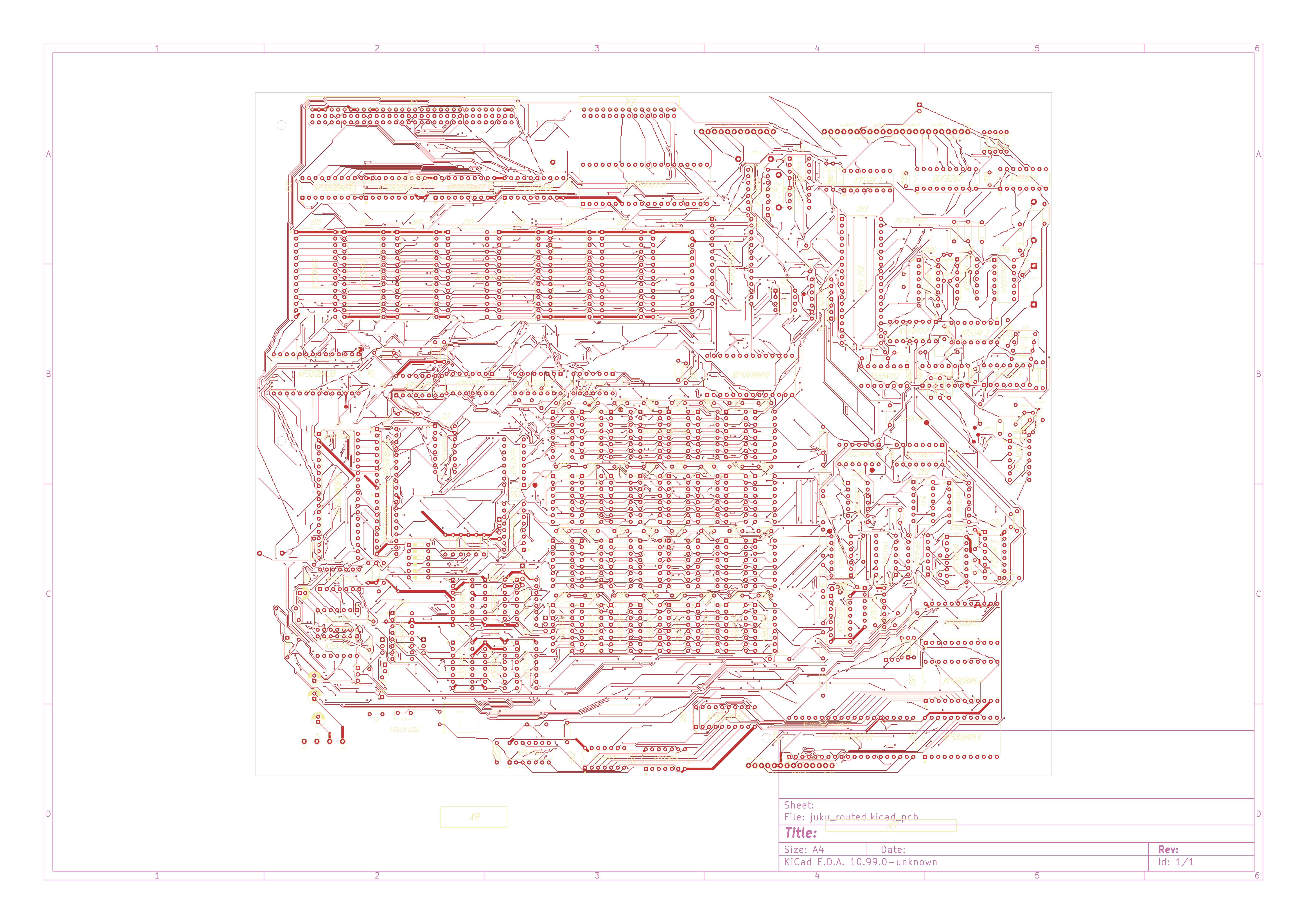
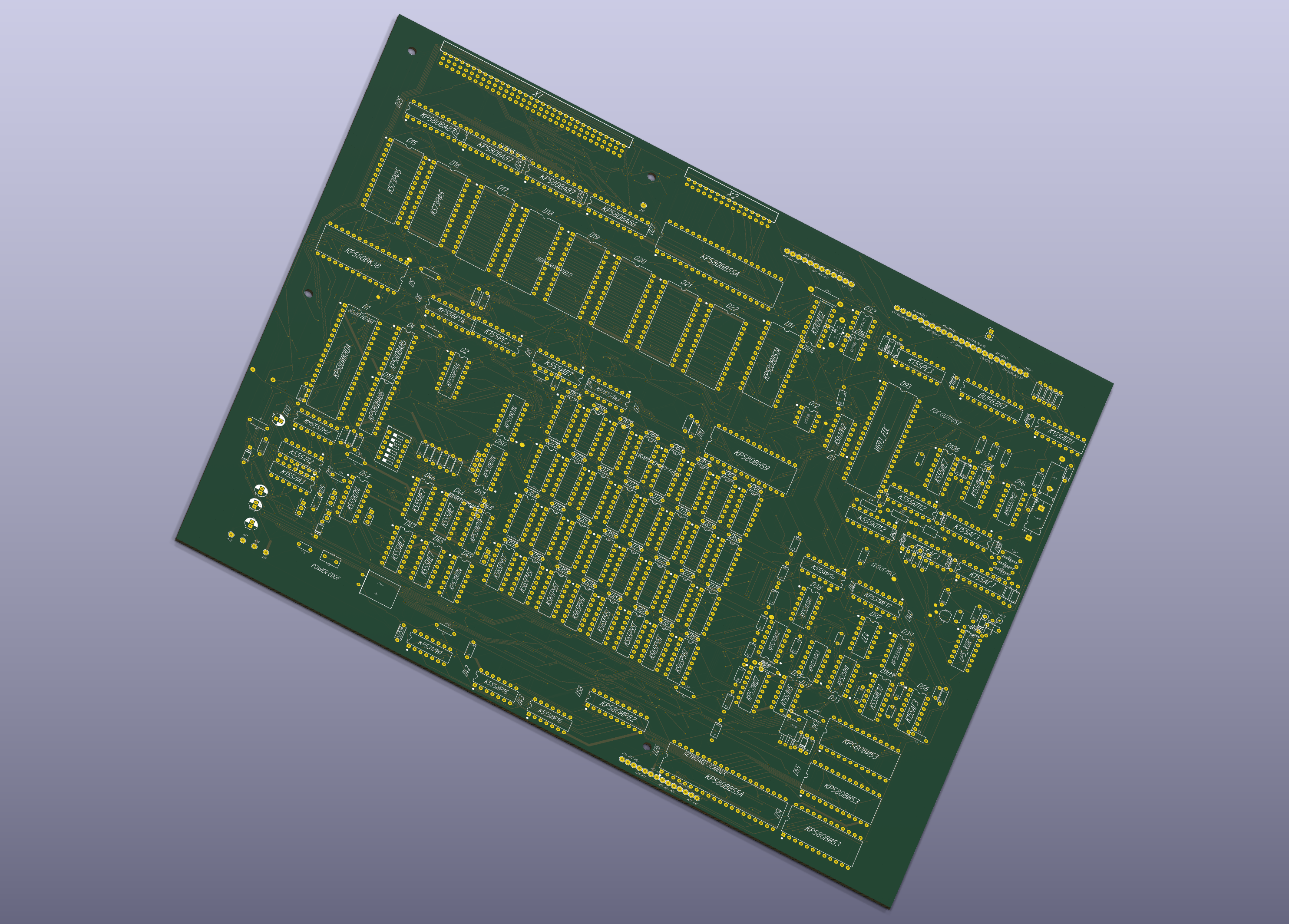
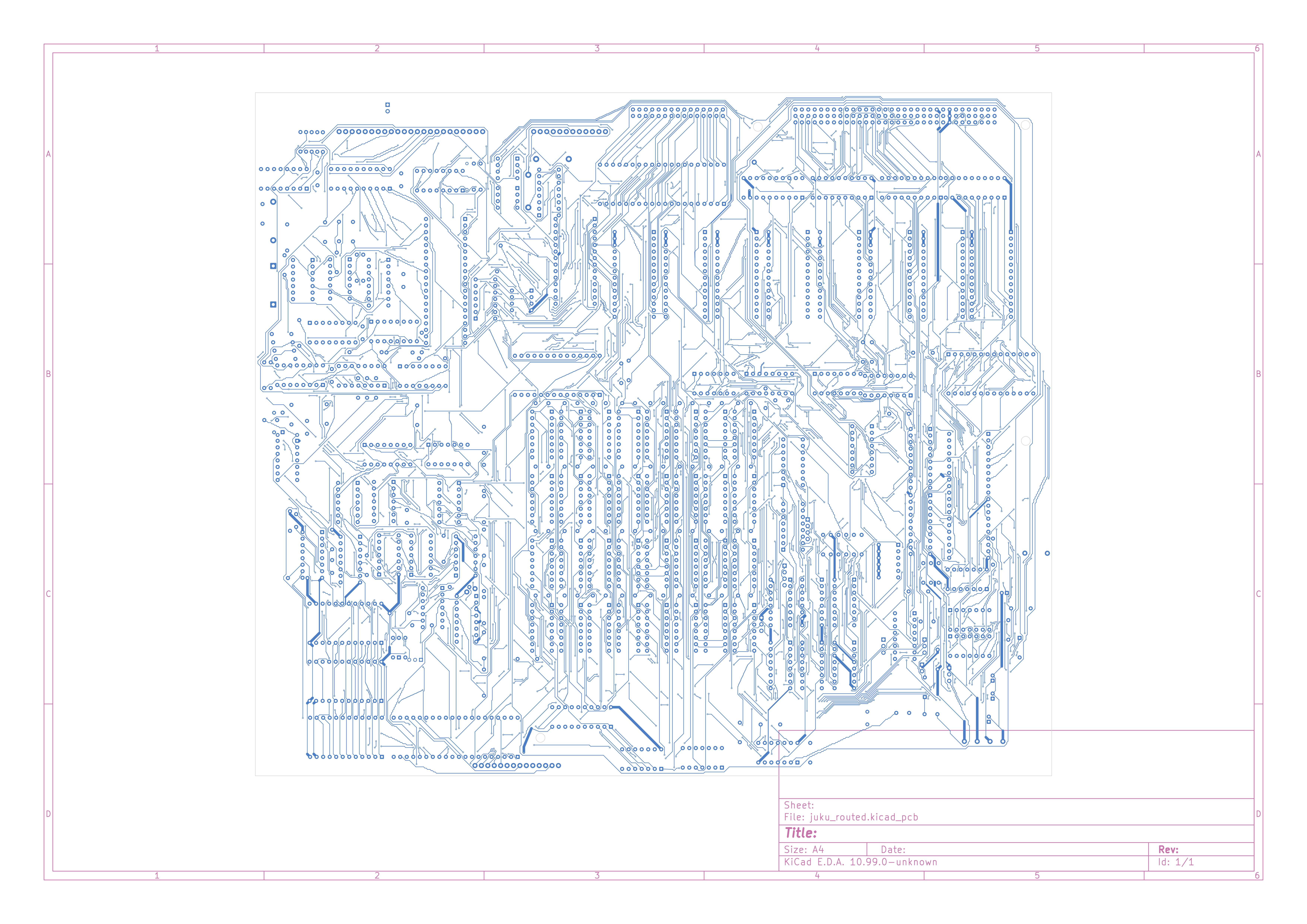
Reconstruction of the Soviet/Estonian Juku E5104 processor board as a physical PCB and a runnable digital model. Structural Verilog connectivity is checked against the machine-readable board model with LVS.
Cpu is an open-source printed circuit board by ddanila, from the ddanila/8080-cosim repository on GitHub. It is a 2-layer board of 100 × 70 mm with 7 parts on 48 nets, routed with 313 tracks and 24 vias.
Its parts include 2 capacitors and 2 ICs.
README
README.md
8080-cosim
Reconstruction of the Soviet/Estonian Juku E5104 processor board as a physical
PCB and a runnable digital model. Structural Verilog connectivity is checked
against the machine-readable board model with LVS.
Emulator dependency
The portable C emulator is maintained in dac-emulation, pinned here as a submodule. After cloning or pulling, run:
Existing cosim/*.c build commands still work through forwarding files. Hardware models and their verification stay here. See the consumer guide for ownership and updating the pin. bash sync/emulation_check.sh runs fast native checks without Verilog.
Current state
The C emulator and structural juku_top have ROM-boot and framebuffer
comparison guards, plus keyboard, CPU, FDC, serial and subsystem checks.
The deep cosim guard compares typed CPU-bus events against the C oracle.
The C emulator boots the vendored EKDOS images and reaches disk BASIC
READY. Recorded HDL runs also
reached that prompt; current Verilator reruns have a
build compatibility limitation.
The bounded boot guard does not establish the full EKDOS/BASIC prompt path.
The production network host is portable C. Linux/macOS, DOS and the Windows
GUI share its core; Janet, Fastboot, NetDisk, N4, snapshots, journals and reset
recovery are implemented. See the host contract
and Windows guide for platform qualification
and the latest build.
The physical board is on DESIGN HOLD / PACKAGE REGENERATION REQUIRED.
Hidden or conflicting source paths, physical placement, routed copper and
parts decisions remain. The evidence archive is a review package, and the
current Gerber/drill upload ZIP is absent. The
manufacturing report owns release
status; PLAN.md lists the remaining work.
The physical shared-DRAM/video slot schedule is not complete. The runnable
framebuffer readout is an abstract oracle, not a proved VIDEO_OUT voltage
waveform. Green behavioral CI and LVS do not establish physical authenticity.
The independent spin-offs are Jukuravi,
VJUGA and
JukuPoly. Their physical results and release
criteria are separate from the replica main board.
Network boot demonstrations
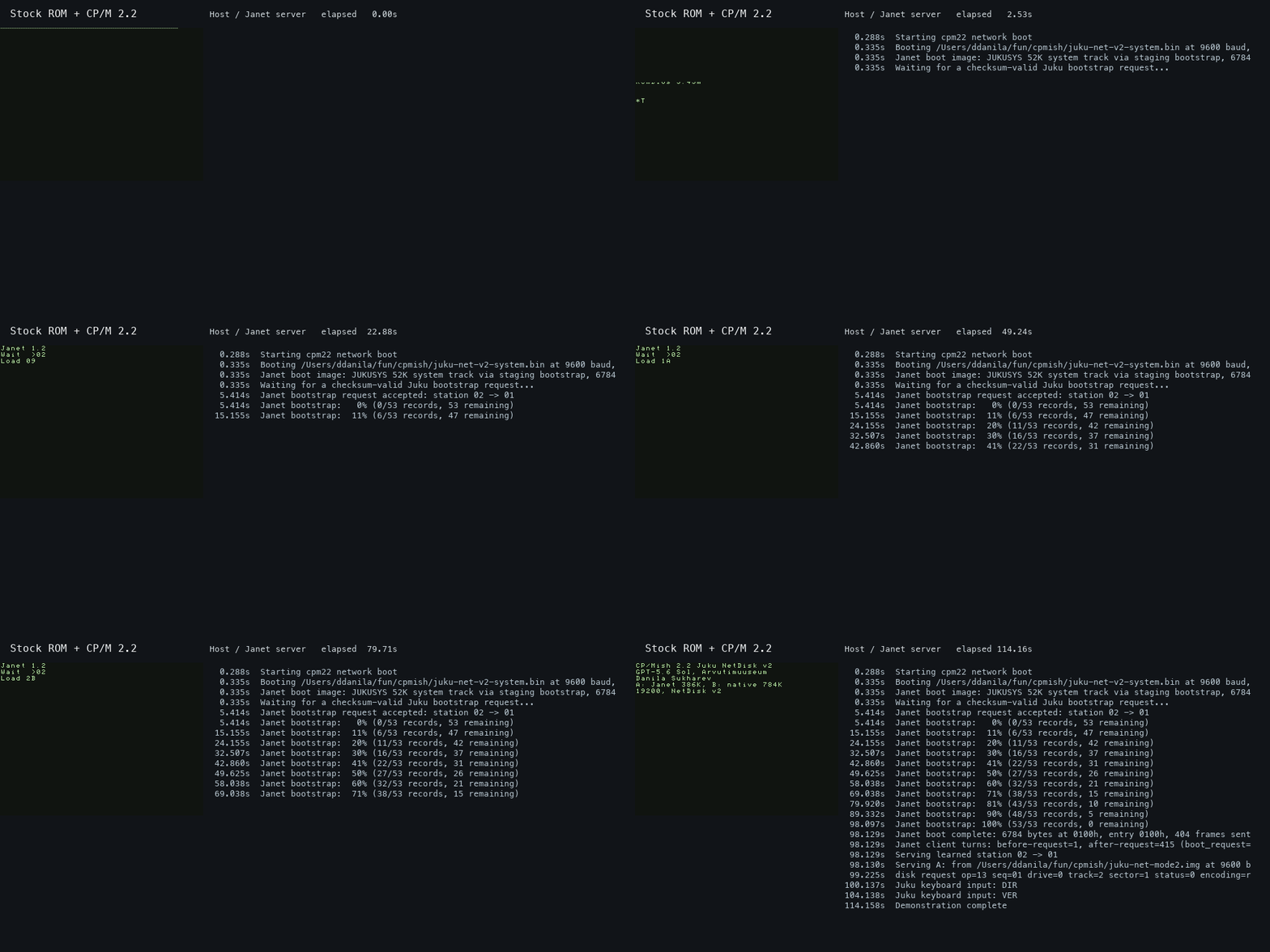
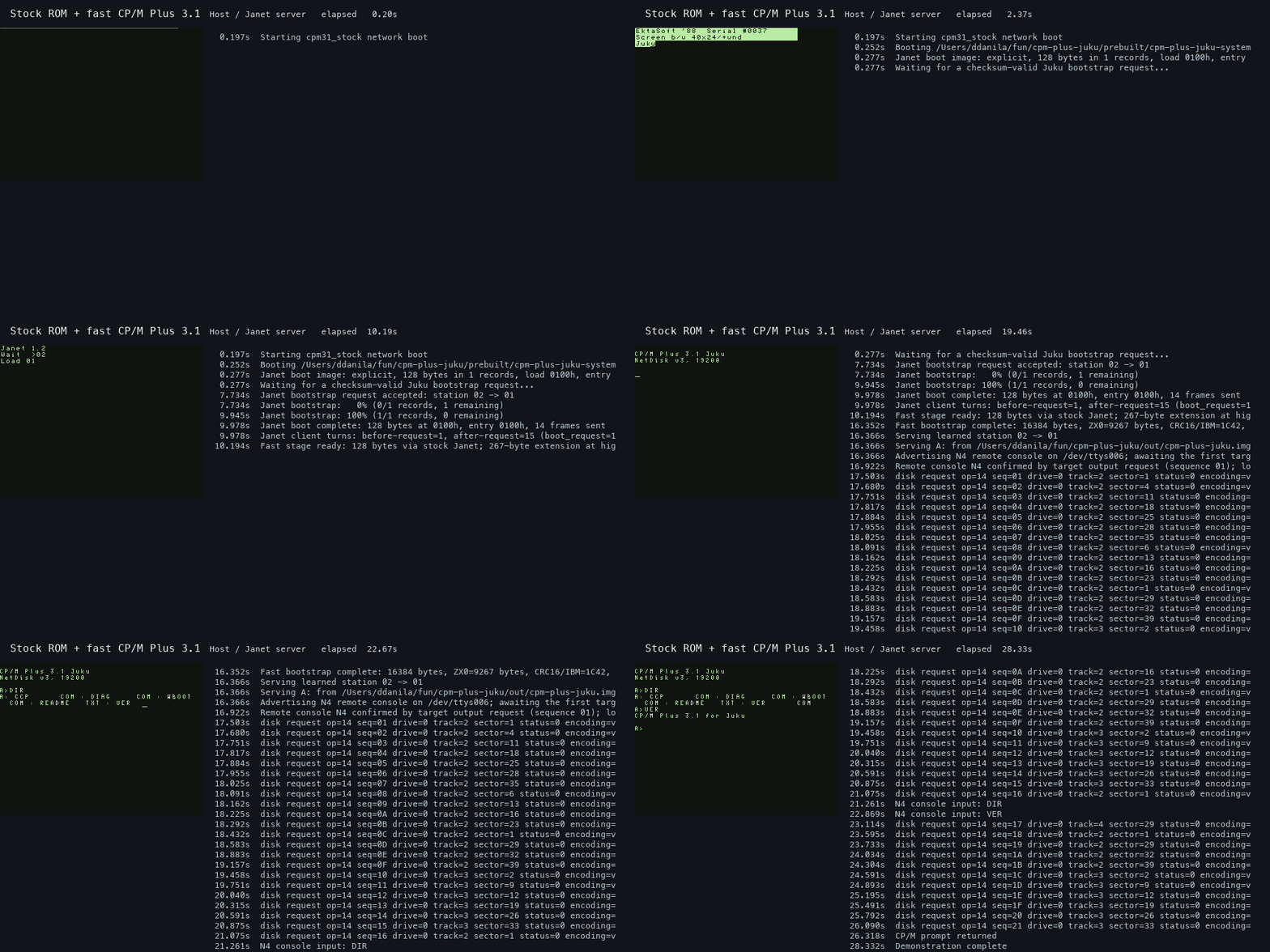
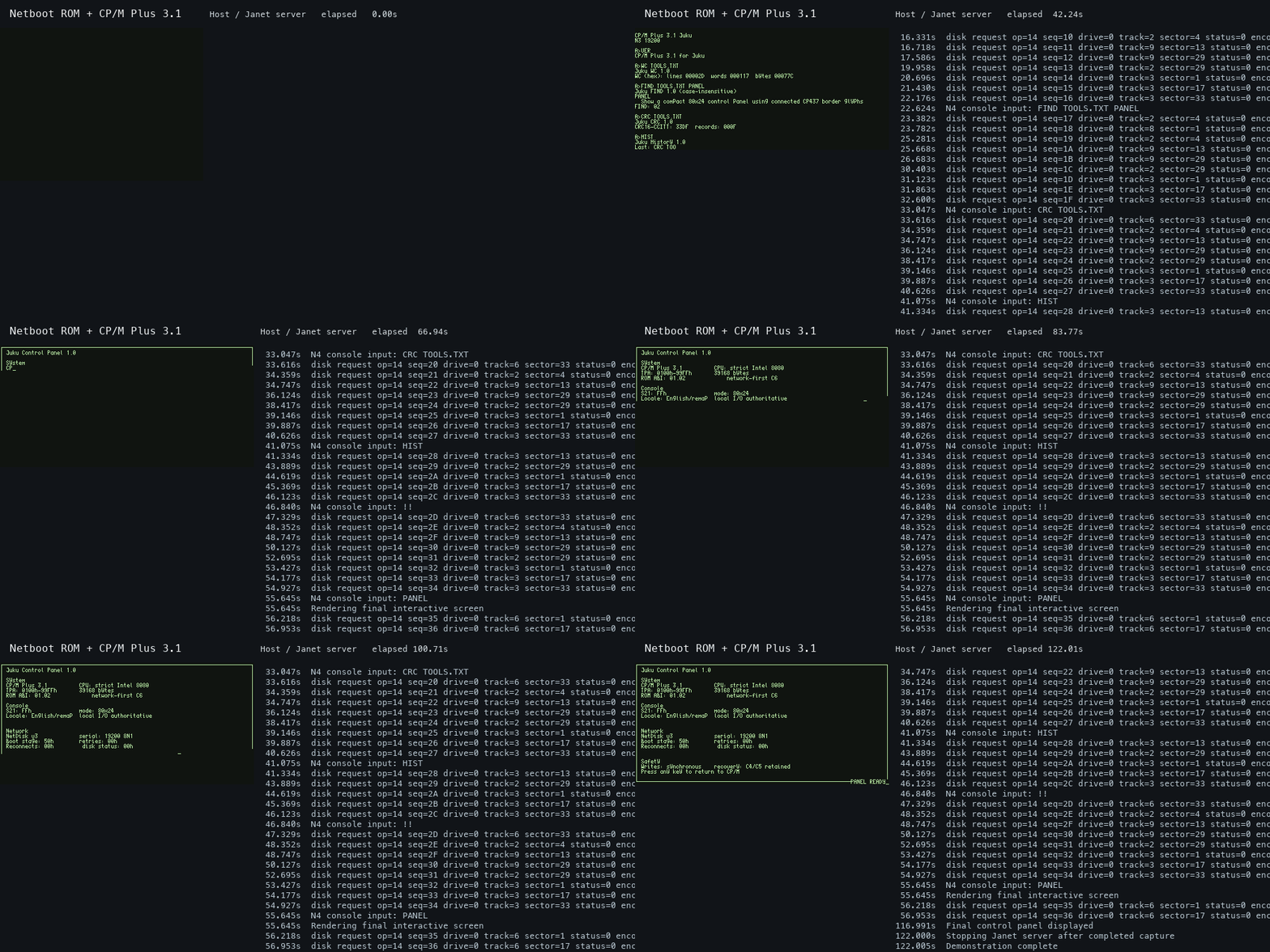
These simulator captures pair the native Juku framebuffer on the left with
timestamped Janet host activity on the right. The simulator is paced at the
approximately 1.7 MHz effective CPU execution rate, the serial links use their
stated baud rates. GIF playback approximates the presentation timeline;
framebuffer timestamp normalization and delay quantization are described in
the capture guide.
Stock ROM and CP/Mish CP/M 2.2
The archival 9,600-baud Janet bootstrap is intentionally shown at its original
speed.
Historical stock-ROM CP/M Plus fast bootstrap
This frozen Python-era V15 capture records the unmodified-ROM experiment whose
compact loader switched to 19,200 baud. The exact JF15 protocol is now
supported by the C host for stock-ROM compatibility, but this historical GIF
itself is not regenerated by the current demo runner.
Network ROM and CP/M Plus tools
The C8 network-first ROM boots CP/M Plus 3.1 through Fastboot V16 and
demonstrates the resident version report, text utilities, command history, and
control panel.
The capture inputs, dependencies, and regeneration commands are documented in
media/demos/README.md.
Downstream smoke kit
Use ghcr.io/ddanila/8080-cosim-smoke-kit:v2 to obtain simulator artifacts
without cloning the repository. The Linux amd64 kit contains the simulator,
static jukuhost, frozen Python test fixtures and three ROMs, listed in
its manifest at
/opt/8080-cosim/smoke-kit.json.
The scratch image has no shell or simulator shared libraries. Copy its
artifacts into a Linux amd64 runtime with the required dynamic loader and
libraries; the Dockerfile uses Ubuntu 24.04.
The Python fixtures are not standalone executables.
Publishing runs for selected input changes
on master or manual dispatch. It produces the moving v2 tag and a
sha-<source commit> tag. Pin an image digest for reproducible inputs.
Evidence and source hierarchy
Factory drawings, board photographs, dumps, and owner measurements under
ref/ are the historical evidence.
kicad/juku.board.json is the current machine-readable connectivity model.
kicad/juku.kicad_sch, the PCB files, and fabrication outputs are derived
from or checked against that model.
hdl/juku_top.v is independently maintained structural Verilog and is
checked against the modeled connectivity by sync/.
cosim/ and the vendored MAME Juku driver (ref/mame_juku.cpp) are behavioral references;
they are not substitutes for missing physical wiring evidence.
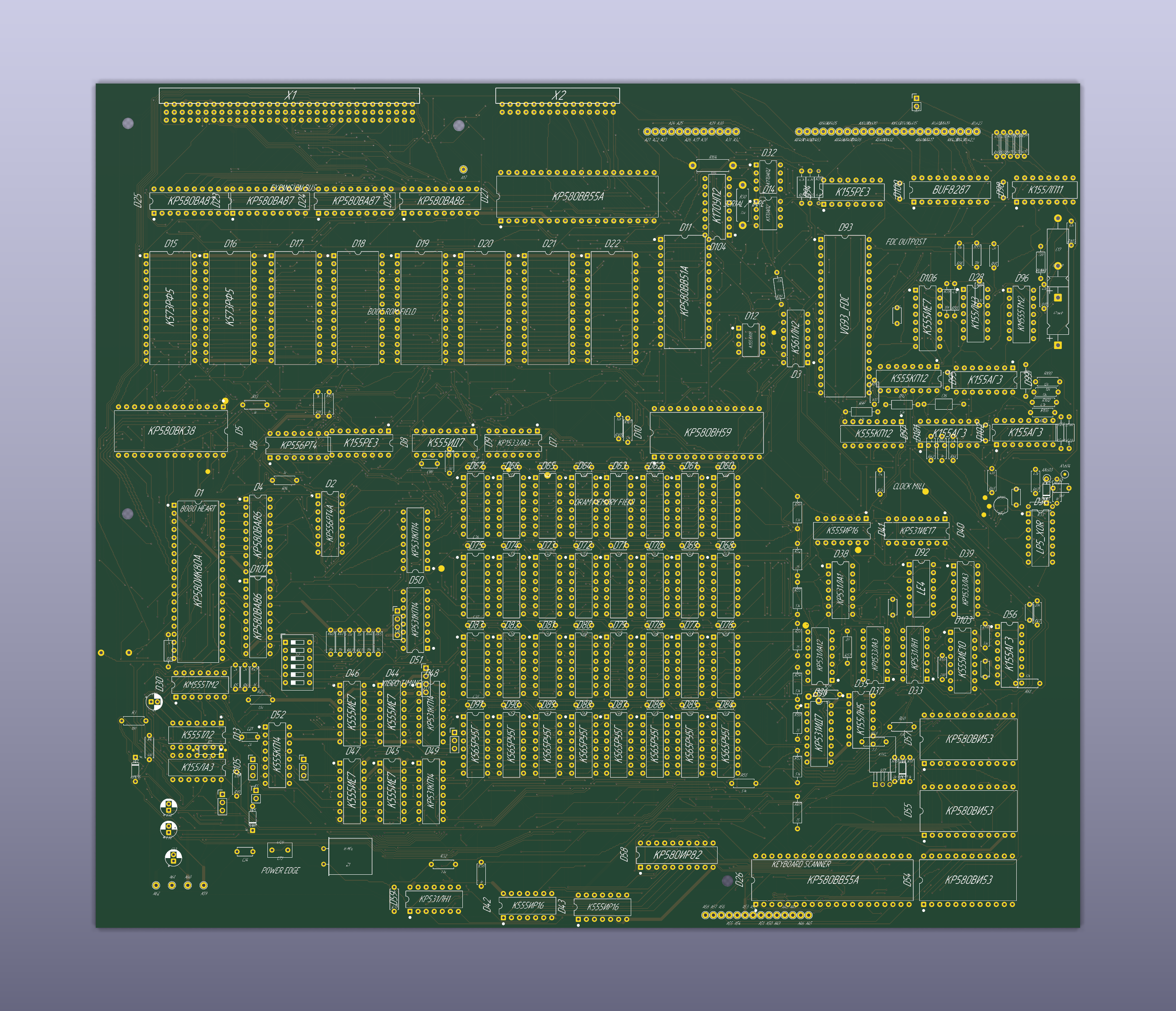
Board previews
These saved renders show a routed engineering snapshot and may lag the current
PCB. Refresh them with kicad/render_views.sh after reviewing board changes;
the renderer documents its KiCad, font and rasterizer
requirements. Use the PCB and release reports to assess the current design.
sync/cosim_check.sh is a deep guard and can take substantially longer than
the other commands. The long reset-to-EKDOS/BASIC and Monitor 3.3 diagnostics
have separate entry points listed in sync/README.md.
Layout
Path
Purpose
ref/
Factory drawings, photographs, firmware evidence, and external references
kicad/
Board model, generated schematic, source/routed PCBs with current routing holds, and fabrication tooling
hdl/
Structural runnable model and device behavior
cosim/
Independent software emulator/oracle
sync/
LVS, behavioral comparisons, and subsystem guards
roms/, media/
Vendored preservation inputs with provenance/checksums
docs/
Current specifications and generated evidence reports
spinoffs/jukupoly/
Independent Juku CP/M three-tone-plus-percussion music engine, importers, songs, and evidence
spinoffs/minimal-vga/
Independent VJUGA experiment; not on the replica critical path
Reconstruction of the Soviet/Estonian Juku E5104 processor board as a physical PCB and a runnable digital model. Structural Verilog connectivity is checked against the machine-readable board model with LVS.
Reconstruction of the Soviet/Estonian Juku E5104 processor board as a physical PCB and a runnable digital model. Structural Verilog connectivity is checked against the machine-readable board model with LVS.
Reconstruction of the Soviet/Estonian Juku E5104 processor board as a physical PCB and a runnable digital model. Structural Verilog connectivity is checked against the machine-readable board model with LVS.
Reconstruction of the Soviet/Estonian Juku E5104 processor board as a physical PCB and a runnable digital model. Structural Verilog connectivity is checked against the machine-readable board model with LVS.
Reconstruction of the Soviet/Estonian Juku E5104 processor board as a physical PCB and a runnable digital model. Structural Verilog connectivity is checked against the machine-readable board model with LVS.
Reconstruction of the Soviet/Estonian Juku E5104 processor board as a physical PCB and a runnable digital model. Structural Verilog connectivity is checked against the machine-readable board model with LVS.
It measures 100 × 70 mm and has 2 copper layers, 1.6 mm thick.
What parts does the Cpu use?
7 parts. The full list of its parts is on this page, with links to each part's symbol and footprint where PCBKit's library has them.
Where can I download the Cpu KiCad files?
From the ddanila/8080-cosim repository on GitHub, at the commit this page was made from: the board is fab/minimal-vga/revb/cpu.kicad_pcb and its schematic kicad/juku.kicad_sch. PCBKit opens the board in the browser, with nothing to install.
Can I use the Cpu design in my own project?
Its repository states no licence, so its author keeps all rights: ask ddanila before reusing the design.